Age of Propaganda Summary: The Everyday Use and Abuse of Persuasion
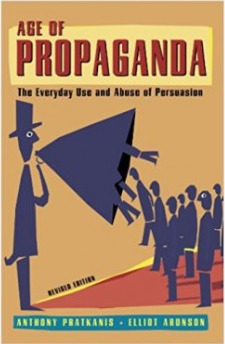
- Amazon: Link
- Score: 10/10
- Categories: Influence
- Mental Models: Action & Reaction: Newton's Third Law, Agenda Setting Theory, Anchoring, Association, Attentional Bias, Authority, Choice Architecture, Confirmation Bias, Denial, Ego, Emotions: Desire, Fear, Guilt, Equilbirum, Evolution: Sexual Selection, Flywheel Effect, Language Instinct, Liking, Reciprocity, Relativity, Scarcity, System 1 vs System 2 Thinking, Tendency to Minimize Energy Output, The Ikea Effect, Trust, Velocity, Vividness Bias
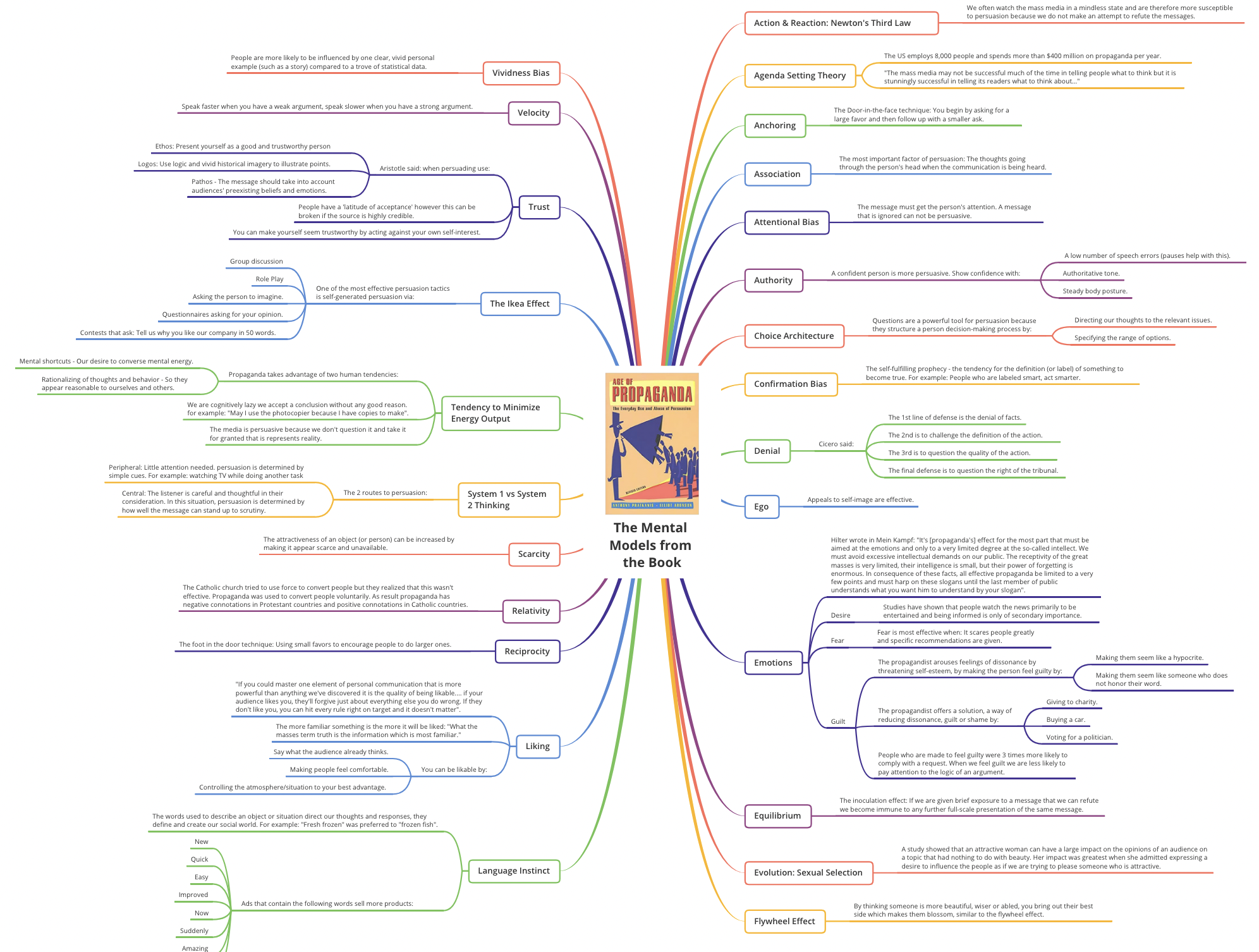
25 Mental Models from the book:
'The Age of Propoganda' can be summarised into 25 mental models:
1. Action & Reaction: Newton's Third Law
- We often watch the mass media in a mindless state and are therefore more susceptible to persuasion because we do not make an attempt to refute the messages.
2. Agenda Setting Theory
- The US employs 8,000 people and spends more than $400 million on propaganda per year.
- "The mass media may not be successful much of the time in telling people what to think but it is stunningly successful in telling its readers what to think about..."
3. Anchoring
- The door-in-the-face technique: You begin by asking for a large favor and then follow up with a smaller ask.
4. Association
- The most important factor of persuasion: The thoughts going through the person's head when the communication is being heard.
5. Attentional Bias
- The message must get the person's attention. A message that is ignored can not be persuasive.
6. Authority
- A confident person is more persuasive. Show confidence with:
- A low number of speech errors (pauses help with this).
- Authoritative tone.
- Steady body posture.
7. Choice Architecture/ Agenda Setting Theory
- Questions are a powerful tool for persuasion because they structure a person decision-making process by:
- Directing our thoughts to the relevant issues.
- Specifying the range of options.
8. Confirmation Bias
- The self-fulfilling prophecy - the tendency for the definition (or label) of something to become true. For example: People who are labeled smart, act smarter.
9. Denial
- Cicero said:
- The 1st line of defense is the denial of facts.
- The 2nd is to challenge the definition of the action.
- The 3rd is to question the quality of the action.
- The final defense is to question the right of the tribunal.
10. Ego
- Appeals to self-image are effective.
11. emotions
- Hilter wrote in Mein Kampf: "It's [propaganda's] effect for the most part that must be aimed at the emotions and only to a very limited degree at the so-called intellect. We must avoid excessive intellectual demands on our public. The receptivity of the great masses is very limited, their intelligence is small, but their power of forgetting is enormous. In consequence of these facts, all effective propaganda be limited to a very few points and must harp on these slogans until the last member of public understands what you want him to understand by your slogan".
11.1 Emotions: Desire
- Studies have shown that people watch the news primarily to be entertained and being informed is only of secondary importance.
11.2 Emotions: Fear
- Fear is most effective when: It scares people greatly and specific recommendations are given.
11.3 Emotions: Guilt
- The propagandist arouses feelings of dissonance by threatening self-esteem, by making the person feel guilty by:
- Making them seem like a hypocrite.
-
Making them seem like someone who does not honor their word. - The propagandist offers a solution, a way of reducing dissonance, guilt or shame by:
-
Giving to charity.
- Buying a car.
- Voting for a politician. - People who are made to feel guilty were 3 times more likely to comply with a request. When we feel guilt we are less likely to pay attention to the logic of an argument.
12. Equilibrium
- The inoculation effect: If we are given brief exposure to a message that we can refute we become immune to any further full-scale presentation of the same message.
13. Evolution: Sexual Selection
- A study showed that an attractive woman can have a large impact on the opinions of an audience on a topic that had nothing to do with beauty. Her impact was greatest when she admitted expressing a desire to influence the people as if we are trying to please someone who is attractive.
14. Flywheel Effect
- By thinking someone is more beautiful, wiser or abled, you bring out their best side which makes them blossom, similar to the flywheel effect.
15. Language Instinct
- The words used to describe an object or situation direct our thoughts and responses, they define and create our social world. For example: "Fresh frozen" was preferred to "frozen fish".
- Ads that contain the following words sell more products:
- New
- Quick
- Easy
- Improved
- Now
- Suddenly
- Amazing
- Introducing
16. Liking
- "If you could master one element of personal communication that is more powerful than anything we've discovered it is the quality of being likable.... if your audience likes you, they'll forgive just about everything else you do wrong. If they don't like you, you can hit every rule right on target and it doesn't matter".
- The more familiar something is the more it will be liked: "What the masses term truth is the information which is most familiar."
- You can be likable by:
- Say what the audience already thinks.
- Making people feel comfortable.
- Controlling the atmosphere/situation to your best advantage.
17. Reciprocity
- The foot in the door technique: Using small favors to encourage people to do larger ones.
18. Relativity
- The Catholic church tried to use force to convert people but they realized that this wasn't effective. Propaganda was used to convert people voluntarily. As result propaganda has negative connotations in Protestant countries and positive connotations in Catholic countries.
19. Scarcity
- The attractiveness of an object (or person) can be increased by making it appear scarce and unavailable.
20. System 1 vs System 2 Thinking
- The 2 routes to persuasion:
- Peripheral: Little attention needed. persuasion is determined by simple cues. For example: watching TV while doing another task
- Central: The listener is careful and thoughtful in their consideration. In this situation, persuasion is determined by how well the message can stand up to scrutiny.
21. Tendency to Minimize Energy Output/Denial
- Propaganda takes advantage of two human tendencies:
- Mental shortcuts - Our desire to converse mental energy.
- Rationalizing of thoughts and behavior - So they appear reasonable to ourselves and others. - We are cognitively lazy we accept a conclusion without any good reason. for example: "May I use the photocopier because I have copies to make". - The media is persuasive because we don't question it and take it for granted that is represents reality.
22. The Ikea Effect
- One of the most effective persuasion tactics is self-generated persuasion via:
- Group discussion
- Role Play
- Asking the person to imagine.
- Questionnaires asking for your opinion.
- Contests that ask: Tell us why you like our company in 50 words.
23. Trust/ Emotions/ Vividness Bias
- Aristotle said: when persuading use:
- Ethos: Present yourself as a good and trustworthy person
- Logos: Use logic and vivid historical imagery to illustrate points.
- Pathos - The message should take into account audiences' preexisting beliefs and emotions. - People have a 'latitude of acceptance' however this can be broken if the source is highly credible. - You can make yourself seem trustworthy by acting against your own self-interest.
24. Velocity
- Speak faster when you have a weak argument, speak slower when you have a strong argument.
25. Vividness Bias
- People are more likely to be influenced by one clear, vivid personal example (such as a story) compared to a trove of statistical data.
Mental Model Mind Maps
Mind maps can help you to remember the most important parts of a book. Signup to my newsletter below to get a free mindmap of this book: