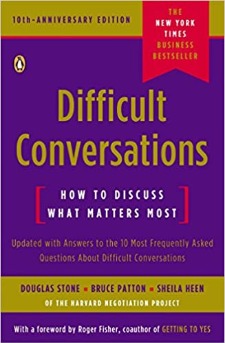
'Difficult Conversations' - 80/20 Summary
- Score: 7/10
- Categories: Influence
- Mental Models: Attentional Bias, Co-operation, Curiosity Instinct, Emotions: Humility, Validation, Hanlon's Razor, Humility, First Principle Thinking, Identity, Resistance, Second-Order Thinking
Mental Models from the book:
“The first rule is that you can't really know anything if you just remember isolated facts and try and bang 'em back. If the facts don't hang together on a latticework of theory, you don't have them in a usable form.” -Charlie Munger
'Difficult conversations' can be summarised into 25 mental models:
1. Attentional Bias/ Identity
Everyone sees the world differently because:
- We Have Different Information
We notice different things. If you take your nephew to a parade, he might notice the trucks, and you notice the cheerleaders. We notice what we care about.
- We Have Different Interpretations.
We are influences by past experience. We often aren't aware of how past experiences affects our view of the world, we just think this is how things are. We apply different rules, for example: "It is unprofessional to be late".
2. Co-operation
People often think that if we accept another person's story then we must reject our
own. Don't think of it as a binary choice, embrace both. Extend an Invitation by using phrases such as:
- Can you help me understand....?
- Let's work on how we might....?
- I wonder whether it is possible to....
3. Curiosity Instinct
Instead of asking: How can they think that? Ask: "I wonder what information they have that I don't?" or: "How might they see the world such that their view makes sense?"
4. Emotions
Emotions are based on our perception, and perceptions are negotiable. You can change your feelings by changing your thinking:
-
Ask yourself: What story am I telling myself that is bringing me this feeling.
-
Explore the other person's intentions.
-
Think about the contribution system.
5. Emotions: Humility
Often when someone is not listening to you, it is not because they are stubborn but
because they don't feel heard. Be humble and shift your stance from "I understand" to "help me understand". Use questions such as:
- Can you say a little more about how you see things?
- What information might you have that I don't?
- How do you see it differently?
- What impact have my actions had on you?
Let people know that what they have said has made an impression on you. Let them know that you are trying to understand them.
- I never knew you felt that way.
- It sounds like that is really important to you?
6. Emotions: Validation
Often we skip acknowledging a person's feelings and go straight to problem-solving
which is a mistake, as the person doesn't feel validated or heard. Start by acknowledging their feelings: "It sounds like my making plans is frustrating for you"
7. Emotions: Vulnerable
The biggest factor that contributes to vulnerability is binary thinking: I'm either
competent or not, good or bad, loveable or not. Binary thinking causes us to be sensitive to feedback.
8. First Principle Thinking
We often ask: "Does that make sense" or "wouldn't you agree" because it is reassuring
but you learn more by asking: "How do you see things differently?"
9. Resistance
Telling someone to change makes it less likely they will. People need to be understood
before change occurs.
The more you can relieve a person's need to be defensive, the easier it becomes for
them to listen to what you are saying. Use phrases such as: "I was surprised that you made the comment. It seemed uncharacteristic of you..."
10. Second-Order Thinking/Hanlon's Razor
When we think others have bad intentions, it has an effect on how we act, and how we act
causes the person to react differently and our initial thought becomes a self-fulfilling
prophecy.
Let me know how these summaries can be improved? Contact me via Email (david@thisdomain.co) or on Twitter.