'How to Talk to Anyone' - 80/20 Summary
- Amazon: Link
- Score: 6/10
- Category: Questioning
- Mental Models: Curiosity Instinct, Ego, First Conclusion Bias, Liking, Mise-en-place, Newton's 3rd Law: Action & Reaction, Pareto Principle, Relativity, Vividness Bias
Mental Models from the book:
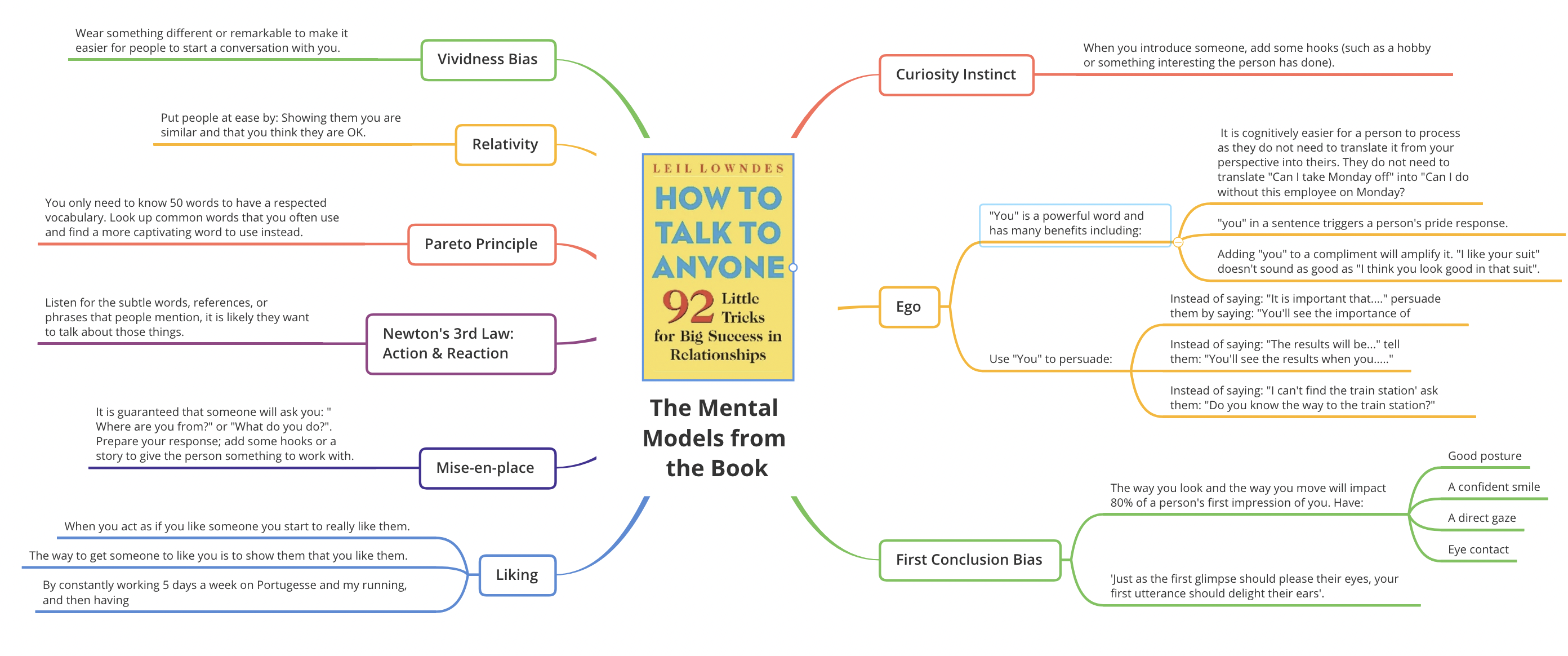
'How to Talk to Anyone' can be summarised into 9 mental models:
1. Curiosity Instinct
- When you introduce someone, add some hooks (such as a hobby or something interesting the person has done).
2. Ego
- "You" is a powerful word and has many benefits including:
- It is cognitively easier for a person to process as they do not need to translate it from your perspective into theirs. They do not need to translate "Can I take Monday off" into "Can I do without this employee on Monday?
- Including "you" in a sentence triggers a person's pride response.
-
Adding "you" to a compliment will amplify it. "I like your suit" doesn't sound as good as "I think you look good in that suit". - Use "You" to persuade:
-
Instead of saying: "It is important that...." persuade them by saying: "You'll see the importance of
- Instead of saying: "The results will be..." tell them: "You'll see the results when you....."
- Instead of saying: "I can't find the train station' ask them: "Do you know the way to the train station?"
3. First Conclusion Bias
- The way you look and the way you move will impact 80% of a person's first impression of you. Have:
- Good posture
- A confident smile
- A direct gaze
- Eye contact - 'Just as the first glimpse should please their eyes, your first utterance should delight their ears'.
4. Liking
- When you act as if you like someone you start to really like them.
- The way to get someone to like you is to show them that you like them.
5. Mise-en-place
- It is guaranteed that someone will ask you: "Where are you from?" or "What do you do?". Prepare your response; add some hooks or a story to give the person something to work with.
6. Newton's 3rd Law: Action & Reaction
- Listen for the subtle words, references, or phrases that people mention, it is likely they want to talk about those things.
7. Pareto Principle
- You only need to know 50 words to have a respected vocabulary. Look up common words that you often use and find a more captivating word to use instead.
8. Relativity
- Put people at ease by: Showing them you are similar and that you think they are OK.
9. Vividness Bias
- Wear something different or remarkable to make it easier for people to start a conversation with you.
Mental Model Mind Maps
Mind maps can help you to remember the most important principles of a book. Signup to my newsletter below to get a free mindmap of this book: