'Influencing Human Behavior' - 80/20 Summary
- Score: 10/10
- Categories: Influence
- Mental Models: Attentional bias, Curiosity Instinct, Incentives, Momentum, Narrative Instinct, Evolution: Natural Selection, Noveility Bias, Randomness, Second-Order Thinking, Status Quo Bias, Vividness Bias
“You’ve got to have models in your head. And you’ve got to array your experience ‑ both vicarious and direct ‑ on this latticework of models.” -Charlie Munger
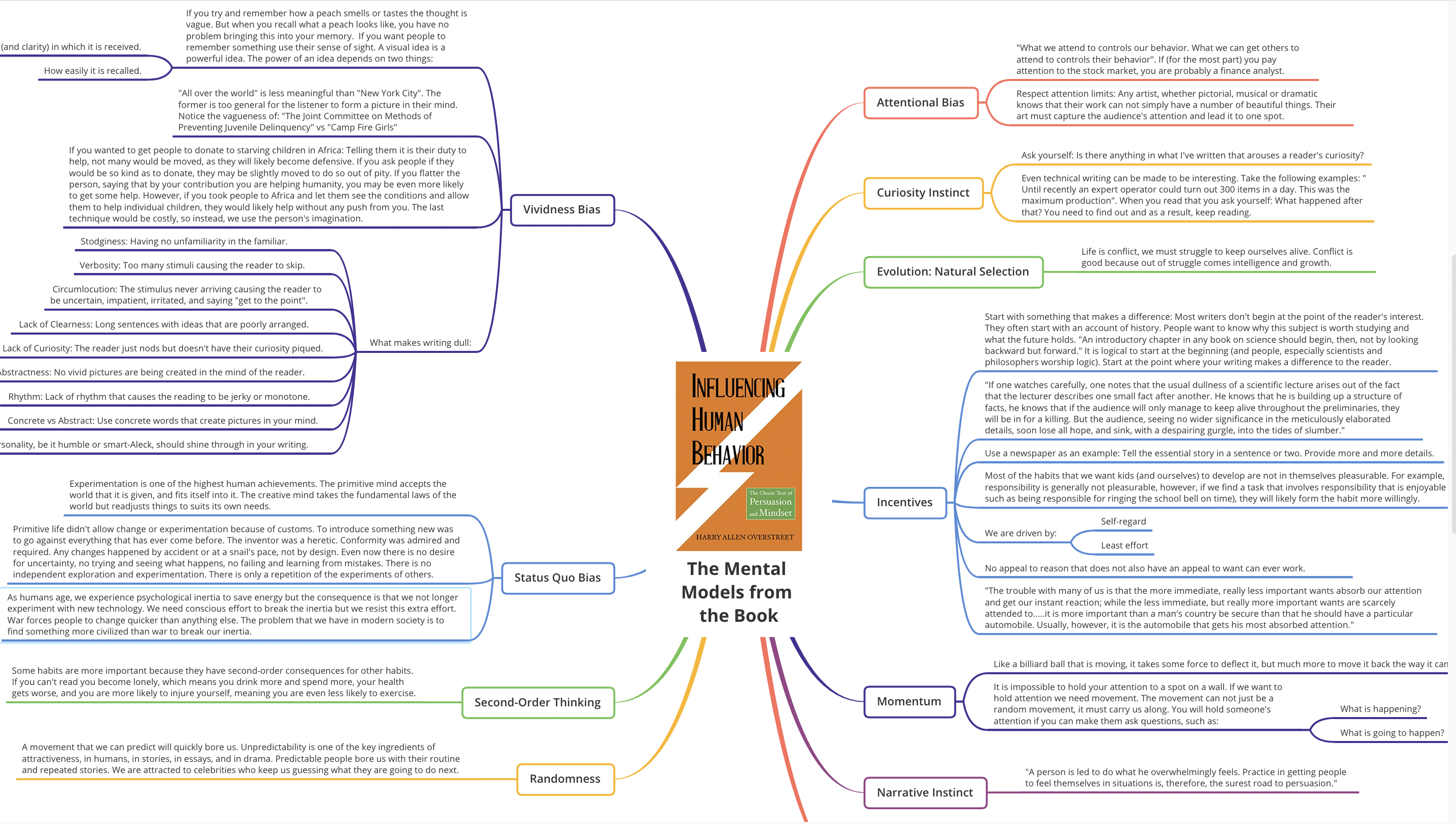
11 Mental Models from the book:
1. Attentional bias
- "What we attend to controls our behavior. What we can get others to attend to controls their behavior". If (for the most part) you pay attention to the stock market, you are probably a finance analyst.
- Respect attention limits: Any artist, whether pictorial, musical or dramatic knows that their work can not simply have a number of beautiful things. Their art must capture the audience's attention and lead it to one spot.
2. Curiosity Instinct
- Ask yourself: Is there anything in what I've written that arouses a reader's curiosity?
- Even technical writing can be made to be interesting. Take the following examples: "Until recently an expert operator could turn out 300 items in a day. This was the maximum production". When you read that you ask yourself: What happened after that? You need to find out and as a result, keep reading.
3. Evolution: Natural Selection
- Life is conflict, we must struggle to keep ourselves alive. Conflict is good because out of struggle comes intelligence and growth.
4. Incentives
- Start with something that makes a difference: Most writers don't begin at the point of the reader's interest. They often start with an account of history. People want to know why this subject is worth studying and what the future holds. "An introductory chapter in any book on science should begin, then, not by looking backward but forward." It is logical to start at the beginning (and people, especially scientists and philosophers worship logic). Start at the point where your writing makes a difference to the reader.
- "If one watches carefully, one notes that the usual dullness of a scientific lecture arises out of the fact that the lecturer describes one small fact after another. He knows that he is building up a structure of facts, he knows that if the audience will only manage to keep alive throughout the preliminaries, they will be in for a killing. But the audience, seeing no wider significance in the meticulously elaborated details, soon lose all hope, and sink, with a despairing gurgle, into the tides of slumber."
- Use a newspaper as an example: Tell the essential story in a sentence or two. Provide more and more details.
- Most of the habits that we want kids (and ourselves) to develop are not in themselves pleasurable. For example, responsibility is generally not pleasurable, however, if we find a task that involves responsibility that is enjoyable (such as being responsible for ringing the school bell on time), they will likely form the habit more willingly.
- We are driven by:
- Self-regard
- Least effort - No appeal to reason that does not also have an appeal to want can ever work. - "The trouble with many of us is that the more immediate, really less important wants absorb our attention and get our instant reaction; while the less immediate, but really more important wants are scarcely attended to.....it is more important than a man's country be secure than that he should have a particular automobile. Usually, however, it is the automobile that gets his most absorbed attention."
5. Momentum
- Like a billiard ball that is moving, it takes some force to deflect it, but much more to move it back the way it came.
- It is impossible to hold your attention to a spot on a wall. If we want to hold attention we need movement. The movement can not just be a random movement, it must carry us along. You will hold someone's attention if you can make them ask questions, such as:
- What is happening?
- What is going to happen?
6. Narrative Instinct
- "A person is led to do what he overwhelmingly feels. Practice in getting people to feel themselves in situations is, therefore, the surest road to persuasion."
7. Novelty Bias
- Using 'new' is effective at getting people's attention but be careful in offering something that is too new, that has no connection with what people are already accustomed to.
- Begin with an effect needing a cause: Something new that is unexplained gets our attention. When you present an effect without the cause, a vacuum is created and the mind of the reader becomes focused and alert trying to fill their empty mind with an explanation. Present a cause....and the mind will want to know what happened.
8. Randomness
- A movement that we can predict will quickly bore us. Unpredictability is one of the key ingredients of attractiveness, in humans, in stories, in essays, and in drama. Predictable people bore us with their routine and repeated stories. We are attracted to celebrities who keep us guessing what they are going to do next.
9. Second-Order Thinking
- Some habits are more important because they have second-order consequences for other habits. If you can't read you become lonely, which means you drink more and spend more, your health gets worse, and you are more likely to injure yourself, meaning you are even less likely to exercise.
10. Status Quo Bias
- Experimentation is one of the highest human achievements. The primitive mind accepts the world that it is given, and fits itself into it. The creative mind takes the fundamental laws of the world but readjusts things to suits its own needs.
- Primitive life didn't allow change or experimentation because of customs. To introduce something new was to go against everything that has ever come before. The inventor was a heretic. Conformity was admired and required. Any changes happened by accident or at a snail's pace, not by design. Even now there is no desire for uncertainty, no trying and seeing what happens, no failing and learning from mistakes. There is no independent exploration and experimentation. There is only a repetition of the experiments of others.
- As humans age, we experience psychological inertia to save energy but the consequence is that we not longer experiment with new technology. We need conscious effort to break the inertia but we resist this extra effort. War forces people to change quicker than anything else. The problem that we have in modern society is to find something more civilized than war to break our inertia.
11. Vividness Bias
- If you try and remember how a peach smells or tastes the thought is vague. But when you recall what a peach looks like, you have no problem bringing this into your memory. If you want people to remember something use their sense of sight. A visual idea is a powerful idea. The power of an idea depends on two things:
- The speed (and clarity) in which it is received.
-
How easily it is recalled. - "All over the world" is less meaningful than "New York City". The former is too general for the listener to form a picture in their mind. Notice the vagueness of: "The Joint Committee on Methods of Preventing Juvenile Delinquency" vs "Camp Fire Girls" - If you wanted to get people to donate to starving children in Africa: Telling them it is their duty to help, not many would be moved, as they will likely become defensive. If you ask people if they would be so kind as to donate, they may be slightly moved to do so out of pity. If you flatter the person, saying that by your contribution you are helping humanity, you may be even more likely to get some help. However, if you took people to Africa and let them see the conditions and allow them to help individual children, they would likely help without any push from you. The last technique would be costly, so instead, we use the person's imagination. - What makes writing dull:
-
Stodginess: Having no unfamiliarity in the familiar.
- Verbosity: Too many stimuli causing the reader to skip.
- Circumlocution: The stimulus never arriving causing the reader to be uncertain, impatient, irritated, and saying "get to the point".
- Lack of Clearness: Long sentences with ideas that are poorly arranged.
- Lack of Curiosity: The reader just nods but doesn't have their curiosity piqued.
- Abstractness: No vivid pictures are being created in the mind of the reader.
- Rhythm: Lack of rhythm that causes the reading to be jerky or monotone.
- Concrete vs Abstract: Use concrete words that create pictures in your mind.
- Personality: Your personality, be it humble or smart-Aleck, should shine through in your writing.
Mental Model Mind Maps:
Mind maps can help you to remember the most important parts of a book. Signup to my newsletter below to get a free mindmap of this book: