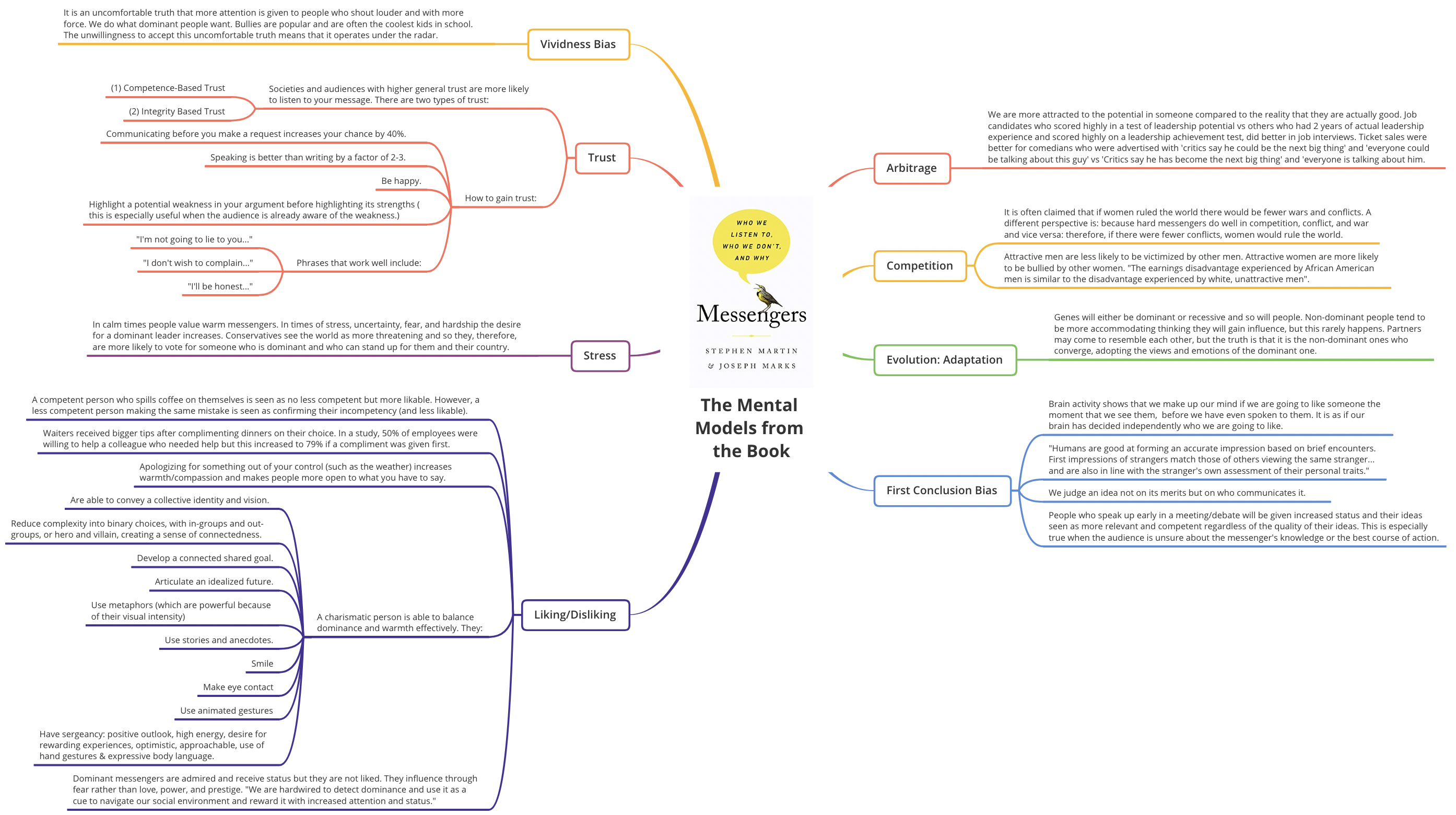
'Messengers' - 80/20 Summary
- Amazon: Link
- Score: 6/10
- Categories: Influence
- Mental Models: Arbitrage, Competition, Evolution: Adaptation, First Conclusion Bias, Liking/Disliking, Stress, Trust, Vividness Bias
“The first rule is that you can't really know anything if you just remember isolated facts and try and bang 'em back. If the facts don't hang together on a latticework of theory, you don't have them in a usable form.” -Charlie Munger
8 Mental Models from the book:
1. Arbitrage
- We are more attracted to the potential in someone compared to the reality that they are actually good. Job candidates who scored highly in a test of leadership potential vs others who had 2 years of actual leadership experience and scored highly on a leadership achievement test, did better in job interviews. Ticket sales were better for comedians who were advertised with 'critics say he could be the next big thing' and 'everyone could be talking about this guy' vs 'Critics say he has become the next big thing' and 'everyone is talking about him.
2. Competition
- It is often claimed that if women ruled the world there would be fewer wars and conflicts. A different perspective is: because hard messengers do well in competition, conflict, and war and vice versa: therefore, if there were fewer conflicts, women would rule the world.
- Attractive men are less likely to be victimized by other men. Attractive women are more likely to be bullied by other women. "The earnings disadvantage experienced by African American men is similar to the disadvantage experienced by white, unattractive men".
3. Evolution: Adaptation
- Genes will either be dominant or recessive and so will people. Non-dominant people tend to be more accommodating thinking they will gain influence, but this rarely happens. Partners may come to resemble each other, but the truth is that it is the non-dominant ones who converge, adopting the views and emotions of the dominant one.
4. First Conclusion Bias
- Brain activity shows that we make up our mind if we are going to like someone the moment that we see them, before we have even spoken to them. It is as if our brain has decided independently who we are going to like.
- "Humans are good at forming an accurate impression based on brief encounters. First impressions of strangers match those of others viewing the same stranger...and are also in line with the stranger's own assessment of their personal traits."
- We judge an idea not on its merits but on who communicates it.
- People who speak up early in a meeting/debate will be given increased status and their ideas seen as more relevant and competent regardless of the quality of their ideas. This is especially true when the audience is unsure about the messenger's knowledge or the best course of action.
5. Liking/Disliking
- A competent person who spills coffee on themselves is seen as no less competent but more likable. However, a less competent person making the same mistake is seen as confirming their incompetency (and less likable).
- Waiters received bigger tips after complimenting dinners on their choice. In a study, 50% of employees were willing to help a colleague who needed help but this increased to 79% if a compliment was given first.
- Apologizing for something out of your control (such as the weather) increases warmth/compassion and makes people more open to what you have to say.
- A charismatic person is able to balance dominance and warmth effectively. They:
- Are able to convey a collective identity and vision.
- Reduce complexity into binary choices, with in-groups and out-groups, or hero and villain, creating a sense of connectedness.
- Develop a connected shared goal.
- Articulate an idealized future.
- Use metaphors (which are powerful because of their visual intensity)
- Use stories and anecdotes.
- Smile
- Make eye contact
- Use animated gestures
- Have sergeancy: positive outlook, high energy, desire for rewarding experiences, optimistic, approachable, use of hand gestures & expressive body language. - Dominant messengers are admired and receive status but they are not liked. They influence through fear rather than love, power, and prestige. "We are hardwired to detect dominance and use it as a cue to navigate our social environment and reward it with increased attention and status."
6. Stress
- In calm times people value warm messengers. In times of stress, uncertainty, fear, and hardship the desire for a dominant leader increases. Conservatives see the world as more threatening and so they, therefore, are more likely to vote for someone who is dominant and who can stand up for them and their country.
7. Trust
- Societies and audiences with higher general trust are more likely to listen to your message. There are two types of trust: (1) Competence-Based Trust (2) Integrity Based Trust
- How to gain trust:
- Communicating before you make a request increases your chance by 40%.
- Speaking is better than writing by a factor of 2-3.
- Be happy.
- Highlight a potential weakness in your argument before highlighting its strengths (this is especially useful when the audience is already aware of the weakness.)
-
Phrases that work well include:
- "I'm not going to lie to you..."
- "I don't wish to complain..."
- "I'll be honest..."
8. Vividness Bias
- It is an uncomfortable truth that more attention is given to people who shout louder and with more force. We do what dominant people want. Bullies are popular and are often the coolest kids in school. The unwillingness to accept this uncomfortable truth means that it operates under the radar.
Mental Model Mind Maps
Mind maps can help you to remember the most important parts of a book. Signup to my newsletter below to get a free mindmap of this book: