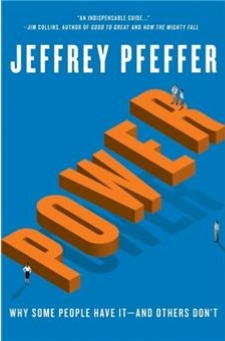
Power: Why Some People Have it — And Others Don't
- Amazon: Link
- Score: 9/10
- Skills Category: Influence
- Mental Models: Agenda Setting Theory, Asymmetric Warfare, Association, Authority, Confirmation Bias, Commitment & Consistency Bias, Emotions: Anger, Feedback Loops, First Conclusion Bias, Liking/Disliking, Reciprocity, Scarcity, Sensitivity to Fairness, Social Proof, Trust
“The first rule is that you can't really know anything if you just remember isolated facts and try and bang 'em back. If the facts don't hang together on a latticework of theory, you don't have them in a usable form.” -Charlie Munger
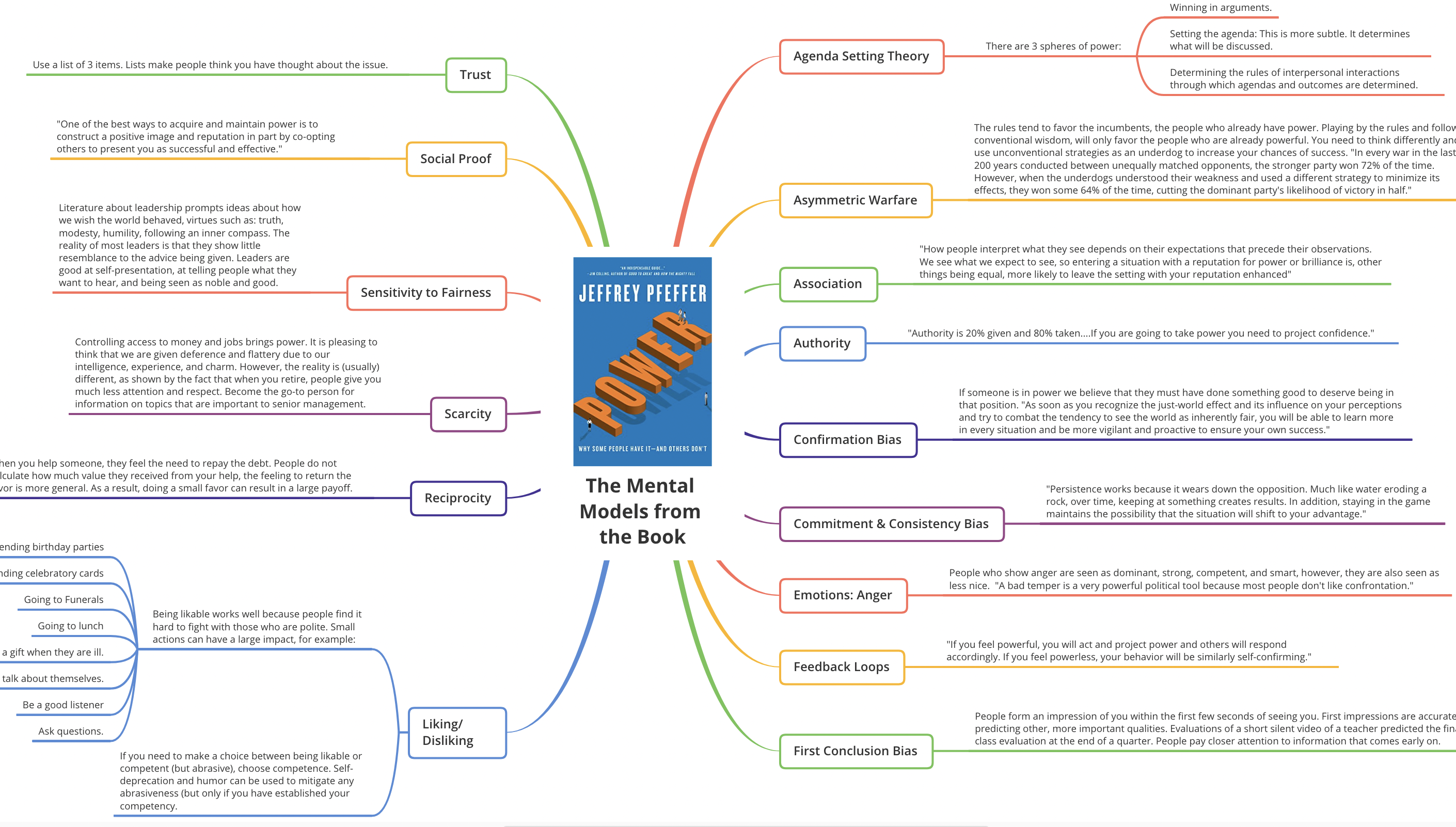
16 Mental Models from the book:
1. Agenda Setting Theory
- There are 3 spheres of power:
- Winning in arguments.
- Setting the agenda: This is more subtle. It determines what will be discussed.
- Determining the rules of interpersonal interactions through which agendas and outcomes are determined.
2. Asymmetric Warfare
- The rules tend to favor the incumbents, the people who already have power. Playing by the rules and following conventional wisdom, will only favor the people who are already powerful. You need to think differently and use unconventional strategies as an underdog to increase your chances of success. "In every war in the last 200 years conducted between unequally matched opponents, the stronger party won 72% of the time. However, when the underdogs understood their weakness and used a different strategy to minimize its effects, they won some 64% of the time, cutting the dominant party's likelihood of victory in half."
3. Association
- "How people interpret what they see depends on their expectations that precede their observations. We see what we expect to see, so entering a situation with a reputation for power or brilliance is, other things being equal, more likely to leave the setting with your reputation enhanced"
4. Authority
- "Authority is 20% given and 80% taken....If you are going to take power you need to project confidence."
5. Confirmation Bias
- If someone is in power we believe that they must have done something good to deserve being in that position. "As soon as you recognize the just-world effect and its influence on your perceptions and try to combat the tendency to see the world as inherently fair, you will be able to learn more in every situation and be more vigilant and proactive to ensure your own success."
6. Commitment & Consistency Bias
- "Persistence works because it wears down the opposition. Much like water eroding a rock, over time, keeping at something creates results. In addition, staying in the game maintains the possibility that the situation will shift to your advantage."
7. Emotions: Anger
- People who show anger are seen as dominant, strong, competent, and smart, however, they are also seen as less nice. "A bad temper is a very powerful political tool because most people don't like confrontation."
8. Feedback Loops
- "If you feel powerful, you will act and project power and others will respond accordingly. If you feel powerless, your behavior will be similarly self-confirming."
9. First Conclusion Bias
- People form an impression of you within the first few seconds of seeing you. First impressions are accurate in predicting other, more important qualities. Evaluations of a short silent video of a teacher predicted the final class evaluation at the end of a quarter. People pay closer attention to information that comes early on.
10. Liking/Disliking
- Being likable works well because people find it hard to fight with those who are polite. Small actions can have a large impact, for example:
- Attending birthday parties
- Sending celebratory cards
- Going to Funerals
- Going to lunch
- Sending a card, visiting or buying a gift when they are ill.
- Allow people to talk about themselves.
- Be a good listener
- Ask questions. - If you need to make a choice between being likable or competent (but abrasive), choose competence. Self-deprecation and humor can be used to mitigate any abrasiveness (but only if you have established your competency.
12. Reciprocity
- When you help someone, they feel the need to repay the debt. People do not calculate how much value they received from your help, the feeling to return the favor is more general. As a result, doing a small favor can result in a large payoff.
13. Scarcity
- Controlling access to money and jobs brings power. It is pleasing to think that we are given deference and flattery due to our intelligence, experience, and charm. However, the reality is (usually) different, as shown by the fact that when you retire, people give you much less attention and respect. Become the go-to person for information on topics that are important to senior management.
14. Sensitivity to Fairness
- Literature about leadership prompts ideas about how we wish the world behaved, virtues such as: truth, modesty, humility, following an inner compass. The reality of most leaders is that they show little resemblance to the advice being given. Leaders are good at self-presentation, at telling people what they want to hear, and being seen as noble and good.
15. Social Proof
- "One of the best ways to acquire and maintain power is to construct a positive image and reputation in part by co-opting others to present you as successful and effective."
16. Trust
- Use a list of 3 items. Lists make people think you have thought about the issue.
Mental Model Mind Maps
Mind maps can help you to remember the most important parts of a book. Signup to my newsletter below to get a free mindmap of this book: