'Talk to Me' Summary
- Amazon: Link
- Score: 7/10
- Category: Questioning
- Mental Models: Activation Energy, Critical Mass, Ego, Emotions: Shame, Sympathy, Equilibrium, Fundamental Attribution Error, Margin of Safety, Miss-en-Place, Narrative Instinct, Randomness
Mental Models from the book:
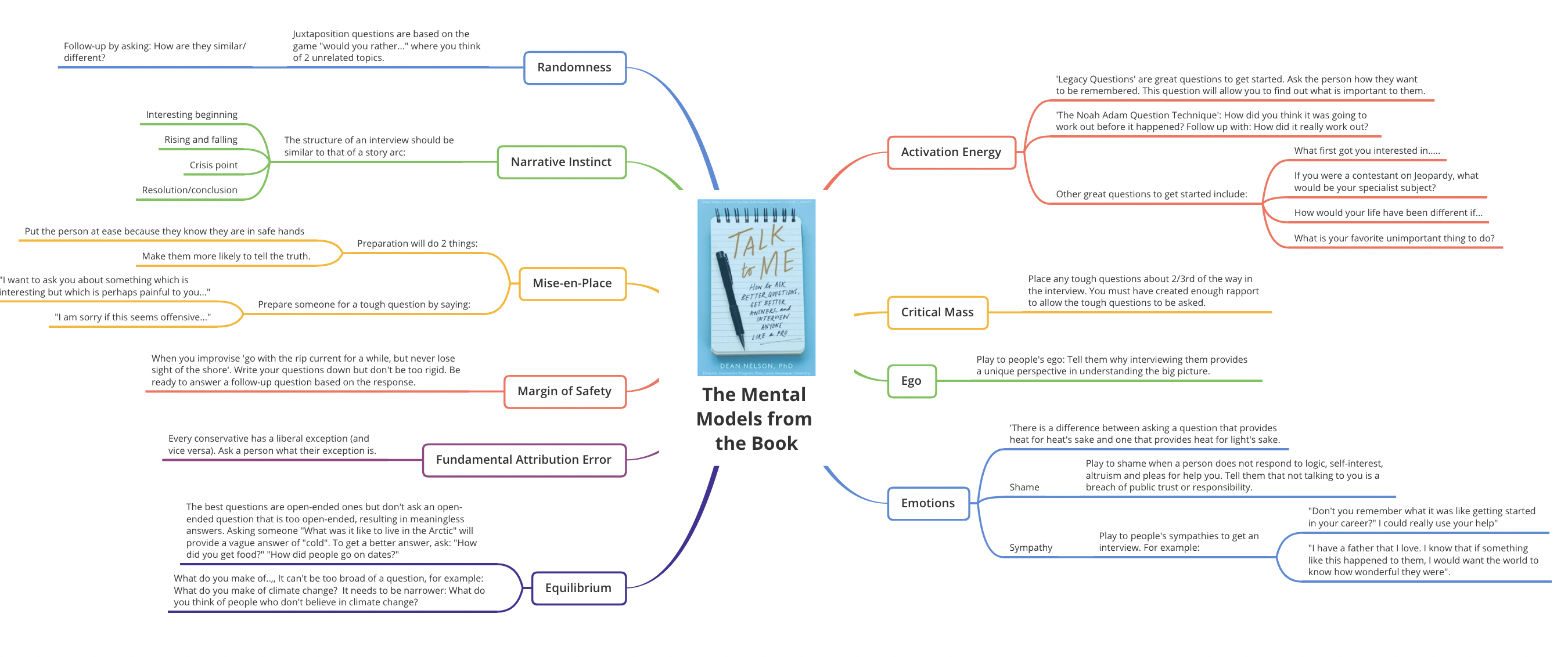
'Talk to Me' can be summarised into 10 mental models:
1. Activation Energy
- 'Legacy Questions' are great questions to get started. Ask the person how they want to be remembered. This question will allow you to find out what is important to them.
- 'The Noah Adam Question Technique': How did you think it was going to work out before it happened? Follow up with: How did it really work out?
- Other great questions to get started include:
- What first got you interested in.....
- If you were a contestant on Jeopardy, what would be your specialist subject?
- How would your life have been different if...
- What is your favorite unimportant thing to do?
2. Critical Mass
- Place any tough questions about 2/3rd of the way in the interview. You must have created enough rapport to allow the tough questions to be asked.
3. Ego
- Play to people's ego: Tell them why interviewing them provides a unique perspective in understanding the big picture.
4. Emotions
- 'There is a difference between asking a question that provides heat for heat's sake and one that provides heat for light's sake.
4.1 Emotions: Shame
- Play to shame when a person does not respond to logic, self-interest, altruism and pleas for help you. Tell them that not talking to you is a breach of public trust or responsibility.
4.2 Emotions: Sympathy
- Play to people's sympathies to get an interview. For example:
- "Don't you remember what it was like getting started in your career?" I could really use your help"
- "I have a father that I love. I know that if something like this happened to them, I would want the world to know how wonderful they were".
5. Equilibrium
- The best questions are open-ended ones but don't ask an open-ended question that is too open-ended, resulting in meaningless answers. Asking someone "What was it like to live in the Arctic" will provide a vague answer of "cold". To get a better answer, ask: "How did you get food?" "How did people go on dates?"
- What do you make of..,, It can't be too broad of a question, for example: What do you make of climate change? It needs to be narrower: What do you think of people who don't believe in climate change?
6. Fundamental Attribution Error
- Every conservative has a liberal exception (and vice versa). Ask a person what their exception is.
7. Margin of Safety
- When you improvise 'go with the rip current for a while, but never lose sight of the shore'. Write your questions down but don't be too rigid. Be ready to answer a follow-up question based on the response.
8. Miss-en-Place
- Preparation will do 2 things:
- Put the person at ease because they know they are in safe hands
-
Make them more likely to tell the truth. - Prepare someone for a tough question by saying:
-
"I want to ask you about something which is interesting but which is perhaps painful to you..."
- "I am sorry if this seems offensive..."
9. Narrative Instinct
- The structure of an interview should be similar to that of a story arc:
- Interesting beginning
- Rising and falling
- Crisis point
- Resolution/conclusion
10. Randomness
- Juxtaposition questions are based on the game "would you rather..." where you think of 2 unrelated topics. Follow-up by asking: How are they similar/different?
Mental Model Mind Maps
Mind maps can help you to remember the most important parts of a book. Signup to my newsletter below to get a free mindmap of this book: