'The 48 Laws of Power' - 80/20 Summary
- Amazon: Link
- Score: 10/10
- Categories: Influence
- Mental Models: Action & Reaction: Newton's Third Law, Asymmetric Warfare, Authority, Choice Architecture, Co-operation, Commitment & Consistency Bias, Evolution: Adaption, Ego, Emotions: Anger, Desire, Envy, Evolution: Adaptation, Feedback Loops, First Conclusion Bias, Incentives, Inertia, Leverage, Liking, Margin of Safety, Narrative Instinct, Niches, Randomness, Scarcity, Second-Order Thinking, Specialization, Status, Tendency to Minimize Energy Output, The Ikea Effect, The Map is Not the Territory, Two-Front War
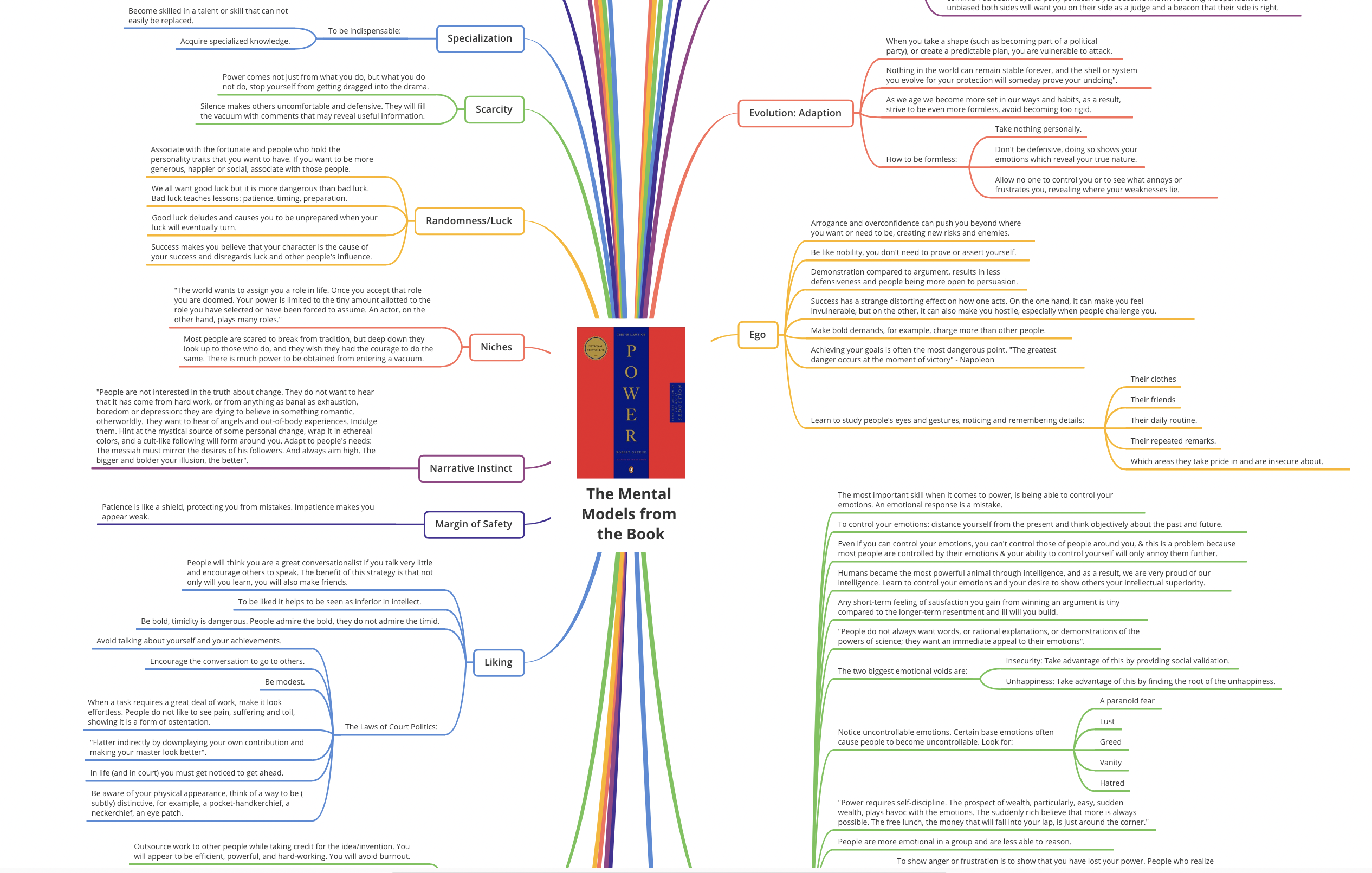
28 The Mental models from The Book:
1. Action & Reaction: Newton's Third Law
- Mirroring causes your target to have difficulty in reading your true intentions.
- Mirroring shows people that you are part of their tribe.
- Mirroring saves mental energy and gives you the time and energy to be creative.
- Mirroring mocks and humiliates, causing a response that is an overreaction.
- Deal with troublemakers and stirrers by shining a light on their actions, and highlighting to others what they are doing. "Stirrers thrive by hiding in the group, disguising their actions among the reactions of others. Render their actions visible and they lose their power to upset."
2. Asymmetric Warfare
- Use surrender to learn more about your enemy. This is what the Japanese did when they resisted the West:
- Became friendly with them.
- They learned the west's methods.
- Outwardly embraced their customs.
- But inwardly they kept their own culture.
3. Authority
- Surrendering is not always weak and can be transformed into strength if strategically used. People often like to show their authority (for example, police and customer service representatives), the surrender technique can be used effectively to deceive them. To use the surrender tactic:
- Notice the feeling of being triggered.
- Do not fight back or become defensive.
- Be like bamboo and bend.
- By not playing their game, you are in control and unbalance them. - Boldness creates fear; fear creates authority. A big, bold move gives the appearance that you are more powerful than you are. If you make a move suddenly it inspires more fear than doing the same move slowly. Once you have set a precedent, people will fear you going forward. - Excuses and apologies are often avoided by the powerful as they create doubts about your competency and other mistakes that you might have made.
4. Choice Architecture
- Often people who advocate for equality are using a power play, allocating rewards in a way which they choose.
- "As long as the faintest mirage of choices flickers on, we rarely focus on the missing options. We "choose" to believe that the game is fair, and that we have our freedom.
- Don't rely on the choices of A+B that you are given, always think to ask about option C (or think outside the box and ask for H19).
- "We prefer not to think too much about the depth of our liberty to choose".
5. Co-operation
- Flattery is often too obvious, instead be discrete: ask for help or advice.
6. Commitment & Consistency Bias
- If you corner someone they will fight harder as there is no way out. Sometimes it is better to leave an escape route that tires and demoralizes the enemy, which results in less work and causalities for your side.
- Humans are creatures of habit and control. They like to see consistency and predictability. This is why natural disasters scare us so much. By being unpredictable you will exhaust people and make them flustered and unbalanced.
- Power relies on appearance and one way to improve your image is to be independent and not commit. You seem beyond petty politics. As you become known for being independent and unbiased both sides will want you on their side as a judge and a beacon that their side is right.
7. Evolution: Adaption
- When you take a shape (such as becoming part of a political party), or create a predictable plan, you are vulnerable to attack.
- Nothing in the world can remain stable forever, and the shell or system you evolve for your protection will someday prove your undoing".
- As we age we become more set in our ways and habits, as a result, strive to be even more formless, avoid becoming too rigid.
- How to be formless:
- Take nothing personally.
- Don't be defensive, doing so shows your emotions which reveal your true nature.
- Allow no one to control you or to see what annoys or frustrates you, revealing where your weaknesses lie.
8. Ego
- Arrogance and overconfidence can push you beyond where you want or need to be, creating new risks and enemies.
- Be like nobility, you don't need to prove or assert yourself.
- Demonstration compared to argument, results in less defensiveness and people being more open to persuasion.
- Success has a strange distorting effect on how one acts. On the one hand, it can make you feel invulnerable, but on the other, it can also make you hostile, especially when people challenge you.
- Make bold demands, for example, charge more than other people.
- Achieving your goals is often the most dangerous point. "The greatest danger occurs at the moment of victory" - Napoleon
- Learn to study people's eyes and gestures, noticing and remembering details:
- Their clothes
- Their friends
- Their daily routine.
- Their repeated remarks.
- Which areas they take pride in and are insecure about.
9. Emotions
- The most important skill when it comes to power, is being able to control your emotions. An emotional response is a mistake.
- To control your emotions: distance yourself from the present and think objectively about the past and future.
- Even if you can control your emotions, you can not control those of people around you, and this is a problem because most people are controlled by their emotions and your ability to control yourself will only annoy them further.
- Humans became the most powerful animal through intelligence, and as a result, we are very proud of our intelligence. Learn to control your emotions and your desire to show others your intellectual superiority.
- Any short-term feeling of satisfaction you gain from winning an argument is tiny compared to the longer-term resentment and ill will you build.
- "People do not always want words, or rational explanations, or demonstrations of the powers of science; they want an immediate appeal to their emotions".
- The two biggest emotional voids are:
- Insecurity: Take advantage of this by providing social validation.
-
Unhappiness: Take advantage of this by finding the root of the unhappiness. - Notice uncontrollable emotions. Certain base emotions often cause people to become uncontrollable. Look for:
-
A paranoid fear
- Lust
- Greed
- Vanity
- Hatred - "Power requires self-discipline. The prospect of wealth, particularly, easy, sudden wealth, plays havoc with the emotions. The suddenly rich believe that more is always possible. The free lunch, the money that will fall into your lap, is just around the corner." - People are more emotional in a group and are less able to reason.
9.1 Emotions: Anger
- To show anger or frustration is to show that you have lost your power. People who realize that you have so little self-control can easily undermine you.
- Anger cuts off your options.
- Angry and aggressive people are usually not in control. Angry people can only see what is in front of them, they do not see the bigger picture. Angry people are reactive, they do not direct events. They become exhausted. Often the best course of action is to keep calm, while others get frustrated and exhausted, biding your time for long-term power.
- If you can train yourself to control the emotional responses you place yourself in a place of tremendous power. Do not repress your anger or other emotions. Repression drains us of energy. Instead see things from a different perspective, disengage from the emotion and remember that nothing is personal.
- If someone gets angry:
- Remind yourself that the anger is not directed at you personally. The anger comes from a long history of the previous hurt.
- "Look at the emotional outburst as a disguised power move, an attempt to control or punish you cloaked in the form of hurt feelings and anger."
- Use lines such as: "What a pity that such a great a man should have such bad manners.
9.2 Emotions: Desire
- "The ability to ignore immediate dangers and pleasures translates into power. It is the power of being able to overcome the natural human tendency to react to things as they happen, and instead to train oneself to step back, imagining the larger things taking shape beyond one's immediate vision. Most people believe that they are in fact aware of the future, that they are thinking ahead. They are usually deluded: What they really are doing is succumbing to their desires, to what they want the future to be. Their plans are vague, based on their imaginations rather than their reality. They may believe they are thinking all the way to the end, but they are really only focusing on the happy ending, and deluding themselves by the strength of their desire".
- An interest that is too strong makes people feel awkward and sometimes fearful. If your interest is too strong you will push away the object you desire.
- Being uncontrolled in your desire gives the appearance that you are weak, unworthy and pathetic.
- Science has enlightened us. What was once mysterious and scary is now comfortable and explainable. In a world devoid of mystique, people desire enigmas and things that can not be easily explained.
- Try to understand the person's motivations: Are they vain? Are they worried about their reputation? Are they worried about enemies? Do they want money?
- Understanding people's (hidden) motives is the best knowledge you can acquire in gaining power.
- "Since we all try to hide our weaknesses, there is little to be learned from our conscious behavior. What oozes out in the little things outside our conscious control is what you want to know." Notice details: how much do they tip a waiter? The clothes and jewelry they wear, what delights them.
9.3 Emotions: Envy
- "Never be so foolish to believe that you are stirring up admiration by flaunting the qualities that raise you above others." By making others aware of their inferior position, you are only stirring up "unhappy admiration" or envy, which will gnaw away at them until they undermine you in ways you can not foresee."
10. Evolution: Adaptation
- Animals, people (and also cultures and institutions), develop protection (armor, rigid rules, rituals, and procedures) to protect themselves from perceived dangers. These protections may work in the short term but in the longer term, they cause death and extinction.
- If you can not move quickly or be flexible due to being weighed down physically or metaphorically you can not adapt to change.
- Success makes you less flexible and able to adapt to changing circumstances.
- "In evolution, largeness is often the first step towards extinction. What is immense and bloated has no mobility, but must constantly feed itself. the unintelligent are often seduced into believing that size connotes power, the bigger, the better."
11. Feedback Loops
- A common error is overreacting to the moves of a rival. This causes a negative feedback loop as the other person overreacts also.
12. First Conclusion Bias
- Reputation (just like someone who looks big and strong) can intimidate and stop attacks before they even happen.
- Start by establishing a reputation for one outstanding single quality. Do not dilute yourself, be known for this one quality, e.g. generosity, honesty, cunning.
- A single act doesn't result in a reputation. A series of (small and unrelated) acts are needed. Once a reputation is established, like a first impression, it is harder to lose.
- Lions circle the hesitant prey: If during your first encounter you seem too eager to placate, compromise or back down you may bring out the lion in people. Power depends on appearance and if you project that you can be pushed around, you will.
13. Incentives
- "Necessity rules the world. People rarely act unless compelled to. If you create no need for yourself, then you will be done away with at first opportunity"
- Pleasure, allaying fears and promising security convert people to your ideas.
14. Inertia
- "Human psychology contains many dualities, one of them being that even while people understand the need for change... they are also irritated and upset by changes that affect them personally. They know that change is necessary, and that novelty provides relief from boredom, but deep inside they cling to the past. Change in the abstract, or superficial change they desire, but a change that upsets core habits and routines is deeply disturbing to them".
15. Leverage
- Outsource work to other people while taking credit for the idea/invention. You will appear to be efficient, powerful, and hard-working. You will avoid burnout.
- "Learn to use the knowledge of the past and you will look like a genius, even when you are really just a clever borrower".
- We have a psychological resistance to change. Pushing against resistance will consume energy. We all have a leverage point, that when pushed will overcome the resistance.
- How to find people's leverage points:
- Pay attention to gestures and unconscious signals
- Normal, everyday conversation provides the greatest source.
- Share an open-hearted secret to help them open up.
- Probe: If you think a person has a need to be loved, give a compliment and notice the response.
16. Liking
- People will think you are a great conversationalist if you talk very little and encourage others to speak. The benefit of this strategy is that not only will you learn, you will also make friends.
- To be liked it helps to be seen as inferior in intellect.
- Be bold, timidity is dangerous. People admire the bold, they do not admire the timid.
- The Laws of Court Politics:
- Avoid talking about yourself and your achievements.
- Encourage the conversation to go to others.
- Be modest.
- When a task requires a great deal of work, make it look effortless. People do not like to see pain, suffering and toil, showing it is a form of ostentation.
- "Flatter indirectly by downplaying your own contribution and making your master look better".
- In life (and in court) you must get noticed to get ahead.
- Be aware of your physical appearance, think of a way to be (subtly) distinctive, for example, a pocket-handkerchief, a neckerchief, an eye patch.
17. Margin of Safety
- Patience is like a shield, protecting you from mistakes. Impatience makes you appear weak.
18. Narrative Instinct
- "People are not interested in the truth about change. They do not want to hear that it has come from hard work, or from anything as banal as exhaustion, boredom or depression: they are dying to believe in something romantic, otherworldly. They want to hear of angels and out-of-body experiences. Indulge them. Hint at the mystical source of some personal change, wrap it in ethereal colors, and a cult-like following will form around you. Adapt to people's needs: The messiah must mirror the desires of his followers. And always aim high. The bigger and bolder your illusion, the better".
19. Niches
- "The world wants to assign you a role in life. Once you accept that role you are doomed. Your power is limited to the tiny amount allotted to the role you have selected or have been forced to assume. An actor, on the other hand, plays many roles."
- Most people are scared to break from tradition, but deep down they look up to those who do, and they wish they had the courage to do the same. There is much power to be obtained from entering a vacuum.
20. Randomness/Luck
- Associate with the fortunate and people who hold the personality traits that you want to have. If you want to be more generous, happier or social, associate with those people.
- We all want good luck but it is more dangerous than bad luck. Bad luck teaches lessons: patience, timing, preparation.
- Good luck deludes and causes you to be unprepared when your luck will eventually turn.
- Success makes you believe that your character is the cause of your success and disregards luck and other people's influence.
21. Scarcity
- Power comes not just from what you do, but what you do not do, stop yourself from getting dragged into the drama.
- Silence makes others uncomfortable and defensive. They will fill the vacuum with comments that may reveal useful information.
22. Specialization
- To be indispensable:
- Become skilled in a talent or skill that can not easily be replaced.
- Acquire specialized knowledge.
23. Second-Order Thinking
- The difference between the Greek Gods and humans was that Greek Gods were thought to have total vision into the future. Humans were seen to be victims of fate, caught up in their emotions in the moment, blind to the future and only seeing current dangers. The most successful humans are the ones who are able to plan for the future and see the benefit of sacrificing current pleasures for payoffs in the future. On a spectrum with animals on one end and Greek gods at the other end, we are in the middle. To be closer to a God we must improve our ability to look into the future.
- When your mind is free from constant emergencies and emotions you can see more clearly and further into the future.
- When you have the skill to play 3D chess and to see many moves ahead, you are no longer distracted by your emotions or the need to improvise. This clearness of mind will free you of anxiety, and it's lack of clearness is why so many fail.
24. Status
- Go after the highest status person, this puts you on the same footing as them.
- Give a gift to people above you, this also put you on an equal footing.
25. Tendency to Minimize Energy Output
- Be aware of people who deceive using the possibility of easy money. People are by nature lazy and want quick easy money, and are therefore attracted to that path.
26. The Ikea Effect
- When you make others react, you hold the power. When you incentivize someone to come to you, they feel like they made the decision themselves and they don't feel like they are being controlled or manipulated.
27. The Map is Not the Territory
- The same lessons that were right for you may be wrong for others as times have changed and the lessons you learned may need to be updated for today's times.
- Avoid the belief that if you follow the recipe of doing exactly what someone else did, you can get what they got. "This cookie-cutter approach will seduce the uncreative, for it is easy, and appeals to their timidity and their laziness. But circumstances never repeat themselves exactly."
28. Two-Front War
- As two competing sides battle, they become weaker and you become stronger.
- Aloofness is powerful: people who are quick to support others, often do not gain respect because their loyalty is so easily obtained. Be interested and show concern but remain neutral.
- In theory, stepping back and avoiding drama may be true but In reality, it may not be possible and it would cause offense. The solutions:
- Appear interested in their problems
- Sometimes take their side
- Show gestures of support, listen with a sympathetic ear.
- However, disengage your emotions
- Maintain your energy and sanity.
- Do not let your interest go beyond the surface.
Mental Model Mind Maps:
Mind maps can help you to remember the most important parts of a book. Signup to my newsletter below to get a free mindmap of this book: