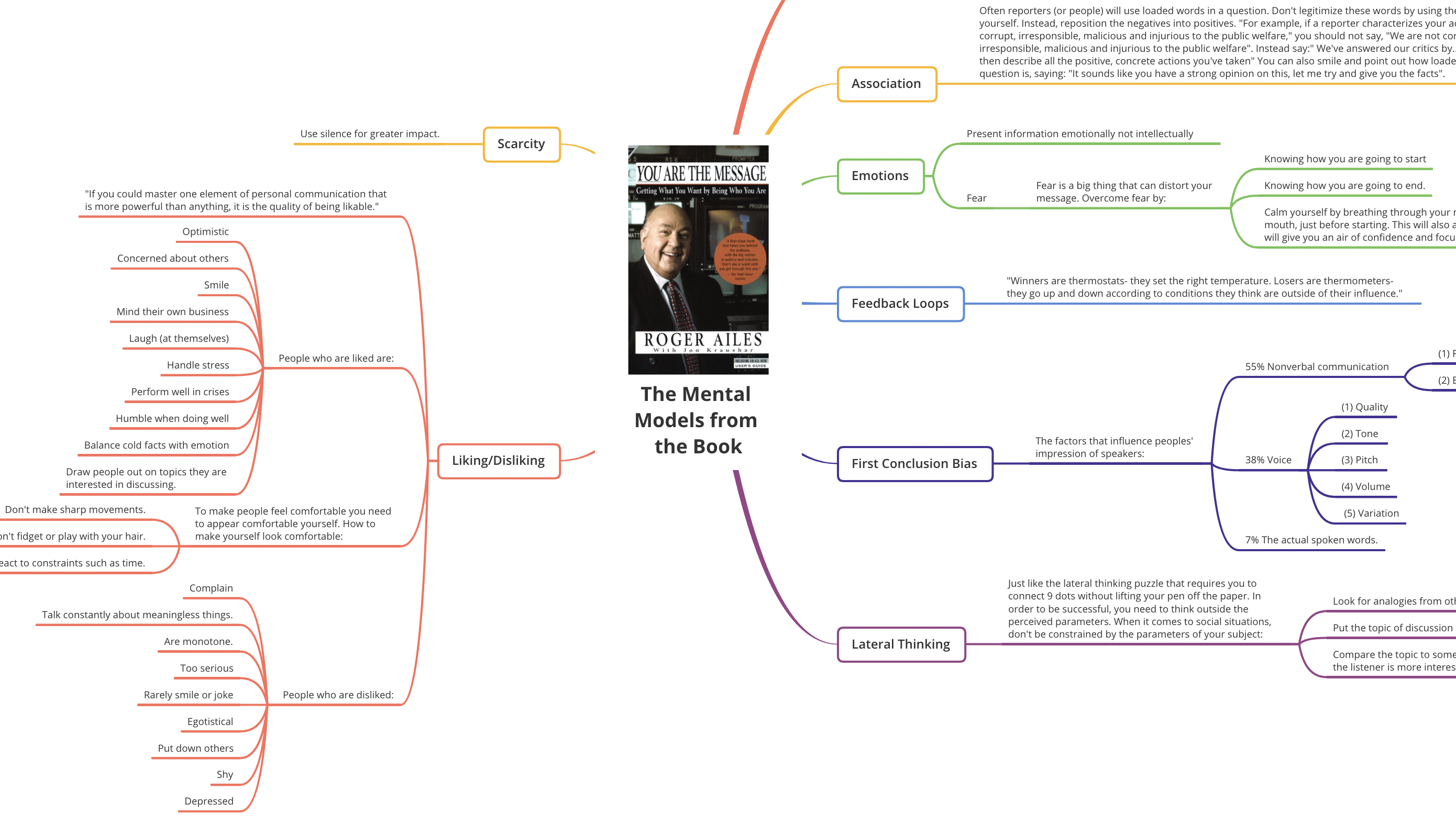
'You Are the Message' - 80/20 Summary

- Score: 6/10
- Categories: Influence
- Mental Models: Agenda Setting Theory, Association, Emotions: Fear, Feedback Loops, First Conclusion Bias, Lateral Thinking, Liking/Disliking, Scarcity
“The first rule is that you can't really know anything if you just remember isolated facts and try and bang 'em back. If the facts don't hang together on a latticework of theory, you don't have them in a usable form.” -Charlie Munger
8 Mental Models from the book:
1. Agenda Setting Theory
- Build a bridge from a reporter's (or someone else's) agenda to your own. Be responsive and use points from your agenda that are interesting and newsworthy, supported with facts. Use the formula: Q = A + 1. When asked a question, reply with a direct answer and then add a point from your own agenda (+1). When you notice an increase in the tone, volume, and rhythm of interrogation, this is your cue to be friendlier, quieter, and slower. This gives the impression to the audience that you are reasonable and that the other person is trying to provoke you. Frame your answer in terms of the public interest or the greater good.
2. Association
- Often reporters (or people) will use loaded words in a question. Don't legitimize these words by using them yourself. Instead, reposition the negatives into positives. "For example, if a reporter characterizes your actions as "corrupt, irresponsible, malicious and injurious to the public welfare," you should not say, "We are not corrupt, irresponsible, malicious and injurious to the public welfare". Instead say:" We've answered our critics by...." and then describe all the positive, concrete actions you've taken" You can also smile and point out how loaded the question is, saying: "It sounds like you have a strong opinion on this, let me try and give you the facts".
3. Emotions
- Present information emotionally not intellectually
3.1 Emotions: Fear
- Fear is a big thing that can distort your message. Overcome fear by:
- Knowing how you are going to start
- Knowing how you are going to end.
- Calm yourself by breathing through your nose and out of your mouth, just before starting. This will also add a pause, which will give you an air of confidence and focus the audience.
4. Feedback Loops
- "Winners are thermostats- they set the right temperature. Losers are thermometers-they go up and down according to conditions they think are outside of their influence."
5. First Conclusion Bias
- The factors that influence peoples' impression of speakers:
- 55% Nonverbal communication: (1) Facial expression (2) Body language
- 38% Voice (1) Quality (2) Tone (3) Pitch (4) Volume (5) Variation
- 7% The actual spoken words.
6. Lateral Thinking
- Just like the lateral thinking puzzle that requires you to connect 9 dots without lifting your pen off the paper. In order to be successful, you need to think outside the perceived parameters. When it comes to social situations, don't be constrained by the parameters of your subject:
- Look for analogies from other fields.
- Put the topic of discussion into a historical perspective.
- Compare the topic to something that is more familiar or something the listener is more interested in e.g. compare it to sports.
7. Liking/Disliking
- "If you could master one element of personal communication that is more powerful than anything, it is the quality of being likable."
- People who are liked are:
- Optimistic
- Concerned about others
- Smile
- Mind their own business
- Laugh (at themselves)
- Handle stress
- Perform well in crises
- Humble when doing well
- Balance cold facts with emotion
-
Draw people out on topics they are interested in discussing. - To make people feel comfortable you need to appear comfortable yourself. How to make yourself look comfortable:
-
Don't make sharp movements.
- Don't fidget or play with your hair.
-
Don't overreact to constraints such as time. - People who are disliked:
-
Complain
- Talk constantly about meaningless things.
- Are monotone.
- Too serious
- Rarely smile or joke
- Egotistical
- Put down others
- Shy
- Depressed
8. Scarcity
- Use silence for greater impact.
Mental Model Mind Maps
Mind maps can help you to remember the most important parts of a book. Signup to my newsletter below to get a free mindmap of this book: