'Made to Stick' - 80/20 Summary
- Amazon: Link
- Score: 7/10
- Skill Category: StoryTelling
- Mental Models: Commitment & Consistency Bias, Curiosity Instinct, Emotions: Mystery, Incentives Narrative Instinct, Niches, Newton's 3rd Law, Pareto Principle, Social Proof, The Map is Not the Territory, Vividness Bias
Mental Models from the book:
I have summarised 'Made to Stick', distilling the book into 11 mental Models:
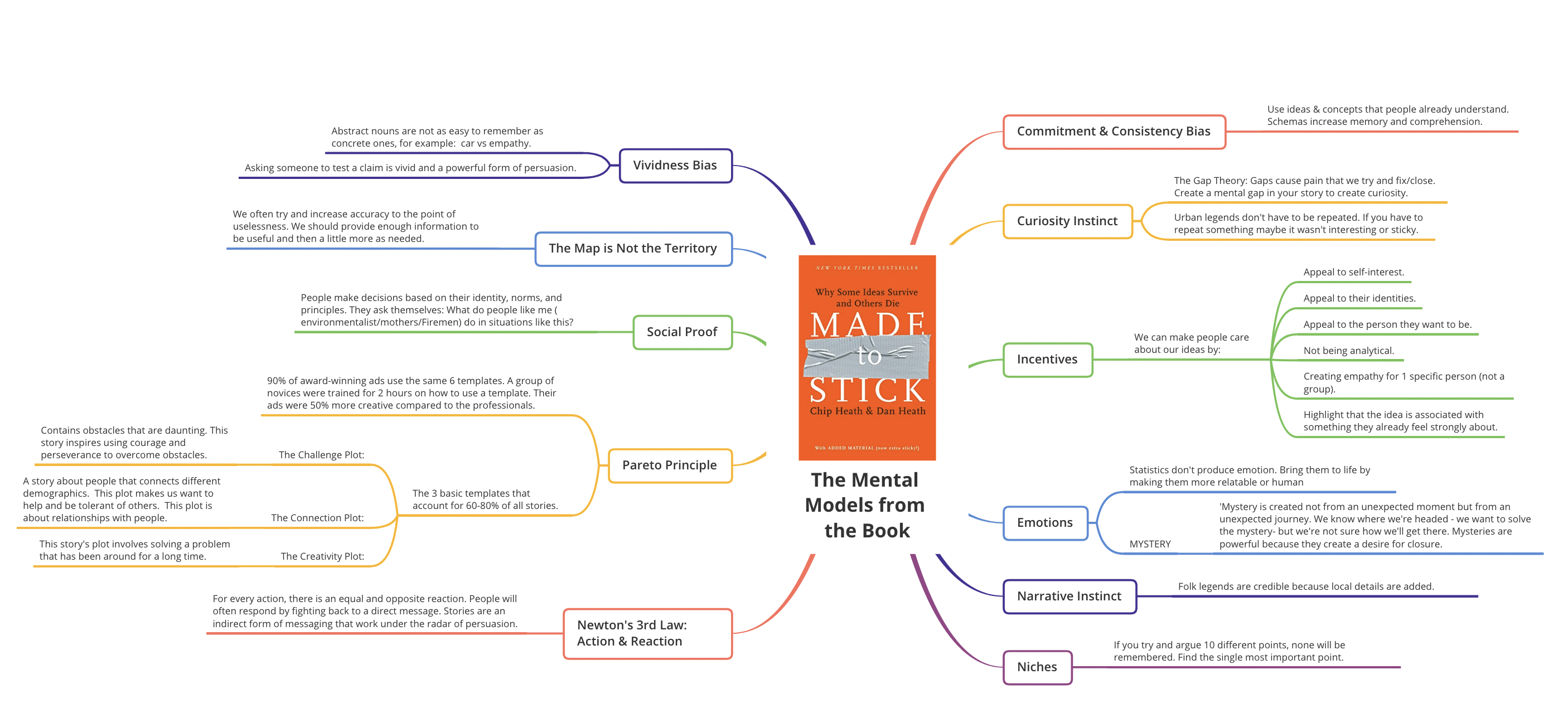
1. Commitment & Consistency Bias
- Use ideas & concepts that people already understand. Schemas increase memory and comprehension.
2. Curiosity Instinct
- The Gap Theory: Gaps cause pain that we try and fix/close. Create a mental gap in your story to create curiosity.
- Urban legends don't have to be repeated. If you have to repeat something maybe it wasn't interesting or sticky.
3. Emotions
- Statistics don't produce emotion. Bring them to life by making them more relatable or human.
3.1 Emotions: Mystery
- 'Mystery is created not from an unexpected moment but from an unexpected journey. We know where we're headed - we want to solve the mystery- but we're not sure how we'll get there. Mysteries are powerful because they create a desire for closure.
4. Incentives
- We can make people care about our ideas by:
- Appeal to self-interest.
- Appeal to their identities.
- Appeal to the person they want to be.
- Not being analytical.
- Creating empathy for 1 specific person (not a group).
- Highlight that the idea is associated with something they already feel strongly about.
5. Narrative Instinct
- Folk legends are credible because local details are added.
6. Niches
- If you try and argue 10 different points, none will be remembered. Find the single most important point.
7. Newton's 3rd Law: Action & Reaction
- For every action, there is an equal and opposite reaction. People will often respond by fighting back to a direct message. Stories are an indirect form of messaging that work under the radar of persuasion.
8. Pareto Principle
- 90% of award-winning ads use the same 6 templates. A group of novices were trained for 2 hours on how to use a template. Their ads were 50% more creative compared to the professionals.
- The 3 basic templates that account for 60-80% of all stories.
- The Challenge Plot: Contains obstacles that are daunting. This story inspires using courage and perseverance to overcome obstacles.
- The Connection Plot: A story about people that connects different demographics. This plot makes us want to help and be tolerant of others. This plot is about relationships with people.
- The Creativity Plot: This story's plot involves solving a problem that has been around for a long time.
9. Social Proof
- People make decisions based on their identity, norms, and principles. They ask themselves: What do people like me (environmentalist/mothers/Firemen) do in situations like this?
10. The Map is Not the Territory
- We often try and increase accuracy to the point of uselessness. We should provide enough information to be useful and then a little more as needed.
11. Vividness Bias
- Abstract nouns are not as easy to remember as concrete ones, for example: car vs empathy.
- Asking someone to test a claim is vivid and a powerful form of persuasion.
Mental Model Mind Maps
Mind maps can help you to remember the most important parts of a book. Signup to my newsletter below to get a free mindmap of this book: