49 Mental Models to be a Better StoryTeller
Storytelling is like a language that the whole world can speak and understand. It is a skill, that once acquired, gives you the ability to connect with anyone. It builds trust and engagment between you and your audience.
We've all been in a meeting room and endured a boring avalanche of boring bullet points and sleep-inducing slides. While most people focus on data and spreadsheets a story will help you to simplify complicated ideas that will be remembered by your audience.
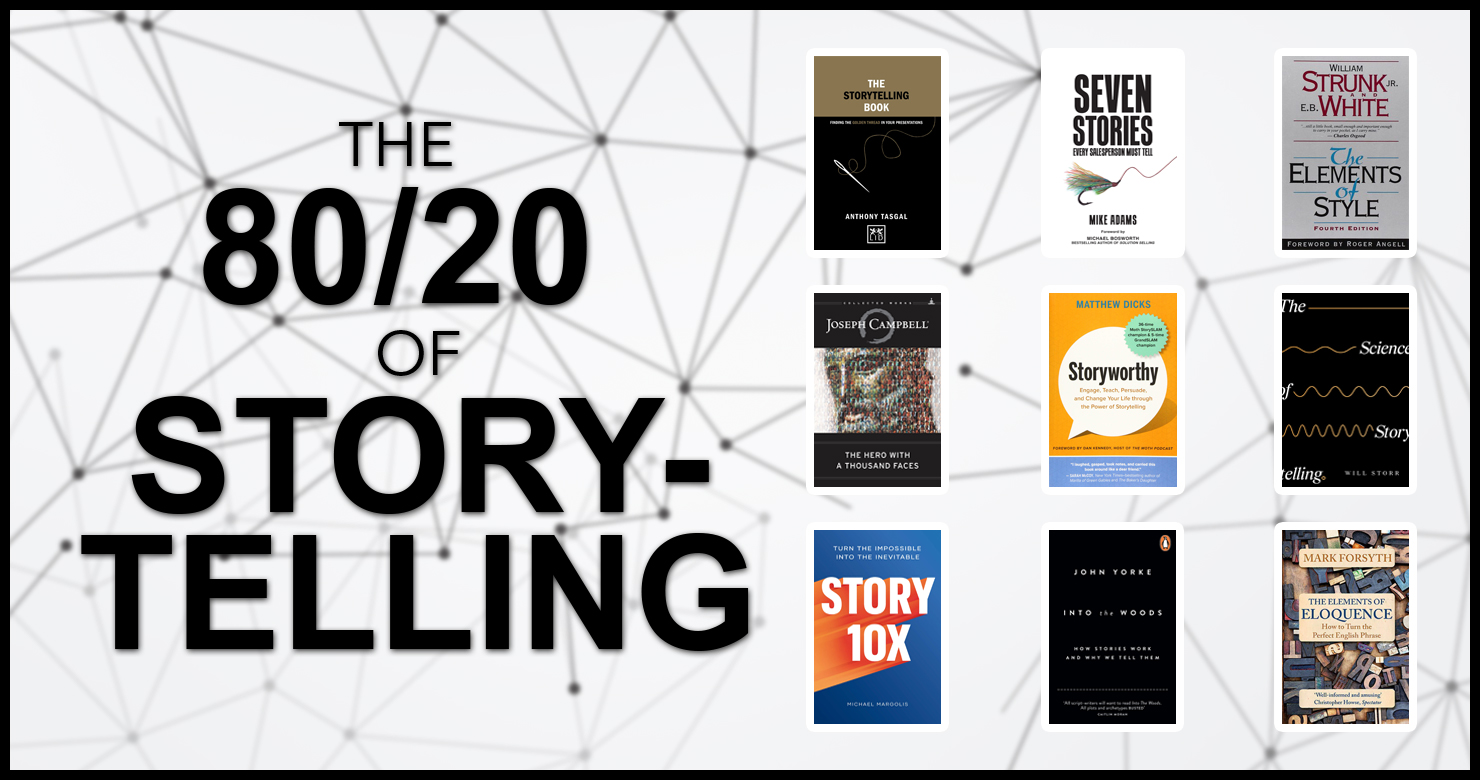
I have taken the top 7 books on storytelling and created a latticework of mental models on the topic. This framework allows for better understanding and recollection.
The Books:
- Story 10x
- The StoryTelling Book
- Into The Woods
- Storyworthy
- The Science of StoryTelling
- Made to Stick
- The Element of Eloquence
49 Mental models for StoryTElling:
- Action & Reaction: Newton's 3rd Law
- Alloying
- Attentional Bias
- Authority
- Availability Heuristic
- Catalysts
- Choice Architecture
- Commitment & Consistency Bias
- Co-operation
- Curiosity Instinct
- Desire
- Ego
- Emergence
- Emotions: Fear, Humor, Jealousy, Moral superiority, Mystery, Surprise, Schadenfreude
- Equilibrium
- Evolution: Adaptation
- Evolution: Natural Selection
- Feedback Loops
- First Principle Thinking
- First Conclusion Bias
- Friction
- Ikea Effect
- Incentives
- Inversion
- Irrationality
- Language Instinct
- Liking/Disliking
- Momentum
- Narrative Instinct
- Niches
- Pareto Principle
- Randomness
- Relativity
- Replication
- Resistance
- Sampling
- Scarcity
- Seizing The Middle
- Self-Preservation
- Social Proof
- Specialization
- Status
- System 1 vs System 2 Thinking
- The Ikea Effect
- The Map is Not the Territory
- Trust
- Utility
- Velocity
- Vividness Bias
1. Action & Reaction: Newton's 3rd Law
- 'As we interact with the world in our own characteristic way, so the world pushes back in ways which reflect it, setting us off in our own particular cause and effect journey - a plot-specific to us'.
- Scenes move like a wave with action to reaction to action to reaction until an unexpected reaction happens and one character is successful in their goal and the other is not. This is a turning point.
- For every action, there is an equal and opposite reaction. People will often respond by fighting back to a direct message. Stories are an indirect form of messaging that work under the radar of persuasion
2. AlloyinG
- Create a word sandwich to add finality, emphasis or judgment. The formula is: (Word or phrase) + (brief interruption) + (word or phrase). For example: burn, baby, burn.
3. Attentional Bias
- When we begin communications with a bang, getting the audiences' attention, we pique their curiosity.
- Attention is focused on things that have personal meaning, not things that simply stand out.
- Humans, don’t talk in lists but that’s what makes them so effective. They startle and bewilder. They grab your attention. We aren't used to them.
4. Authority
- Asking a rhetorical question both parties know the answer to can assert authority and belittle.
5. Availability Heuristic
- Every generation views the world through the lens of available facts.
- The Earth was supported by Atlas.
- Cigarettes were good for you.
- The Earth is the center of the universe.
6. Catalysts
- End a sentence with a word and begin the next with that same word. This gives both sentences power, strength, and the illusion of logic. It is satisfying, beautiful and structured. It is progression. It is like a story that leads to a climax.
- There are two ways to start a story:
-
The Sledgehammer:
- Smash the audience's assumptions and shift their paradigm.
-
Ice Cream Cone:
-
Make the audience feel good and create a stream of "Yes's"
- Capture their imagination.
- Get them excited and intrigued.
7. Choice Architecture
- By piquing the interest of the audience early, you are leading them down a path that provides cognitive ease, a clear path for our brain to follow. This enables you to prime the audience by taking them down the path of your choosing.
8. Commitment & Consistency Bias
- Use ideas & concepts that people already understand. Schemas increase memory and comprehension.
- Structure is the most important part of story writing. The brain needs a pattern and order to follow.
9. Co-operation
- Individualism started in the hilly landscape of ancient Greece where group activities like farming were difficult and self-reliance more common. This led to personal glory and the creation of the Olympics and democracy. Collectivism started in the East and it arose because the land was flat and ideal for group farming.
10. Curiosity Instinct
- The secret to a successful story is the control of suspense. Every sentence should lead to the next sentence.
- Dogs live in a world of smells, humans live in a social world. As the social world is so important to us, we have a heightened curiosity about it.
- There are 4 ways of creating curiosity:
- The presentation of a question or puzzle.
- A sequence of events with anticipated but unknown resolution.
- The violation of expectations, triggering a search for an answer.
- Surprise with red hearings and seduce with someone else knowing the secret. - Maximum curiosity is when the reader has an idea but they are not quite sure and must resolve that itch of curiosity. - Provide the audience with facts and allow them to find the connection.'Good storytelling never gives you 4, it gives you 2 + 2. Don't give the audience the answer; give the audience the pieces and compel them to conclude the answer. Audiences have an unconscious desire to work for their entertainment. They are rewarded with a sense of thrill and delight when they find the answers themselves. - Breadcrumbs are used to hint towards a future event. Enough is revealed to keep the listener wondering and guessing. Breadcrumbs are effective when something unexpected happens in the story. For example: 'As I climb into the car, I see my crumpled McDonald's uniform on the backseat, and I suddenly have an idea. - Urban legends don't have to be repeated. If you have to repeat something maybe it wasn't interesting or sticky.
11. Desire
- Our favorite characters are often the ones who we want part of ourselves to be: the good and the bad.
- All successful stories are about human desires because they matter to us:
- Success
- Revenue
- Love
- Survival
- Protection of family or home
- Belonging
- Friendship
- Survival
- Self Esteem - The desire for safety, if we want to live within a group, means we must accept that we can not have unrestricted access to our other wants. A thirst for sex and revenge are not good ingredients for living in a community in harmony. Desires need to be repressed which results in an internal conflict between the way we want to be seen and our inner desires. - Change is linked to desire. If the hero wants something they are going to have to change in order to get it.
12. Ego
- People pay attention when a story has parallels to themselves.
- For communication to be effective it needs to massage the ego of the listener relative to the informational content.
- When a person listens to your story they will instantly decide if you and your idea is part of their tribe. If they do not connect emotionally with your story, they will discount your data.
- We believe our desires will make us complete and give us peace. We wear masks to protect our ego, and to hide our more vulnerable inner selves. By confronting this vulnerability and its cause the hero can move on and become whole again.
13. Emergence
- The traditional view of decision-making was linear. These linear theories have been discredited for ones that are more:
- Non-linear
- Unconscious
-
Context-dependent - Avoid the linear by:
-
Finding a way of avoiding "the prison of chronology" on your story journey.
-
Avoid saying or writing a linear series of "and then...and then..." - Sentences, paragraphs, and science work against each other like the serrated blades of a knife. They progress through the use of opposites (it was this but now it's this). They create a new idea from the previous sentence (this plus this equals this). If you listen to someone talking about their vacation it is usually boring: "We went here and it was so good and then we went here and it was so good also". The negative is often better for storytelling, we become much more interested when we are told about something that went wrong. Saying what someone is not, is better than saying what they are: I am ugly and poor vs I'm not at all good looking and I'm not rich. The reason is because of the hidden 'but' that it contains. It says I could have been rich, it implies what I could have been. Most people wrongly connect sentences, paragraphs and scenes together with the word 'and'. 'And' stories are like running on a treadmill, there is no real movement. Instead, use:
-
But
- Therefore
- However
- Except
- As a result
- Instead - 'But' and 'therefore' signal change. The story goes in one direction and then another. The best storytellers don't move the story in a straight line. - 'Stories are built from acts, acts are built from even smaller units called beats. All these units are constructed in 3 parts: fractual versions of the 3-act whole. ' - Scenes are built around mini inciting incidences that connect to make a story.
14. Emotions
- All humans look similar but we are all different. We have the same psychological needs but we all have different experiences. We all have the ability to: love, be vengeful, and jealous.
- Who is the character in your story? This is a very hard question because we don't know who we are. We are led astray by our inner voice that tells us we are good and justifies everything we do. We think our inner voice is "us". It feels like the voice has direct access to who we are but it doesn't. It is simply generated by speech circuitry in the left hemisphere of our brain, "we" are our neural models. We model everything we know in the world. We also have different models of ourselves, which are continually fighting over who we are. Our behavior is the result of this fight. "Because the narrator exists separately from the circuits that are the true cause of our emotions and behaviors, it's forced to rapidly hash together anything that makes sense, a (usually heroic) story about what we are up to and why ."
- Our narrator organizes everything we see into a story that says who we are, why we did or felt something. It's designed to help us feel in control. It looks for an explanation for cause and effect, any explanation will do, facts are a bonus. In a study, split-brain patients had their right eye covered and were shown a sign that read "walk". Their brain sent this message to the right side of their brain, hidden from their narrator. The subjects got up and walked but when asked what they were doing they would make an excuse to justify their actions.
- Statistics don't produce emotion. Bring them to life by making them more relatable or human.
- Fill a metaphorical backpack with your hopes and fears before moving forward in the story. This increases wonder in your listeners about what will happen next and helps them to experience similar emotions to how you were feeling at the time. For example: 'I make a plan. I'm going to beg for gas because it's 1991. Gas is eighty-five cents a gallon, so eight dollars is all I need to get me home. I'll offer my license, my wallet, everything as collateral in exchange for $8 worth of gas and the promise that I will return and repay the money and money. Whatever it takes. So I rehearse my pitch, take a deep breath, and walk in.'
- A long sentence drawn out, with many commas stops you from being too emotional. You can't be too rude or enthusiastic with a long sentence.
- The ending of your story should include a resolution that results in an emotional crescendo.
- The Peak End Rule: When we recall a memory our recollection (whether good or bad) will be determined by 2 points:
- How you felt at the peak (low or high)
- How you felt at the end.
14.1 Emotions: Fear
- The inciting incident is often a decision the hero must take that will result in them confronting their worst fear.
14.2 Emotions: Humor
- Make your story funny by combing two words that don't normally go together. For example: My sadist grandmother.
- Oddly specific words are funnier.
14.3 Emotions: JEALOUSY
- Reading about wealth, popularity, and the good looks of others causes pain regions to be activated.
14.4 Emotions: Moral superiority
- Violence and cruelty have 4 causes:
- Greed and ambition
- Sadism
- High self-esteem
- Moral superiority - Popular opinion and stories tend to presume 'greed' and 'dominance' are key. In fact, it is moral superiority that causes most acts of evil.
14.5 Emotions: Mystery
- 'Mystery is created not from an unexpected moment but from an unexpected journey. We know where we're headed - we want to solve the mystery- but we're not sure how we'll get there. Mysteries are powerful because they create a desire for closure.
- Using a pronoun before a noun creates mystery and grabs your attention. For example: 'Nobody heard him, the dead man' instead of 'The dead man was not heard'.
- The 14th Rule. The use of specific numbers (instead of “many”) feels mysterious and significant.
14.6 Emotions: Surprise
- Stories need surprise so the listener can experience an emotional response. Use contrast to enhance surprise. Highlight a contrasting version of the world before the moment of surprise. Build expectations so that you can upend them.
- Don't set expectations by saying: "This funny thing happened". This reduces the chances of surprising the listener and surprise is one of the key ingredients of storytelling.
- 'To get a reaction and a response, we need to make what we say as surprising as possible.'
14.7 Emotions: schadenfreude
- Reading about misfortune causes the reward system to be activated.
15. Equilibrium
- Art is born from the battle between order and chaos. There is order and form, even when reflecting chaos and anarchy.
- Jung believed that every psychological force has its opposite: the facade we show the world and our shadow unconscious urges, which result in an identity crisis. Other psychologists had similar views and that in order to be happy this internal war must be overcome in order to reach happiness or completion. There is then a connection between stories and their journeys and our own reconciliation of our two sides.
- There is no character without conflict. There needs to be a clash of opposites, a rivalry, a ying and yang. Conflict comes naturally to all living things and it is vital to storytelling. Our brain is constantly in conflict, much of which is short-term vs long-term gratification.
- A story becomes more interesting when the antagonist is part of the protagonist, making them more real, for example: cowardice, fear or addiction.
- 'Successful happy endings, both in fiction and in psychology, involve the individual resolving conflicts and learning to integrate and balance opposing forces. Just as all stories seek to resolve order from chaos, man seeks to still the raging conflict within.'
16. Evolution: Adaptation
- Story is about learning. It is a map that pushes us to go off the path that our society and psychology has placed us on. It encourages us to find a new path to learn from, to embrace, and to grow. Story is a dramatization of acquiring knowledge, the pursuit of truth.
- Tell a story that shows the future they want and identify with. "The best kind of 'New Stories' don't reject the 'Old Stories' but rather demonstrate a natural evolution."
- A story needs to be more than just a sequence of interesting events. A story must have change. The story must start with one version of you and end with a new you.
- Every dramatic scene is a test for the protagonist, asking them: who are they going to be? The same flawed version of themselves or a reborn new version?
- At the start of a story you may be 25% x and 75% y. At the end of the story you'll be 75% x and 25% y. For example:
- 25% man & 75% boy ----->75% man & 25% boy
- 25% brave & 75% fearful ----->75% brave & 25% fearful
17. Evolution: Natural Selection
- Pattern formation was developed through natural selection to help us make the decision on whether to flee, fight, feed, or fuck.
18. Feedback Loops
- What is important can't be measured. What can be measured is measured and the flood of data and possible analysis steers us away from what really matters.
19. First Principle Thinking
- When you begin a story with data you signal that the story is finished before it has even begun. Instead:
- Start your story with timeless truth.
- Ask questions that are related to the timeless truth within a changing world and a changing context.
20. First Conclusion Bias
- If you can't get the attention or imagination of your audience in the first few minutes you'll lose them for your entire presentation.
- Start with a laugh within the first 30 seconds. This signals that you are a good storyteller and the audience can relax. It signals that you control the floor.
- The Top-Down Approach: Start with the big idea or the insight instead of a long introduction that hides your story and annoys the audience. Start with:
- The conclusion
- An unexpected insight or recommendation.
- An itch of ambiguity that makes your audience want to scratch to find a resolution.
- Inviting: "Come and let me take you on a journey".
21. Friction
- Brains have friction for "and then". Scenes should have a "because" between them, not "and then".
22. Ikea Effect
- Allow the reader to anticipate the unfolding of the scene. This lets them input their own feelings, interpretation, and narrative into why the scene happened. Show rather than tell, suggest instead of explaining.
23. Incentives
- Find your audience's key concern and prioritize it. Start by acknowledging it and answering it initially to set them at ease.
- We can make people care about our ideas by:
- Appealing to self-interest.
- Appealing to their identities.
- Appealing to the person they want to be.
- Not being analytical.
- Creating empathy for 1 specific person (not a group).
- Highlight that the idea is associated with something they already feel strongly about.
24. Inversion
- A story is often the mirror image of itself.
- Make your listener think they are going down one path but then show them they have been on a different path all the long. This strategy is effective when the story is heavy or emotional. Make the beginning light and fun, this will contrast to the sadness at the end.
- Reversal of expectation is a key device in stories.
- All characters are at war with themselves. In public we portray ourselves as model, virtuous citizens. We hide our dark side. We worry about how others will see us and this worry is the fuel for many of our decisions. Characters are more interesting when they act in the opposite of what they say. They are more true to life.
- The opposite of the first 15 minutes of a movie is usually the ending.
25. Irrationality
- 'Follow the sacredness. Find out what people find sacred and when you do you'll find irrationality'.
26. Language Instinct
- Don't tell the reader that the person is annoyed, show them subtly by writing 'He's tapping his finger'.
27. Liking/Disliking
- Mavericks are popular: we've all felt at times like we are the only sane person surrounded by idiots.
28. Momentum
- Start with forward movement in your stories. It makes the listener feel like they are going somewhere and the story is not stagnant. Start with walking, driving, or riding a train for example.
- The protagonist should be active. Books that appear in the NYT bestseller list contain 2x more of the following words:
- 'do'
- 'need'
- 'want'
29. Narrative Instinct
- The common elements in all stories:
- 'Home' is at risk
- The hero suffers from a flaw or problem
- The hero goes on a journey to overcome the problem
- At exactly the halfway point the hero finds the cure to their problem
- On their return journey the hero must confront the consequences of taking it
- The hero faces a real or analogous death
- The hero is reborn with the cure and their home is saved. - The 3- Act Story:
Act 1:
- A flawed hero is presented
- Ends with 'The Inciting Incident' where the hero falls down a rabbit hole.
Act 2:
- The hero tries to return to their original world.
- They learn that important lessons can be learned in this new world.
- The hero is confronted by their opposite.
- They must decide whether to use the lessons learned to defeat the enemy or return to their old world.
- Ends with 'The Crisis'
Act 3:
- The hero and their opposite battle, reconcile and achieve balance.
- Some of the best examples include:
-
Christopher Vogler - The Hero's Journey:
- A symmetrical chain of cause and effect containing a beginning, middle, and end.
- The hero is introduced in their ordinary world where....
- The call to adventure is received.
- The hero is reluctant and often refuses the call initially but....
- They are encouraged by a mentor to....
- Cross the threshold and enter the new world where...
- They encounter tests, allies and enemies.
- They enter the inmost cave, crossing a 2nd threshold.
- Here is where they undergo the supreme ordeal.
- They take their reward and...
- Are followed back to the ordinary world, undergoing a spiritual death before....
- They cross the 3rd threshold and experience a rebirth, transformed by the experience.
- They return to the ordinary world with the elixir, treasure or knowledge
-
Christopher Booker 7 recurring plots:
-
Rags to Riches
- The Quest
- Voyage and Return
- Rebirth
- Comedy
- Tragedy
-
Pixar
-
The protagonist, living a settled life, has a goal.
- A challenge appears.
- Resulting in a cause-and-effect sequence of events.
- The story builds to a climax.
- Good wins over evil.
- The moral of the story is revealed.
- Jung
The protagonist will be out of balance, either too strong or weak in:
- Strength/order (masculine)
- Feeling/understanding (feminine)
The story concludes with the hero achieving the perfect balance of the 4 traits.
- Each with a 5 stage structure:
- Call to action
- The dream/Goldilocks stage
- Frustration
- Conflict
- Resolution
30. Niches
- If you try and argue 10 different points, none will be remembered. Find the single most important point.
31. Pareto Principle
- 90% of award-winning ads use the same 6 templates. A group of novices were trained for 2 hours on how to use a template. Their ads were 50% more creative compared to the professionals.
- The 3 basic templates that account for 60-80% of all stories.
- The Challenge Plot: Contains obstacles that are daunting. This story inspires using courage and perseverance to overcome obstacles.
- The Connection Plot: A story about people that connects different demographics. This plot makes us want to help and be tolerant of others. This plot is about relationships with people.
- The Creativity Plot: This story's plot involves solving a problem that has been around for a long time.
32. Randomness
- We are blind to randomness. We are hardwired to disregard evidence that we don't notice.
- We have an aversion to the unknown or unpredictable.
- Start a pattern (with 2 items) and break it (with the 3rd). For example: Life, liberty and the pursuit of happiness.
33. Relativity
- Our brains need context to put something into perspective.
34. Replication
- Stories that tap into our universal similarities will be timeless. Stories about:
- Mothers
- Fathers
- Sexuality
- Death - Two phrases or sentences that are parallel and structurally similar can be used to imply the two things are the same even when not. For example: "Have a break, Have a KitKat" & "The Future is Bright, The Future is Orange". - Tell your audience about one person's life and then multiply by the number of people you serve. For example: "This is the story of Liz and she is just one of 3,000 lives that we saved".
35. Resistance
- When we are young our brains are constantly changing, developing models of the world, but we quickly reach a turning point where we go from being model builders to model defenders. This is where human conflict and drama are born. The character is at war not only with the external world but primarily with themselves. The reward of this war is the answer of: Who am I?
36. Sampling
- A study was undertaken with horse race pundits. First they were told they could use any 5 pieces of information that they wanted. Then this was increased to 10, 20 and finally 40. The result was that there was no increase in accuracy but there was an increase in confidence
37. Scarcity
- The key point about telling a big story is that it must be about something small. Something that the listener can relate to, which is often not the case in a typical 'big' story. A common mistake is for storytellers to look for the big themes instead of small moments, a 5 second moment. A 5 second moment is an experience that changes you in some way. A story is a snapshot of your life told with the greatest clarity possible. This 5 second moment is the most important part of the story. It should come close to the end, often the last thing you say. Moments of change within a story could include:
- You fall in love
- You fall out of love
- You discover something about yourself
- You discover something about someone else
- Your opinion on something changes dramatically
- You forgive
- You accept
- You fall into despair
- You resign yourself
- You regret
- You make a decision that changes your life
- You choose a new path
- You accomplish something
- You fail - Once you have found your '5 second moment' ask yourself, what is the opposite of that moment and this will be the start of your story. - In a study conducted by Carnegie Mellon University, students who were given a 5,000-word chapter and a 1,000-word summary were found to remember more with the 1,000 summary after 20 minutes and also after a year.
38. Seizing The Middle
- When there is less back story the audience has a broader opportunity to connect with the character.
39. Self-Preservation
- Both in story and in real life safety is different for all people. For some it will be:
- Being the highest status person in the room, for others the lowest.
- Being with their husband, for others they will only feel safe without them.
- Being without a job, for others being with a job makes them feel trapped and vulnerable.
40. Social Proof
- People make decisions based on their identity, norms, and principles. They ask themselves: What do people like me (environmentalist/mothers/Firemen) do in situations like this?
41. Specialization
- Folk legends are credible because local details are added.
42. Status
- Evolutionary biologists state that humans have 2 incompatible goals:
- To connect - To be liked and seen as non-selfish members of the tribe.
- To dominate - Alpha male chimps must balance dominance with the appearance of protecting lower ranks as chimps often support the underdog, providing an opportunity for revolution. Is this why we support the underdog in stories? At the start of a story the hero is: (1) low status (2) reluctant (3) vulnerable. At the happy ending of a story, they combine the 4 values of (1) strength (2) order (3) feeling (4) understanding. - We are constantly trying to signal and receive indicators of ours and other's fitness and status. Our message should focus on understanding what others want and not telling them what we have. - Gossip builds status and prestige, allowing information to be a commodity, showing people what you know. "Most communication is not primarily about the exchange of information or truth-telling: it is more about conveying an impression". How can you include a detail in your story or brand that makes it stand out, iconic or gossip-worthy. For example, Ogilvy used a black eye batch on the model for one of his advertisements.
43. System 1 vs System 2 Thinking
- The system 1 part of our brain notices patterns subconsciously, without the knowledge or approval of the deliberate, system 2 part of the brain.
44. The Ikea Effect
- Movies like Ocean 11 explain the plan before the robbery. They do this so that you can feel as if you are on team Oceans 11, and the resulting fear and suspense when things don't go to plan. Your audience wants you to succeed but they want struggle and problems within the story first. They want you to overcome something.
45. The Map is Not the Territory
- We often try and increase accuracy to the point of uselessness. We should provide enough information to be useful and then a little more as needed.
46. Trust
- When it comes to telling a story, ensure that your story is believable and everything associated with it has integrity.
47. Utility
- Repeating words twice, ads a bit of emphasis. Three times and it's "Like a nuclear bomb, effective but a bit weird if you use it every 5 minutes" For example: 'Location, Location, Location' & "Ask me 3 main priorities of government and I will tell you: education, education, education".
48. Velocity
- Slow time down to build the anticipation. Describe things that don't require a description. Slow your actual pace of delivery. Reduce the volume of your voices when you reach the crucial part that the audience has been waiting to hear.
49. Vividness Bias
- Provide a physical location for every moment of the story. If the listener can imagine the location, you've created a cinematic experience.
- Instead of telling the reader something was "terrible", describe it so they will be terrified.
- To make stories vivid, one study found that 3 specific traits should be mentioned, for example: A shiny, black coffee pot or A furry, little cat.
- Evoke the senses by pairing sensory information (touch/smell/taste/hearing) + visual. For example: Lemony, fresh hands or cabbagey, brown socks.
- Use two senses described in terms of another. For example: 'Colours are harmonious' & 'Her voice is silky' & 'Music that stinks'.
- Abstract nouns are not as easy to remember as concrete ones, for example: car vs empathy.
- Asking someone to test a claim is vivid and a powerful form of persuasion.