The Science of StoryTelling - 80/20 Summary
- Amazon: Link
- Skill Category: StoryTelling
- Mental Models: Attentional Bias, Co-operation, Curiosity Instinct,Emotions: Jeoulusy, Moral superiority, Schadenfreude, Evolution: Adaptation, Friction, Ikea Effect, Irrationality, Momentum, Narrative Instinct, Newton's 3rd Law: Action & Reaction, Resistance, Status, Vividness Bias
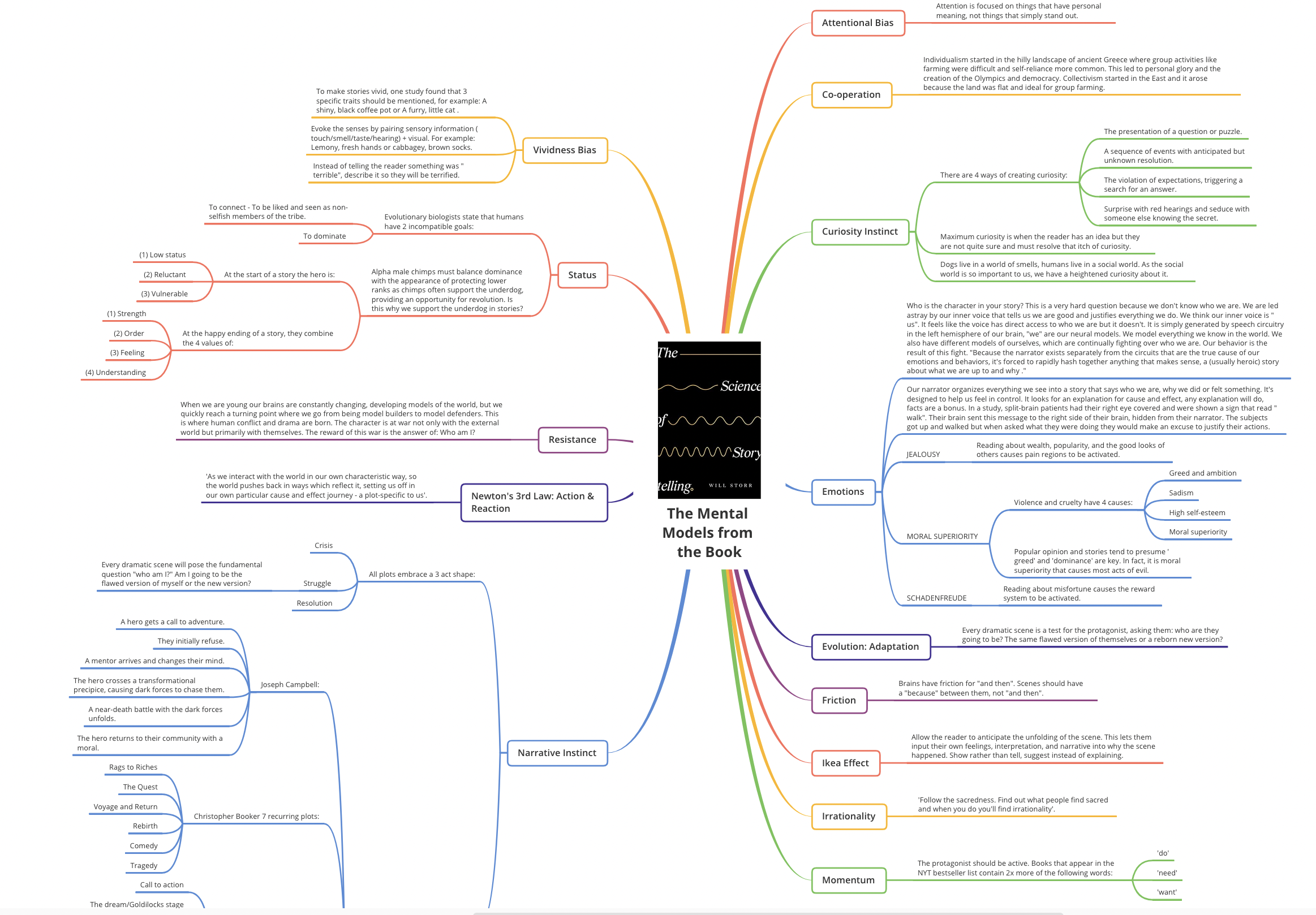
14 Mental Models from the book:
'The Science of StoryTelling' can be summarised into 14 mental models:
1. Attentional Bias
- Attention is focused on things that have personal meaning, not things that simply stand out.
2. Co-operation
- Individualism started in the hilly landscape of ancient Greece where group activities like farming were difficult and self-reliance more common. This led to personal glory and the creation of the Olympics and democracy. Collectivism started in the East and it arose because the land was flat and ideal for group farming.
3. Curiosity Instinct
- There are 4 ways of creating curiosity:
- The presentation of a question or puzzle.
- A sequence of events with anticipated but unknown resolution.
- The violation of expectations, triggering a search for an answer.
- Surprise with red hearings and seduce with someone else knowing the secret. - Maximum curiosity is when the reader has an idea but they are not quite sure and must resolve that itch of curiosity. - Dogs live in a world of smells, humans live in a social world. As the social world is so important to us, we have a heightened curiosity about it.
4. Emotions
- Who is the character in your story? This is a very hard question because we don't know who we are. We are led astray by our inner voice that tells us we are good and justifies everything we do. We think our inner voice is "us". It feels like the voice has direct access to who we are but it doesn't. It is simply generated by speech circuitry in the left hemisphere of our brain, "we" are our neural models. We model everything we know in the world. We also have different models of ourselves, which are continually fighting over who we are. Our behavior is the result of this fight. "Because the narrator exists separately from the circuits that are the true cause of our emotions and behaviors, it's forced to rapidly hash together anything that makes sense, a (usually heroic) story about what we are up to and why ."
- Our narrator organizes everything we see into a story that says who we are, why we did or felt something. It's designed to help us feel in control. It looks for an explanation for cause and effect, any explanation will do, facts are a bonus. In a study, split-brain patients had their right eye covered and were shown a sign that read "walk". Their brain sent this message to the right side of their brain, hidden from their narrator. The subjects got up and walked but when asked what they were doing they would make an excuse to justify their actions.
4.1 - Emotions: Jealousy
- Reading about wealth, popularity, and the good looks of others causes pain regions to be activated.
4.2 - Emotions: Moral Superiority
- Violence and cruelty have 4 causes:
- Greed and ambition
- Sadism
- High self-esteem
- Moral superiority - Popular opinion and stories tend to presume 'greed' and 'dominance' are key. In fact, it is moral superiority that causes most acts of evil.
4.3 - Emotions: Schadenfreude
- Reading about misfortune causes the reward system to be activated.
5. Evolution: Adaptation
- Every dramatic scene is a test for the protagonist, asking them: who are they going to be? The same flawed version of themselves or a reborn new version?
6. Friction
- Brains have friction for "and then". Scenes should have a "because" between them, not "and then".
7. Ikea Effect
- Allow the reader to anticipate the unfolding of the scene. This lets them input their own feelings, interpretation, and narrative into why the scene happened. Show rather than tell, suggest instead of explaining.
8. Irrationality
- 'Follow the sacredness. Find out what people find sacred and when you do you'll find irrationality'.
9. Momentum
- The protagonist should be active. Books that appear in the NYT bestseller list contain 2x more of the following words:
- 'do'
- 'need'
- 'want'
10. Narrative Instinct
- All plots embrace a 3 act shape:
- Crisis
- Struggle - Every dramatic scene will pose the fundamental question "who am I?" Am I going to be the flawed version of myself or the new version?
- Resolution
Some of the best examples include:
- Joseph Campbell:
- A hero gets a call to adventure.
- They initially refuse.
- A mentor arrives and changes their mind.
- The hero crosses a transformational precipice, causing dark forces to chase them.
- A near-death battle with the dark forces unfolds.
-
The hero returns to their community with a moral. - Christopher Booker 7 recurring plots:
-
Rags to Riches
- The Quest
- Voyage and Return
- Rebirth
- Comedy
-
Tragedy - Each with a 5 stage structure:
-
Call to action
- The dream/Goldilocks stage
- Frustration
- Conflict
-
Resolution - Pixar
-
The protagonist, living a settled life, has a goal.
- A challenge appears.
- Resulting in a cause-and-effect sequence of events.
- The story builds to a climax.
- Good wins over evil.
- The moral of the story is revealed. - Jung
The protagonist will be out of balance, either too strong or weak in:
- Strength/order (masculine)
- Feeling/understanding (feminine)
The story concludes with the hero achieving the perfect balance of the 4 traits.
11. Newton's 3rd Law: Action & Reaction
- 'As we interact with the world in our own characteristic way, so the world pushes back in ways which reflect it, setting us off in our own particular cause and effect journey - a plot-specific to us'.
12. Resistance
- When we are young our brains are constantly changing, developing models of the world, but we quickly reach a turning point where we go from being model builders to model defenders. This is where human conflict and drama are born. The character is at war not only with the external world but primarily with themselves. The reward of this war is the answer of: Who am I?
13. Status
- Evolutionary biologists state that humans have 2 incompatible goals:
- To connect - To be liked and seen as non-selfish members of the tribe.
- To dominate - Alpha male chimps must balance dominance with the appearance of protecting lower ranks as chimps often support the underdog, providing an opportunity for revolution. Is this why we support the underdog in stories? At the start of a story the hero is: (1) low status (2) reluctant (3) vulnerable. At the happy ending of a story, they combine the 4 values of (1) strength (2) order (3) feeling (4) understanding.
14. Vividness Bias
- To make stories vivid, one study found that 3 specific traits should be mentioned, for example: A shiny, black coffee pot or A furry, little cat .
- Evoke the senses by pairing sensory information (touch/smell/taste/hearing) + visual. For example: Lemony, fresh hands or cabbagey, brown socks.
- Instead of telling the reader something was "terrible", describe it so they will be terrified.
Mental Model Mind Maps:
Mind maps can help you to remember the most important parts of a book. Signup to my newsletter below to get a free mindmap of this book: