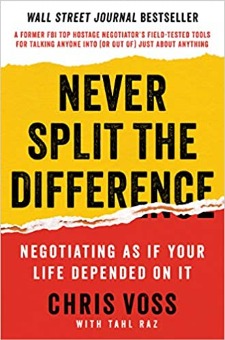
'Never Split the Difference' - 80/20 Summary
Follow me on X: @DaviddeSouza
- Score: 10/10
- Category: Negotiation
- Mental Models: Anchoring, Denial, Emotions: Calm, Fear, Ikea Effect,Inertia/Status Quo Bias,Liking, Language Instinct, Newton's 3rd Law: Action & Reaction, Leverage, Loss Aversion, , Randomness, Reciprocity, ScarcityStress, System 1 vs System 2, Tendency to Want to Do Something, The Map is Not the Territory, Velocity
18 Mental Models from the Book
1. Anchoring
- Anchor Their Emotions: If you can anchor a person's emotions so that they expect a loss, they will be motivated to avoid it. For example say: "I have got a lousy proposition for you...you're going to think I'm a lousy businessman. You're going to think I can't budget or plan."
- Let the Other Person Anchor Monetary Negotiations: Prepare yourself to avoid being anchored by a low number. Avoid saying "No" to spare their pride, instead respond with: "How am I supposed to do that?"
- Provide a Range: Columbia Business school found that people who gave a range were offered a much higher salary. Use a "bolstering range" where the low number is the amount that you want.
- Anchor with an extreme offer. Use a number that doesn't feel like it has been plucked out of the air. An odd number like $39,543 looks like it is the result of a thoughtful calculation. Then surprise them with an unrelated gift.
- When starting negotiations, begin with a high anchor by alluding to a high price that someone else might charge: "If you go to abc they will charge you $2000 a day"
- Deflect their extreme anchor offer by saying "no" in a variety of ways: (1) How am I supposed to do that? (2) What are you trying to accomplish here?
2. Denial
-
You can get your counterpart to bid against themselves by saying "No" 4 times without actually saying the word:
- How am I supposed to do that?
- Say something along the lines of: "Your offer is very generous, I'm sorry, that just doesn't work for me."
- "I'm sorry, I'm afraid I just can't do that (at that price)"
- No, said with a downward inflection.
3. Emotions
- Great negotiators don't try and ignore or deny emotions, they identify them and influence them. "Emotions aren't the obstacles, they are the means."
- Identify with how the person feels and give those feelings a name: "It all seems so unfair, I can now see why you sound so angry"
-
Listening is the cheapest concession we can give in a negotiation. When people feel like they are being listened to they:
- Listen to themselves more carefully and clarify their own thoughts, allowing you to learn more about what they are thinking and their goals.
- They become less defensive.
- They are more willing to listen to other points of view.
- They become calmer and more logical.
-
When you've noticed an emotion, label it with one of the following:
- It sounds like
- It seems like
- It looks like
- Do not say: "I hear...." because hearing "I" can cause people to become defensive. It also indirectly shows that you are focusing on yourself and it causes you to take responsibility for the words that follow.
3.1 - Emotions: Calm
-
The calming process:
- Get them feeling safe and at ease...
- So that they talk...
- So you can find out what they need:
- Which could be....money, emotional support, or something else...
-
Softening Words to Calm
- Perhaps
- Maybe
- I think
- It seems
- Start with: How, What...and avoid Why
-
Softening phrases to calm:
- What about this is important to you?
- How can I help make this better for you?
- How would you like us to move forward with this?
- How can we solve this issue?
- What's your objective?
- How am I supposed to do that?
3.2 - Emotions: Fear
- People fear conflict, and so arguments, that are potentially useful, are avoided for fear they may escalate. If you want to be a great negotiator, manager or spouse you need to get over your fear of conflict.
- When people are shown images of faces with strong emotions, there is a 'fear' reaction in the amygdala. When people are asked to label the emotion, the rational part of the brain is activated, and fear decreases.
4. Ikea Effect
- "How" questions engage with the person because they ask for help/advice. The other person thinks the solution is their idea.
- Open-Ended Questions allow you to suggest ideas without sounding pushy. Compare: "You can't leave" with "What do you hope to gain by leaving?"
5. Inertia/Status Quo Bias
- Often "No" doesn't mean "No", it is often used as a means to protect the person and to maintain the status quo.
6. Language Instinct
-
The most powerful tool in verbal communication is your voice. There are 3 voice tones that a negotiator has:
- Late-night FM DJ voice: Inflecting your voice in a downward manner. Talk slowly, talk clearly. This style of talking shows that you have things under control.
- The positive playful voice: This is the voice you should be using most of the time. You should have a light and encouraging attitude. Relax and smile while talking in this voice as the person will pick up on it.
- The direct or assertive voice.
7. Liking
- Change can only happen when we accept people as they are, this is known as unconditional positive regard.
- When planning a negotiation strategy people focus their time and effort on what to say.
- The easiest and most effective thing to focus on is your demeanor.
- Use an apology, use the person's name: "I am sorry David, how am I meant to do that?"
8. Leverage
- Be careful with using too much leverage as people who feel like their autonomy is being taken away will act illogically.
9. Loss Aversion
- Use loss aversion to avoid having your emails ignored. Ask: "Have you given up on this project". This gives the person a feeling of safety and the illusion of control and it encourages them to explain their position to you.
10. Newton's 3rd Law: Action & Reaction
- Mirroring gives you the ability to disagree without being disagreeable. The FBI uses a simple technique to mirror in negotiations, they repeat the last 3 words of what the person has said.
- Mirroring should give the impression that you are trying to understand the other person.
-
After someone says "No" pause and ask one of the following questions:
- What about this doesn't work for you?
- What would you need to make it work?
- It seems like there is something here that bothers you?
- The key to getting people to see things your way is not to confront them on their ideas ("You can't leave") but to acknowledge their ideas openly ("I understand why you're pissed off") and then guide them toward solving the problem (What do you hope to accomplish by leaving?)
11. Randomness
- Use non-round numbers such as $48,945 so as to give the number credibility and weight.
- Ask your counterpart for a pen and do some fake calculations to make it look like
- you are finding every last dollar. On your final offer throw in a nonmonetary item, which will give the impression that you are at your limit.
12. Reciprocity
- Studies have shown that people who get concessions feel better about the bargaining process than those who are given a simple "fair" offer. They feel better even when they pay more!
13. Scarcity
- Never be needy. If you can't walk away you've been taken hostage.
- Deadlines make people do impulsive things that are against their own interests. Good negotiators resist the effect that deadlines have on their psychology and take advantage of it in others.
-
When you tell your counterpart about a deadline you will get a better deal. Hiding a deadline is not a good idea as it will:
- Increase the risk of an impasse and
- Cause you to increase your concessions as the deadline approaches.
14. Stress
- When negotiating, start by considering your counterpart's most basic human needs of feeling safe and feeling in control.
15. System 1 vs System 2
- "If you know how to affect your counterpart's system 1 thinking, by how you frame and deliver your questions and statements, then you can guide his system 2 rationality and therefore modify his responses."
- By asking: "How am I supposed to do that?" You influence your counterpart's emotional system 1 mind into thinking that their offer isn't good enough. As a result, his system 2 mind uses logic to rationalize to give a better deal.
16. Tendency to Want to Do Something
- When you go into a shop, instead of telling the salesperson what you need, describe what you are looking for and ask for their help, advice, and suggestions. When you have found an item, instead of offering a price, say: "It is a little more than I have budgeted" and ask for their help (with the price).
17. The Map is Not the Territory
- When things don't add up it is often because our frame of reference is wrong. The calculation will never work unless you break free from your expectations. Allow the known-knowns to guide you but not blind you. Having an enhanced awareness to any unknown unknowns can free your mind to see and hear things that can cause a huge breakthrough. Always ask yourself: "Why are they communicating what they are communicating right now?"
18. Velocity
- One of the biggest mistakes is going too fast. Research shows that time is one of the best tools for a negotiator.
Let me know how these summaries can be improved. Contact me via Email (david@thisdomain.co) or on Twitter.
Enjoyed this? Follow me on X: @DaviddeSouza