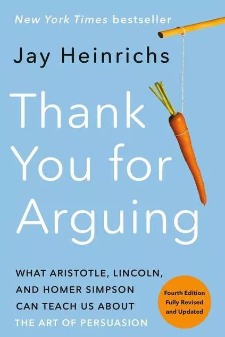
Thank You for Arguing - 80/20 Summary
- Amazon: Link
- Score: 10/10
- Skill Category: Persuasion
- Mental Models: Action & Reaction: Newton's 3rd Law, Activation Energy, Alloying, Association, Choice Architecture, Curiosity Instinct, Desire, Ego, Emotions: Anger, Calm, Shame, Feeback-Loops, Inversion, Language Instinct, Liking/Disliking, Mise-en-Place, Momentum, Reciprocity, Second-Order Thinking, Sensitivity to Fairness, Status, Trust, Utility, Velocity
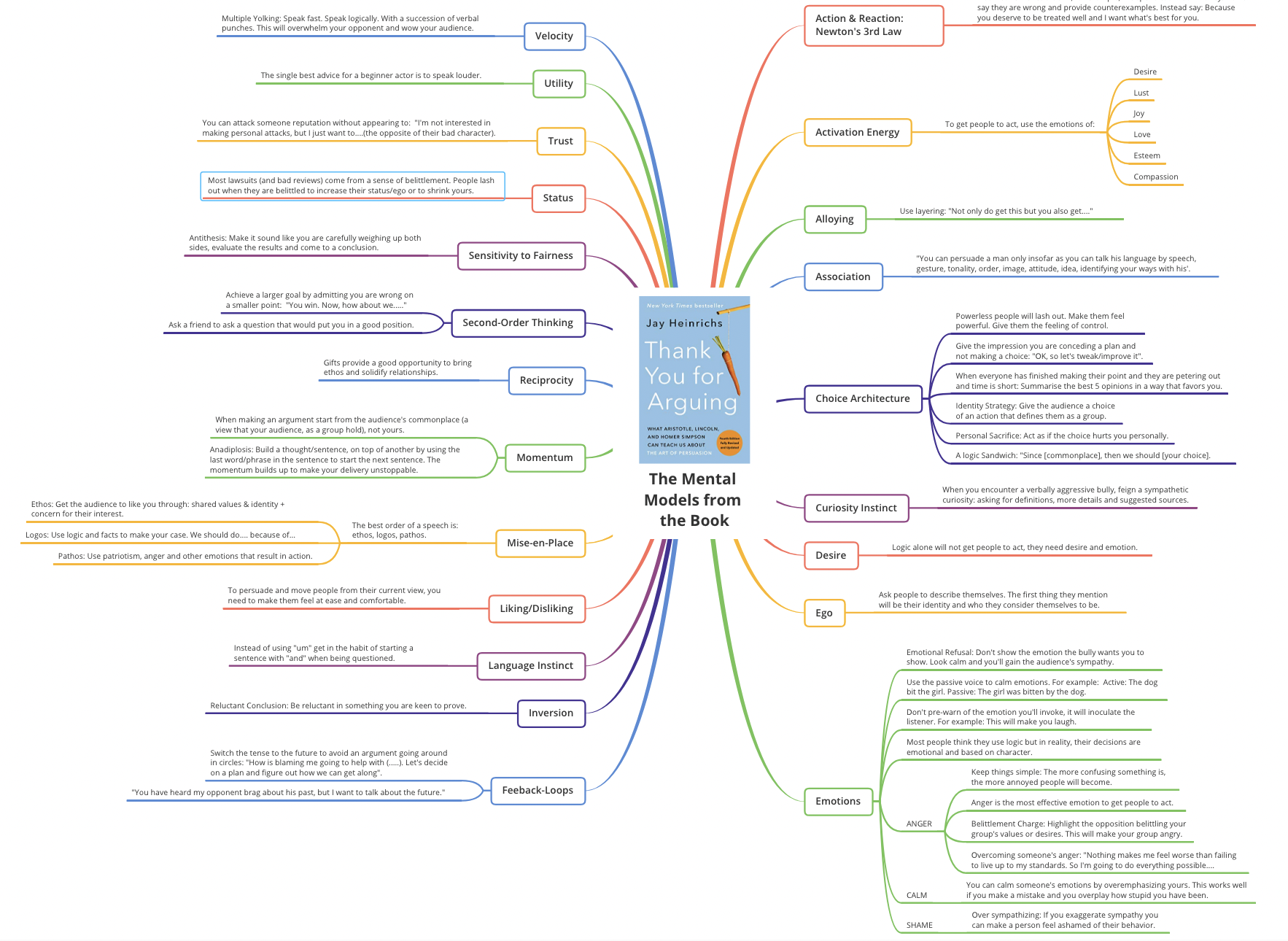
Mental Models from the book:
I have summarised 'Thank You for Arguing', distilling the book into 22 core principles:
1. Action & Reaction: Newton's 3rd Law
- If someone makes a claim, for example, We spend too much money. Don't say they are wrong and provide counterexamples. Instead say: Because you deserve to be treated well and I want what's best for you.
2. Activation Energy/Emotions
- To get people to act, use the emotions of:
- Desire
- Lust
- Joy
- Love
- Esteem
- Compassion
3. Alloying
- Use layering: "Not only do get this but you also get...."
4. Association
- "You can persuade a man only insofar as you can talk his language by speech, gesture, tonality, order, image, attitude, idea, identifying your ways with his'.
5. Choice Architecture
- Powerless people will lash out. Make them feel powerful. Give them the feeling of control.
- Give the impression you are conceding a plan and not making a choice: "OK, so let's tweak/improve it".
- When everyone has finished making their point and they are petering out and time is short: Summarise the best 5 opinions in a way that favors you.
- Identity Strategy: Give the audience a choice of an action that defines them as a group.
- Personal Sacrifice: Act as if the choice hurts you personally.
- A logic Sandwich: "Since [commonplace], then we should [your choice].
6. Curiosity Instinct
- When you encounter a verbally aggressive bully, feign a sympathetic curiosity: asking for definitions, more details and suggested sources.
7. Desire/Emotion
- Logic alone will not get people to act, they need desire and emotion.
8. Ego
- Ask people to describe themselves. The first thing they mention will be their identity and who they consider themselves to be.
9. Emotions
- Emotional Refusal: Don't show the emotion the bully wants you to show. Look calm and you'll gain the audience's sympathy.
- Use the passive voice to calm emotions. For example: Active: The dog bit the girl. Passive: The girl was bitten by the dog.
- Don't pre-warn of the emotion you'll invoke, it will inoculate the listener. For example: This will make you laugh.
- Most people think they use logic but in reality, their decisions are emotional and based on character.
9.1 Emotions: Anger
- Keep things simple: The more confusing something is, the more annoyed people will become.
- Anger is the most effective emotion to get people to act.
- Belittlement Charge: Highlight the opposition belittling your group's values or desires. This will make your group angry.
- Overcoming someone's anger: "Nothing makes me feel worse than failing to live up to my standards. So I'm going to do everything possible....
9.2 Emotions: Calm
- You can calm someone's emotions by overemphasizing yours. This works well if you make a mistake and you overplay how stupid you have been.
9.3 Emotions: Shame
- Over sympathizing: If you exaggerate sympathy you can make a person feel ashamed of their behavior.
10. Feeback-Loops
- Switch the tense to the future to avoid an argument going around in circles: "How is blaming me going to help with (.....). Let's decide on a plan and figure out how we can get along".
- "You have heard my opponent brag about his past, but I want to talk about the future."
11. Inversion
- Reluctant Conclusion: Be reluctant in something you are keen to prove.
12. Language Instinct
- Instead of using "um" get in the habit of starting a sentence with "and" when being questioned.
13. Liking/Disliking
- To persuade and move people from their current view, you need to make them feel at ease and comfortable.
14. Mise-en-Place
- The best order of a speech is: ethos, logos, pathos.
- Ethos: Get the audience to like you through: shared values & identity + concern for their interest.
- Logos: Use logic and facts to make your case. We should do.... because of...
- Pathos: Use patriotism, anger and other emotions that result in action.
15. Momentum
- When making an argument start from the audience's commonplace (a view that your audience, as a group hold), not yours.
- Anadiplosis: Build a thought/sentence, on top of another by using the last word/phrase in the sentence to start the next sentence. The momentum builds up to make your delivery unstoppable.
16. Reciprocity
- Gifts provide a good opportunity to bring ethos and solidify relationships.
17. Second-Order Thinking
- Achieve a larger goal by admitting you are wrong on a smaller point: "You win. Now, how about we....."
- Ask a friend to ask a question that would put you in a good position.
18. Sensitivity to Fairness
- Antithesis: Make it sound like you are carefully weighing up both sides, evaluate the results and come to a conclusion.
19. Status/Ego
- Most lawsuits (and bad reviews) come from a sense of belittlement. People lash out when they are belittled to increase their status/ego or to shrink yours.
20. Trust
- You can attack someone reputation without appearing to: "I'm not interested in making personal attacks, but I just want to....(the opposite of their bad character).
21. Utility
- The single best advice for a beginner actor is to speak louder.
22. Velocity
- Multiple Yolking: Speak fast. Speak logically. With a succession of verbal punches. This will overwhelm your opponent and wow your audience.
Mental Model Mind Maps
Mind maps can help you to remember the most important parts of a book. Signup to my newsletter below to get a free mindmap of this book: