45 Mental Models For Asking Better Questions
Follow me on X: @DaviddeSouza
School teaches us how to answer questions, but it fails to educate us on how to ask better questions.
Knowing the right question to ask will help you find the answers you are looking for but questions will also make you more likable, persuasive, and a better leader.
Questions help us to see things from a different perspective and in the words of Indira Gandhi “The power to question is the basis of all human progress.”
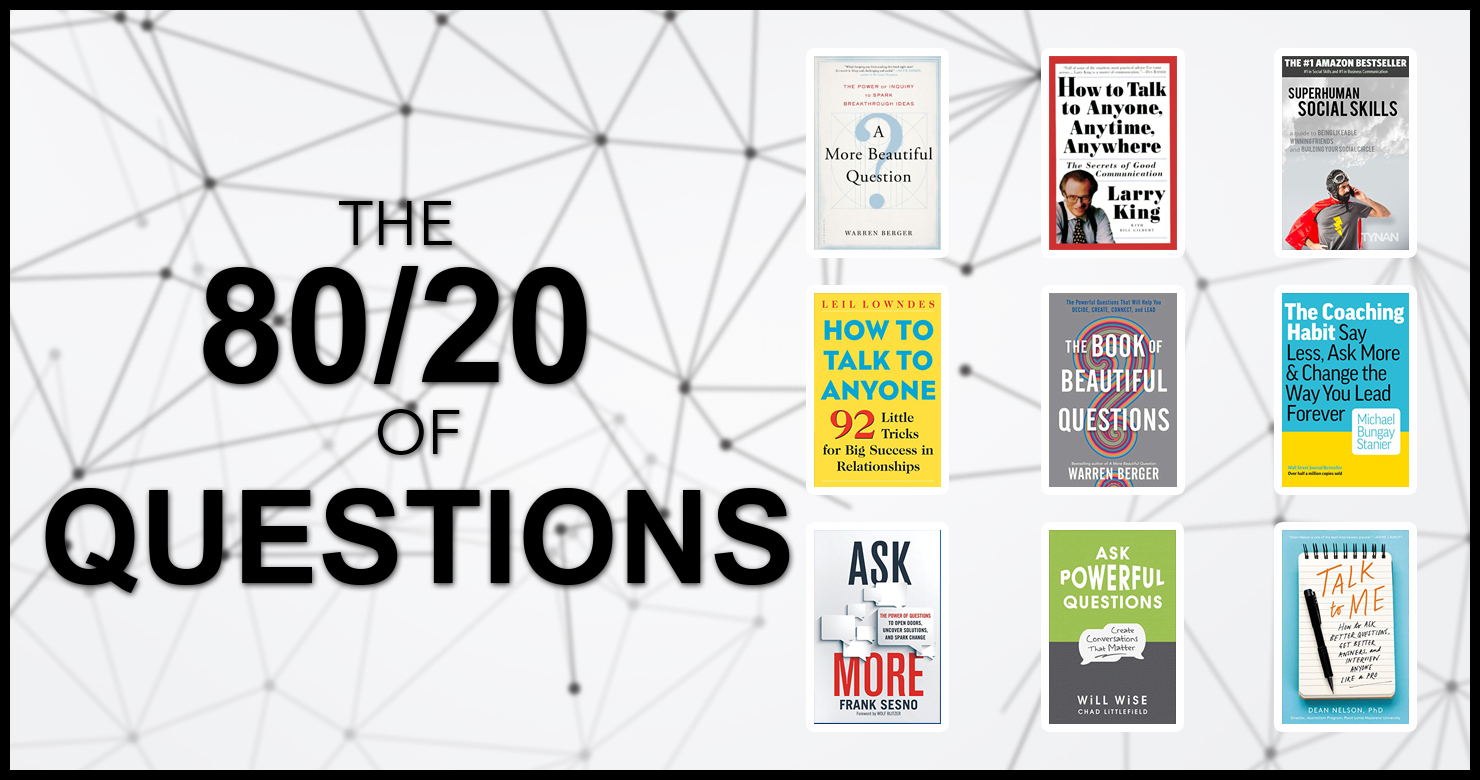
There aren't many books specifically on the subject of questioning but a number of other books on such subjects as interviewing and social skills include sections on questions also. Below is the list of books I used to create this guide:
The Books
- A More Beautiful Question
- Ask More
- How to Talk To Anyone
- The Book of Beautiful Questions
- Ask Powerful Questions
- Talk to Me
- Superhuman Social Skills
- How to Talk to Anyone, Anytime, Anywhere
- The Coaching Habit
I've studied these books and distilled the core principles from each. I've deleted any overlapping principles to produce the ultimate guide to the 80/20 of becoming a better questioner:
45 Mental Models for asking Better Questions
- Activation Energy
- Alloying
- Authority
- Availability Heuristic
- Comparative Advantage
- Commitment & Consistency Bias
- Co-operation
- Critical Mass
- Curiosity Instinct
- Desire
- Ego
- Emotions: Anger, Fear, Nervousness, Shame, Sympathy
- Equilibrium
- False Dichotomy
- Feedback Loops
- First Conclusion Bias
- First Principle Thinking
- Fundamental Attribution Error
- Ikea Effect
- Inversion
- Language Instinct
- Lateral Thinking
- Liking
- Margin of Safety
- Mise-en-Place
- Narrative Instinct
- Newton's 3rd Law: Action & Reaction
- Pareto Principle
- Randomness
- Reciprocity
- Relativity
- Resistance
- Scarcity
- Seizing the Middle
- Self-Preservation
- Status
- Stress
- Supply & Demand
- System 1 vs System 2 Thinking
- Tendency to Minimize Energy Output
- The Map is Not the Territory
- The Red Queen Effect
- Trust
- Utility
- Vividness Bias
1. Activation Energy
- To start a conversation, look for things such as furnishings, mementos or photographs to ask about.
-
The Kickstart Question: What's on your mind? After asking this question use the 3P framework to focus further:
- Projects: What projects are you working on & what challenges are you facing?
- People: Are there any issues with the people you are working with?
- Patterns: What patterns of life and behavior do you want to change?
-
'Legacy Questions' are also great questions to get started. Ask the person how they want to be remembered. This question will allow you to find out what is important to them.
- 'The Noah Adam Question Technique': How did you think it was going to work out before it happened? Follow up with: How did it really work out?
-
Other great questions to get started include:
- What first got you interested in.....
- If you were a contestant on Jeopardy, what would be your specialist subject?
- How would your life have been different if...
- What is your favorite unimportant thing to do?
- How would you like things to be different in your life?
-
'What if' Questions - Are a fail-safe way to start a conversation or to pick one up during a lull. E.g "What if COVID continues, do you think the stock market will take a hit"? or "What if you had just built your dream home and you were told that scientists had discovered a fault line, would you move?"
- Interest Gauging Questions - These questions help to determine if you will connect with the person. It will show if they follow current events and their level of interest in the subject. E.g: "Everybody seems to have an opinion on 'abc'. What's yours? or "I just heard 'xyz', do you think we are headed for....?
- The Awe Question: "And what else?
2. Alloying
- Making connections between unrelated questions, problems or ideas is the most effective way to innovate.
- To be creative you don't have to have a unique idea. You can simply combine two or more ideas that already exist. Take features from 2 objects to create something original, surprising or interesting. Think wider than just: "What if we combine A + B". Instead think about combining A + Z or A + 27.
3. Authority
- There is an inverse relationship between being an expert and being a good questioner.
-
Challenge the experts. They owe you an explanation as to what's going on. Ask them:
- How did they reach their conclusion?
- What was their process?
- What are your options?
- How would they feel if their mother was in the same position?
-
Project moral authority by evoking a statement from a respected 3rd party. This takes the attack from you as the questioner to someone with expertise, trust or moral authority.
4. Availability Heuristic
- You can use questions to prime and persuade someone. The more you think about something the more likely you are to engage in that behavior. For example: Asking someone if they are going to vote will increase the likelihood that they will vote by 25%
5. Commitment & Consistency Bias
- Jeff Bezos says 'if you have a conviction....even if there is no consensus say: "Look, I know we disagree on this but will you gamble with me on it? [can we disagree and commit?]
- Our brains have a preference for clarity and certainty.
6. Comparative Advantage
- A valuable question to ask yourself is: What does the world need most and that I am uniquely able to provide?
- Everyone has something interesting to say: Everybody is an expert at something. Ask yourself: What can I learn from them?
- We speak 18,000 words a day, so it makes sense to become the best speaker that we can be.
7. Co-operation
- Use "we" to empower and exhilarate people around you.
- When using reflective listening, end by saying: "Did I get that right?"
- To be empathetic describe how a person sees the world: "It sounds like you believe...."
8. Critical Mass
- Place any tough questions about 2/3rd of the way in the interview. You must have created enough rapport to allow the tough questions to be asked.
9. Curiosity Instinct
- Shift your perspective so that you are looking at the world as a curious child.
- Question those with whom you disagree in an open, curious way. Ask yourself: Why might they see the issue this way? Why do I see it differently? What assumptions are we each operating under?
- 'What if' questions: inspire creativity & spark the imagination.
- Be playful: Ask a person if they would be willing to play a game, for example: give them a name or a topic, and ask them to give you a 1-word answer.
- When you introduce someone, add some hooks (such as a hobby or something interesting the person has done).
- Everyone has a unique life story and experience. We all have something of value to share. Your goal is to find out what that thing is.
- To build rapport, ask questions about something you are curious about. For example: "I'm curious about your hat. How does the world respond to you, when you wear that hat?"
- "By employing the right kind of questions: open, curious, slightly provocative at times, but never judgmental, one could have a meaningful dialogue with people who are very different from you, culturally, politically, and temperamentally."
- When you forgo judging and use curiosity within your questions, people feel like you are saying "I hear you".
- "Out of curiosity" reduces the abruptness of a question and makes it easier on both you and the person answering.
-
Some of the best questions don't have question marks:
- Tell me more.
- Please explain that to me.
- Go on.
10. Desire
-
There are 9 universal needs. Translate what needs the person wants when they ask a question:
- Creation
- Recreation
- Affection
- Participation
- Identity
- Freedom
- Understanding
- Protection
- Subsistence
11. Ego
- Look for opportunities to allow people to talk about themselves and their life accomplishments.
- Play to people's ego: Tell them why interviewing them provides a unique perspective in understanding the big picture.
- When others talk, do you convert what you hear into a reference about you or a similar experience you had?
- When we sympathetically listen, we think we are listening, but we are really listening to how we feel. We are hearing our own story while they tell theirs.
-
"You" is a powerful word and has many benefits including:
- It is cognitively easier for a person to process as they do not need to translate it from your perspective into theirs. They do not need to translate "Can I take Monday off" into "Can I do without this employee on Monday?
- Including "you" in a sentence triggers a person's pride response.
- Adding "you" to a compliment will amplify it. "I like your suit" doesn't sound as good as "I think you look good in that suit".
-
Use "You" to persuade:
- Instead of saying: "It is important that...." persuade them by saying: "You'll see the importance of
- Instead of saying: "The results will be..." tell them: "You'll see the results when you....."
- Instead of saying: "I can't find the train station' ask them: "Do you know the way to the train station?"
12. Emotions
- 'There is a difference between asking a question that provides heat for heat's sake and one that provides heat for light's sake.'
- When there is tension in a conversation, leave the content (what is being talked about) and pivot to a place of process (how it is being talked about). For example: "Wait a moment. Let's leave this topic for a moment and talk about what got us so worked up".
12.1 Emotions: Anger
- People who are angry, don't usually find others who listen. A person who affirms, acknowledges and listens can provide a welcome solace.
12.2 Emotions: Fear
- We are happier when we make bolder choices. Steven Levitt conducted a study using people who were in the process of making a difficult decision. These people agreed to use a coin flip to decide if they would go ahead with their decision, if it landed heads they would say "yes". 6 months later he found that the "yes/heads" people were significantly happier than the "no/tails" people. When left to our devices we are too risk-averse and say no too often.
- To overcome our risk aversion tendency: (instead of using a coin) use a weighted question: If I am usually better off saying yes to bold opportunities, why wouldn't I say yes to this one?
-
The 2 most common fears for connecting with people are:
- Fear of being rejected
- Fear of looking stupid
12.3 Emotions: Nervousness
- Tell your audience that you are nervous if you are nervous. This will reduce your nerves and make you more relaxed and help you to connect with the audience.
12.4 Emotions: Shame
- Play to shame when a person does not respond to logic, self-interest, altruism and pleas to help you. For example, tell them that not talking to you is a breach of public trust or responsibility.
12.5 Emotions: Sympathy
-
Play to people's sympathies to get an interview. For example:
- "Don't you remember what it was like getting started in your career?" I could really use your help"
- "I have a father that I love. I know that if something like this happened to them, I would want the world to know how wonderful they were".
13. Equilibrium
- The best questions are open-ended ones but don't ask an open-ended question that is too open-ended, resulting in meaningless answers. Asking someone "What was it like to live in the Arctic" will provide a vague answer of "cold". To get a better answer, ask: "How did you get food?" "How did people go on dates?"
- "What do you make of...." It can't be too broad of a question, for example: What do you make of climate change? It needs to be narrower: What do you think of people who don't believe in climate change?
- Crossing the Line: In social situations, we are walking a line between what's polite and what's too intimate. Most people are too conservative and err on the side of caution. Friendships strengthen through disclosures of intimacy. Test the line with small steps.
14. False Dichotomy
- In 71% of decisions, the choices are binary, yes or no. Having 1 extra option (doing something else), reduced failures by 30%.
15. Feedback Loops
- When you get a long Email, reply with either: (1) There's a lot going on here. What's the real challenge for you, do you think?" or (2) Before I jump into a longer reply, let me ask you: What's the real challenge for you?
-
You need to know what triggers your habits. If you don't know you'll continue doing what you've always done. There are 5 possible habit triggers:
- Location
- Time
- Emotional State
- Other people
- The action preceding the habit.
16. First Conclusion Bias
- Scientific studies do not support the idea of following your gut instincts. You will be wrong more than you are right.
- 'Just as the first glimpse should please their eyes, your first utterance should delight their ears'.
- Convey as quickly as possible what makes you interesting and worth being friends with.
- Asking: "And what else?"... encourages people to think more and go beyond the obvious answers and conclusions.
17. First Principle Thinking
- "In all affairs, it's a healthy thing now and then to hang a question mark on the things you take for granted. - Bertrand Russell
- Open questions encourage creative thinking, for example: What If?/Why?/How?
- The greatest question ever is: "Why?"
- 'Why' questions are: Probing, penetrative, and cut through assumptions.
- Questionstorming encourages thinking of questions instead of ideas. During a questionstorming session, the group is asked to think of 50 questions about a specific problem. "How might we....." is the best way to structure questionstorming questions.
18. Fundamental Attribution Error
- Every conservative has a liberal exception (and vice versa). Ask a person what their exception is.
19. Ikea Effect
- Instead of asking someone a question, let them create their own question. The result is that the question becomes their question and they will take ownership of it.
- Peter Drucker said that his greatest strength was "to be ignorant and ask a few questions". People often expected him to come up with great solutions, but he told clients: "The answers need to be yours."
20. Inversion
- Force your brain from its natural way of thinking by purposely thinking wrong. Think of ideas that don't make any sense and mix things that don't go together. "When you force yourself to confront contrary thoughts, you jiggle the synapses in the brain".
- One of the most important questions you should ask is: What should we stop doing?
- To become more open be aware of what triggers you to become closed.
- "But" has the effect of negating anything that was said before it. Use "and" instead of but".
21. Language Instinct
-
To become a better listener ask:
- "Just to make sure I am understanding, are you saying...."
- "Can I try and explain what I think your position is- and then you can do the same for me? Because until we can accurately present one another's arguments, we do not know what the other is saying"
- Repeat back a few words that the person has said in the form of a question.
22. Lateral Thinking
- The best conversationalists look at things from a new or unique angle, taking an unusual perspective on a common subject.
23. Liking
- 'Your name is the least interesting thing about who you are, and yet it's disproportionately flattering when someone remembers it.' It is easy to forget someone's name when they first introduce themselves. Ask again a few minutes later, it will help you to remember and the person will be flattered.
- If you ask more questions you become more likable.
- People remember how you make them feel not what you say.
- When you act as if you like someone you start to really like them.
- The way to get someone to like you is to show them that you like them.
- People want to be heard and understood and it provides deep value to them when they are.
- Compliments are a form of judging and can therefore be problematic. Don't say: "I like your tattoo say "You must get comments about your tattoo all the time."
24. Margin of Safety
- When you improvise 'go with the rip current for a while, but never lose sight of the shore'. Write your questions down but don't be too rigid. Be ready to answer a follow-up question based on the response.
25. Mise-En-Place
-
Preparation will do 2 things:
- Put the person at ease because they know they are in safe hands
- Make them more likely to tell the truth.
-
Prepare someone for a tough question by saying:
- "I want to ask you about something which is interesting but which is perhaps painful to you..."
- "I am sorry if this seems offensive..."
-
It is guaranteed that someone will ask you: "Where are you from?" or "What do you do?". Prepare your response; add some hooks or a story to give the person something to work with.
-
When public speaking use this structure:
- Tell the audience what you are going to tell them.
- Tell them.
- Summarize what you've told them
26. Narrative Instinct
- Open-ended questions are a springboard for opinions and stories.
- 'How' questions trigger explanations, background and stories.
- The Journalist Mindset - Before going to a gathering tell yourself: I am going to go to this event as a journalist, looking for stories about the people I meet.
- We are too short-termist in our thinking. To overcome this ask yourself: Which decision will make for a better story in 5 years?
-
The structure of an interview should be similar to that of a story arc:
- Interesting beginning
- Rising and falling
- Crisis point
- Resolution/conclusion
27. Newton's 3rd Law: Action & Reaction
- Ask without comment or judgment and then allow the silence to linger. This allows the person to reflect and answer more deeply.
- Listen for the subtle words, references, or phrases that people mention, it is likely they want to talk about those things.
- Ask Don't Sell - People put up their defenses when they think you are trying to sell them something. When you ask questions you build a relationship.
28. Pareto Principle
- You only need to know 50 words to have a respected vocabulary. Look up common words that you often use and find a more captivating word to use instead.
-
The way you look and the way you move will impact 80% of a person's first impression of you. Have:
- Good posture
- A confident smile
- A direct gaze
- Eye contact
- Good voice
- Good delivery
29. Randomness
- Juxtaposition questions are based on the game "would you rather..." where you think of 2 unrelated topics. Follow-up by asking: How are they similar/different?
30. Reciprocity
-
Managing over talkers by:
- Stopping them: "Can I pause you there".
- Complimenting them genuinely: Thank you for sharing"
- Reflecting on what you heard: "I heard you say..."
- Inviting others to respond: "Let's see how others respond to what you just said".
31. Relativity
- Put people at ease by showing them you are similar and that you think they are OK.
32. Resistance
- You are more likely to be challenged or ignored when you approach people with answers. When you come with a question, people can not resist advising or helping you.
- Be respectful, charismatic yet forceful and skeptical when asking questions. For example: Mr. President. You seem so sincere in your quest for peace. Why don't you do something to demonstrate that to Israel? Perhaps you could open some direct human contact with Israel. Why not allow an exchange of journalists, or athletes or scholars?"
- If you ask: "How was your weekend?" it takes people to the past, somewhere they are not. This creates unconscious resistance.
- Open-ended questions usually start with: How/What/Why. Be careful with 'Why' questions, they can often produce defensiveness and scripted responses. Reframe 'why' questions into 'what' questions.
33. Scarcity
- Don't Use the Front Door, Use the Side Door: Everyone uses the front door so there will be a line and it will be busy. Look for side doors for meeting interesting people (but also for life in general).
- Become unafraid of silence. It is a trait of successful people.
34. Seizing the Middle
A good question is one that resonates with everyone, one that can cut through generations, education, and sociological and economic lines.
35. Self-Preservation
-
There are 4 variables that determine how your brain responds to a situation, whether it is safe or a threat:
- Tribe: Your brain is asking: Is this person part of my tribe?
- Expectations: Do I know what is going to happen (in the future?)
- Rank: Your brain is asking: Is this person more important than me?
- Autonomy: Your brain is asking: Do I have a choice in this situation?
36. Status
- Involve everyone. Increase engagement and make people feel important by asking: "David, you always have an interesting perspective, what do you think?"
-
Show status by:
- Making eye contact.
- Taking up a lot of body space.
- Speaking with clarity.
- Speaking loudly.
37. Stress
- Start by asking safe questions. When the person seems relaxed, ask the deeper, more probing questions.
- Ask people questions that you (and they) already know the answer to. Get into a comfortable dialogue so that they feel at ease and then take the questioning somewhere that they had not anticipated.
- Ask people about what shaped them and what adversities they faced.
38. Supply and Demand
- Notice when people do not ask clarifying questions.
- Incorporate as many hooks into your stories and descriptions as possible, allowing the audience to bite on one (or more).
- Notice when people ask you to continue telling your story, this is a good indication that it is interesting. Do the same for other people. Allow them to tell even a boring story because by doing so you are letting them enjoy themselves and you are learning about them. They will feel good if you ask them to carry on telling the story if the conversation got distracted.
39. System 1 vs System 2 Thinking
- System 1 questions are easy for people to answer, they do not require much thinking. System 2 involves thinking and can make people defensive.
40. Tendency to Minimize Energy Output
- Our brain finds ways to reduce our mental workload and one way it does that is to accept without questioning.
- Daniel Kahneman found that "people who face a difficult question, often answer an easier one instead."
41. The Map is Not the Territory
- Self-help books try to provide answers to meaning and happiness but these answers are one-size-fits-all. To find our meaning we must learn to ask the right questions to find our answers.
- You improve your questioning by going out into the real world and listening and observing.
42. The Red Queen Effect
- Instead of having a mission statement, companies (and people) should think about having a 'mission question'. "It tells the outside world, "This is what we're striving for - we know we're not there yet, but we're on the journey." It acknowledges room for possibility, change and adaptability. A company that is arrogant and claims to have figured things out doesn't sound as impressive as one that is striving to answer an ambitious question.
43. Trust
- The most important thing in conversation is to put the person at ease.
- The more you show genuine curiosity, the more people will open up and trust you.
- Combine being persistent in asking a question with discretion, asking in a way that makes the person feel at ease.
- By being pleasantly disagreeable, it shows that you are a safe person to be around. For example: "I've always thought the opposite, but that's fascinating".
- Disclose something personal, such as a struggle or something embarrassing to form deeper connections with people.
- Teasing can be used to bring you closer, and it gives permission to the person to tease you also.
44. Utility
- Be a net positive in social situations. Being neutral is often a negative, as you are taking up space.
-
Don't ask questions that aim to impress, ask a question that:
- Informs
- Entertains
- Engages
45. Vividness Bias
- Wear something different or remarkable to make it easier for people to start a conversation with you.
Enjoyed this? Follow me on X: @DaviddeSouza