33 Mental Models for Copywriting
Don't fool yourself. Copywriting isn't just for advertising professionals. Writing effectively and persuasively is a multidisciplinary skill that impacts many areas of your life including your career, business, and relationships.
Copywriting is a skill that will stand the test of time. It has been used for over 5,000 years, since humans started writing on clay and it will continue to be useful until the day we stop writing.
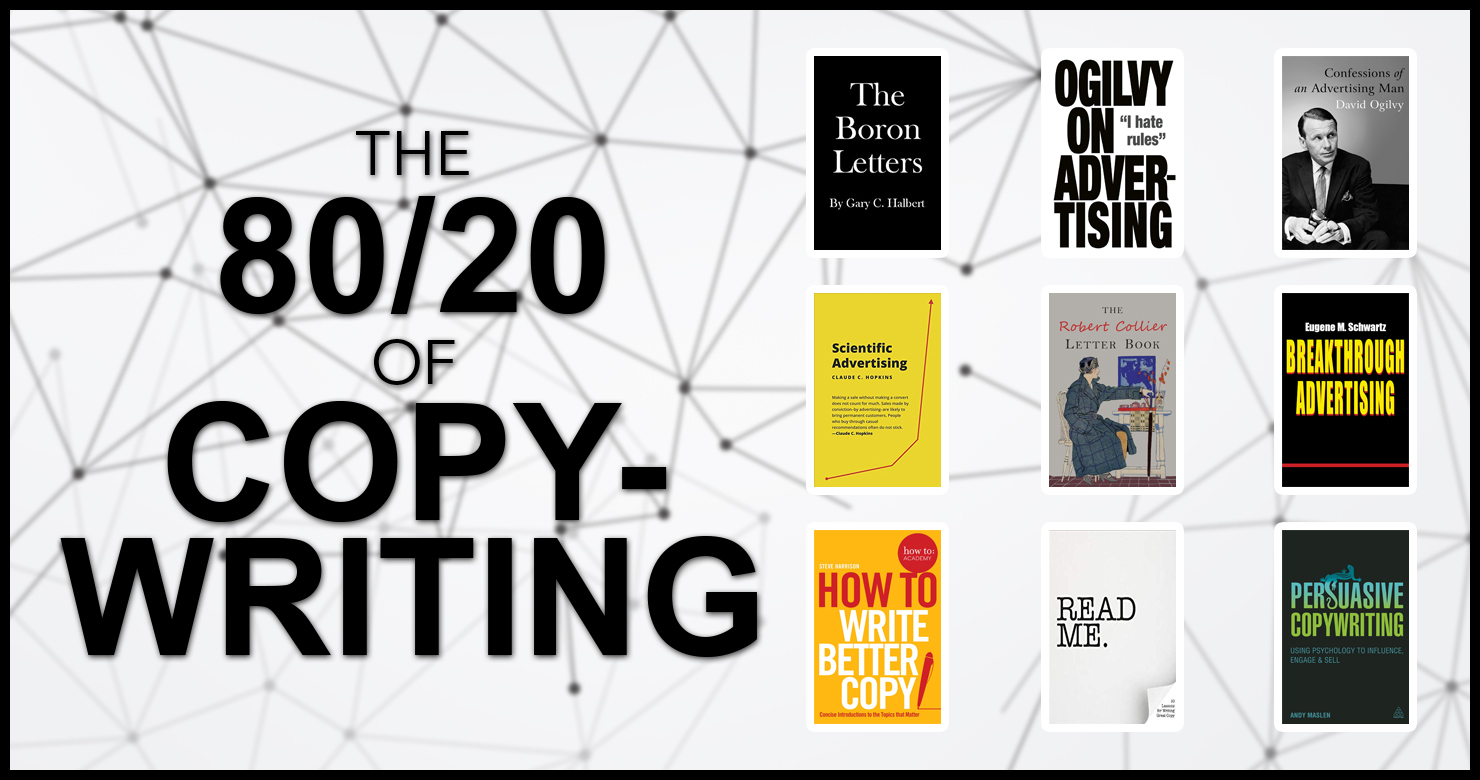
There are thousands of books devoted to copywriting but you only need to read a few to learn the core principles. I've asked the best copywriters to recommend the most valuable books on the subject:
The Books:
- Scientific Advertising
- Boron Letters
- Ogilvy on Advertising
- Confessions of an Advertising Man
- Breakthrough Advertising
- The Robert Collier Letter Book
- Persuasive Copywriting: Using Psychology to Influence, Engage and Sell
- Read Me
- How to Write Better Copy
- The Copy Book
- On Writing Well
I've studied these books and distilled the mental models. I've deleted any overlapping principles to produce the 33 mental models for copywriting:
The 33 Mental models for Copywriting:
- Algorithms
- Association
- Attentional Bias
- Authority
- Catalysts
- Commitment & Consistency Bias
- Co-operation
- Curiosity Instinct
- Desire
- Ego
- Emotions: Empathy, Humor, Fear, Surprise
- Equilibrium
- Evolution: Adaptation
- First Conclusion Bias
- Friction
- Incentives
- Language Instinct
- Mise-en-Place
- Momentum
- Narrative Instinct
- Novelty Bias
- Replication
- Resistance
- Scarcity
- Second-Order Thinking
- Specialization
- Status
- Supply & Demand
- System 1 vs System 2 Thinking
- The Ikea Effect
- Trust
- Velocity
- Vividness Bias
1. Algorithms
- After centuries of use and conditioning, these words, regardless of their truth, carry weight and should be woven into your writing:
- It's as simple as...
- Here's why...
- And, most important of all is the fact that...
- Therefore...
- There is a basic underlying reason for this...
- They discovered in case after case that....
- This has been proven in thousands of studies
2. Association
- Find a concept that connects with people, for example, a childhood game.
- Use "bricks she can handle". Words and mental images that are common and familiar.
- Using the word "and+most important" as a joining phrase which implies the sentence after is similar to the one before.
3. Attentional Bias
- 5 x times more people read the headline vs the copy.
- Your st/age in the market determines your headline.
- The only job of your headline is to stop your customer and to compel her to read the second line.
- Use the following features in headlines: Promises/ News/ Long/ Specifics/ information/ flag/ quotes
- Use captions under photos.
4. Authority
- Use "experts have discovered" which continues the acceptance momentum.
5. Catalysts
- The last word of a sentence stays in the reader's ear and gives the sentence punch.
6. Commitment & Consistency Bias
- The Rule of Belief: "If you violate your prospect's established beliefs in the slightest degree nothing you promise him, no matter how appealing, can save your ad."
- Ask a prospect: "Will you do me a favor and try our product and give you their opinion."
- Be a rebel with sufficient independence of mind to express your private opinion and not the party line.
7. Co-operation
- Committees can criticize ads but don't allow them to write them.
- Use language that encourages readers to join the tribe by aligning themselves.
8. Curiosity Instinct
- Curiosity is one of the strongest human incentives.
- Write headlines that make you think: "Bloody Hell, that's interesting, tell me more.
- Reveal a secret (or a lie) in headlines.
- Ask questions and answer them yourself in your writing.
- The reader's imagination is important - Spell it out and you ruin the spell.
- Use juxtaposition. The reader must use their intelligence to reconcile and gets a 'smile in the mind'.
- The most effective method is 'The 1,2,3,4': This [x] is probably not like anything you've ever tried because: 1/2/3/4 reasons.
9. Desire
- The basic motivations of people never change. Use them for great advertising. Human history boils down to the influence of:
- Love
- Hate
- Sex
- Greed
- Hunger
- Insecurity - "People don't change: only the direction of their desires do." - Make a promise that is: (1) Commanding (2) Specific (3) Desirable. For example: Earn your annual salary by working 4 hours a week. - Their beliefs may be shallow or profound, valid or false, logical or wishful thinking. It is not your job to argue with them.
10. Ego
- Both flattery (and greed) are one of the most powerful motivators. Use them at the start of your copy.
- The best headline would be one written about literally me! The more you can make the ad personally relevant the better.
- The most powerful short word is 'you'.
- Make sure that "you" appears 3 times more than "I" or "we".
- "Our job is not to make people think what a great ad, it's to make them think what a great product".
11. Emotions
- The job of the copywriter is not to create desire but to channel and direct it by taking hopes, dreams, fears and desires.
- Find your reader's pain point and you've found your way into their emotions.
- Find the primal motive that your product appeals to and direct your copy there "Appeal to emotion and follow up with a swift shift to intellect".
- Emotions cause buying vs information (that causes analysis). You want your reader to act.
- We make a snap emotional decision to buy a product. We then look for information to rationalize our decisions.
- Use your life to bring your copy alive. If something has moved you, chances are that it will move someone else.
11.1 Emotions: Empathy
- Use empathy to overcome resistance, build rapport and make your copy more engaging.
11.2 Emotions: Humor
- Your ad should not be cute or funny. People don't buy from clowns.
11.3 Emotions: Fear
- Don't build better mousetraps. Build larger mice (or the perception that they are big). Build a fear of mice in your customers.
- Alternate between persuasion and fear for optimal results in getting people to pay.
11.4 Emotions: Surprise
- Use surprise. One way to do this is to start a couple of sentences into your argument. This will create a jolt that will grab the reader's attention.
12. Equilibrium
- At the end, use a quote or bring the story full circle.
13. Evolution: Adaptation
- Your best writing will often relate less to the subject than to its significance. It's not about what you did in a situation but how that situation affected you and shaped who you became.
- Build a bridge between what your reader currently believes and what you want them to believe. Build up using their kind of logic, not your own.
- The first paragraph must segway from the headline into the sales pitch.
14. First Conclusion Bias
- In the beginning, grab the reader using a provocative idea.
- Headlines that offer a benefit are remembered by 4x more people.
- Include the problem the reader has within the headline.
15. Friction
- Transition words help your writing flow, for example: "And, of course, ...."
16. Incentives
- Appeal to the reader's self-interest.
- Ads that offer no benefit do not sell.
- Prevention does not sell. People will spend a lot to cure troubles but not to prevent them.
- Find the main thing that your prospect is interested in.
- Forget about you and 'your proposition', 'your goods' and 'your interests'. What will the product do for the reader?
- What sells is not what your product is, but what it will do for your customer.
- People naturally postpone, get immediate action with:
- A time-limited offer
- An incentive
- Letting them know that a delay will cost them.
17. Language Instinct
- Don't say something was fascinating. Describe how it was fascinating.
- Use:
- Repetition
- Alliteration
-
Rythme - Use different tenses for different effects:
-
1st person (I/we/us/our) = warmth / subjective opinions
- 3rd person (s/he, it, they, its, their) = formal / objective points
-
3rd person creates distance from the writer and reader - The do/don't of adjectives and adverbs:
-
Don't tell how great something is, let the reader decide.
- Information, not emphasis.
- Evoke the emotional response you are looking for. Do not describe your emotions. Readers do not care how the writer is feeling.
-
Don't say it was night: show the reader it was night by saying "the moon reflected in the lake". - These magic words for headlines are most effective in making people buy:
-
How to
- Truth
- Life
- Love
- At last
- Now
- Advice
- Fact's you should know about...
18. MisE-en-Place
- Finding the most effective promise is the best use of research. Show people a number of promises and say they are for different products. Ask them to rate for importance and uniqueness.
19. Momentum
- Verbs are the most important tool of a writer. They provide momentum.
- Use active verbs. "Joe saw him" is better than "He was seen by Joe".
- Use common symptoms that allow for a stream of "yes" answers.
- Keep the momentum going by asking a question at the end of a paragraph.
20. Narrative Instinct
- 'You aren't selling the product you are selling the experience of ownership'.
- If you can't find a story turn a description into an intriguing tale.
- 'The essence of drama is conflict' - if a brand story contains tension it will be more readable and memorable.
21. Novelty Bias
- Consider only new customers, don't write for existing ones.
22. Replication
- Write every headline 100 possible ways, don't stop too soon.
23. Resistance
- Don't attempt to sell obviously, it makes you look desperate and creates resistance.
- Suggest. Don't sell.
24. Scarcity
- Readers can only process one idea at a time, in a linear passage. Therefore, each sentence should contain one thought.
- Express yourself briefly, clearly, and concisely.
- Use short sentences and paragraphs.
- Avoid fine writing (and talking), it takes away from the product and makes it appear like you are selling.
25. Second-Order Thinking
- The biggest mistake: Finding a product first. Always find a market first.
26. Specialization
- Concentrate on creating a sharply defined personality, it will get the majority of sales at the highest margin.
- Your ad can not be all things to all people. It can't be a male brand and a female brand. The result will be a brand without personality.
- "Every successful piece of nonfiction should leave the reader with one provocative thought". Decide on the one point you are trying to make.
- Use precise verbs. The president "resign/retire/fired" vs "stepped down".
27. Status
- Make them feel like the prestigious group that owns the product.
28. Supply & Demand
- To be in high demand be hard-headed. Clients, won't admit it but they are relieved with someone who takes a hardstand.
- When picking markets to test: Use 3 guidelines: Recency, Frequency, Unit of Sales.
- Pay attention to what isn't free and is staying on top of: Amazon/The New York Times non-fiction List.
29. System 1 vs System 2 Thinking
- Break free from reason and unblock your imagination to be creative.
- Big ideas come from your subconscious. Stuff your mind with knowledge and then walk/relax.
30. The Ikea Effect
- "Your prospect must identify with your headline before he can buy from it. It must be his headline, his problem, his state of mind at that particular moment".
31. Trust
- Platitudes such as "best in the world" make readers discount all other claims. Statements of fact are often believed and have their full weight and effect.
- Start with axioms that people can not question and then move on to more questionable ones.
- Tell clients about your weaknesses before they are noticed. It will make you more trustworthy and your strong points more believable.
- Qualifiers dilute your style, persuasiveness and trust. Remove qualifiers related to: Your thinking/feelings/what you saw.
- To strengthen believability use an inclusion question.
- The more facts you provide the more you'll sell.
- Raw statistics are better than opinions e.g 68 MPG is better than "outstandingly economical"
- When an improvement to a product has been made, naming the person that made the improvement will increase believability.
32. VELOCITY
- Be abruptive: For example: New, Announcing, Now.
- Take a train or a plane. Movement will help you write better.
33. Vividness Bias
- Unless your campaign has a big idea, it will go unnoticed.
- People read/view an ad in the following order (so put them in this order):
- Illustration
- Headline
-
Copy - Build a picture in the buyer's eye of what she will get from your product. - Reduce an abstract principle into an image that can be visualized. - If your product stimulates the senses, then describe how. - Sharpen desire by allowing the reader to see it, feel it, touch it, sit in it, imagine their friends talking about it. - What made your experience different from everyone else's? The reader doesn't want to hear that the grand canyon was amazing They want to hear if someone fell off the Grand Canyon or something out of the ordinary. - Use mental imagery through verbalization which will do 3 things:
-
Renew the claim by making it fresh again: highlight it from a different angle or use an example.
- Intrigue the reader and pull them in by promising information, a partial payoff/open loop.
- Strengthen the claim by measuring it or making it more vivid.