59 Mental Models for Influence
Follow me on X: @DaviddeSouza
Learning the skill of influence is like learning a martial art, it can be used for both good or evil. The dark side of influence may be unappealing, but enlightening ourselves can protect us from manipulative people and provide the knowledge to counterattack against an opponent's moves.
Your ability to influence creates ripples that stretch both near and far. If you can influence your children to develop good habits, the benefits will compound as it will impact their friends. If you want to change the world, you need to have the skills to be able to influence the people that you share your ideas and vision with.
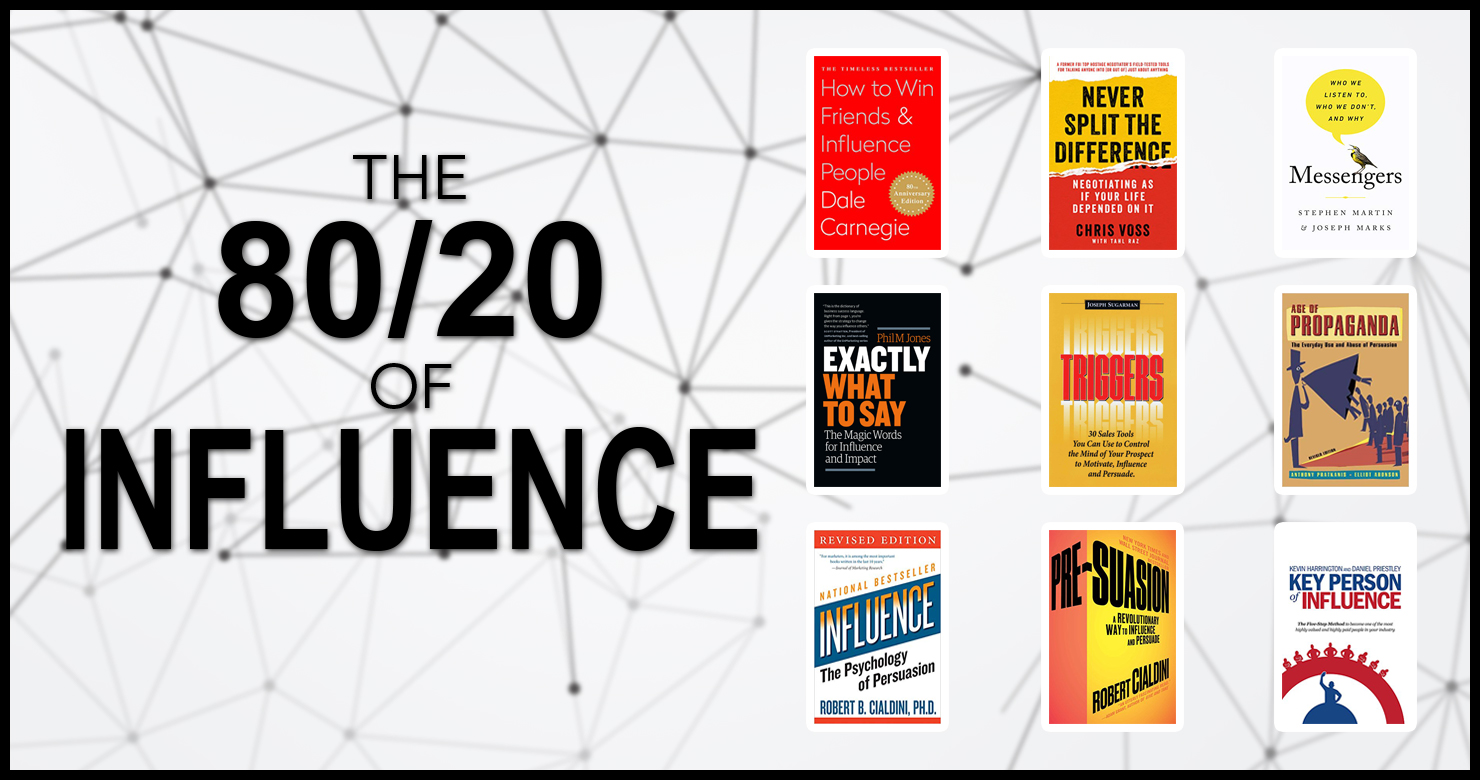
I have taken insights from 12 books and created a latticework of mental models on the topic of influence. This latticework provides a framework allowing for easier recollection and it helps to show how knowing a small number of big ideas can have a huge impact on your life.
The Books
- Pre-suasion
- Influence
- How to Win Friends and Influence People
- Influencing Human Behavior
- Gravitas
- Power - Why Some People Have it and Others Don't
- The 48 Laws of Power
- You are the Message
- Age of Propaganda
- Messengers
- Exactly What to Say
- Triggers
The 59 Mental models for Influence
- Action & Reaction: Newton's 3rd Law
- Agenda Setting Theory
- Algorithms
- Anchoring
- Arbitrage
- Association
- Asymmetric Warfare
- Attentional Bias
- Authority
- Availability Heuristic
- Choice Architecture
- Competition
- Confirmation Bias
- Co-operation
- Consistency & Commitment Bias
- Curiosity Instinct
- Denial
- Eco-systems
- Ego
- Emotions: Anger, Desire, Empathy, Envy, Fear, Guilt, Hope
- Evolution: Adaptation
- Evolution: Sexual Selection
- Feedback Loops
- First Conclusion Bias
- Flywheel Effect
- Friction
- Hanlon's Razor
- Incentives
- Inertia
- Inversion
- Language Instinct
- Lateral Thinking
- Leverage
- Liking/Disliking
- Loss Aversion
- Margin of Safety
- Momentum
- Mise-en-Place
- Narrative Instinct
- Niches
- Novelty Bias
- Randomness/luck
- Reciprocity
- Relativity
- Scarcity
- Second-Order Thinking
- Self-Preservation
- Social Proof
- Status
- Status Quo Bias
- Stress
- System 1 vs System 2 Thinking
- Tendency to Minimize Energy
- The Ikea Effect
- The Map is Not the Territory
- Trust
- Two-Front War
- Velocity
- Vividness Bias
1. Action & Reaction: Newton's 3rd Law
- Mirroring causes your target to have difficulty in reading your true intentions.
- Mirroring shows people that you are part of their tribe.
- Mirroring saves mental energy and gives you the time and energy to be creative.
- Mirroring mocks and humiliates, causing a response that is an overreaction.
- Deal with troublemakers and stirrers by shining a light on their actions, and highlighting to others what they are doing. "Stirrers thrive by hiding in the group, disguising their actions among the reactions of others. Render their actions visible and they lose their power to upset."
- We often watch the mass media in a mindless state and are therefore more susceptible to persuasion because we do not make an attempt to refute the messages.
2. Agenda Setting Theory
- The media does not change opinion by providing compelling evidence that changes peoples' minds. They persuade by giving selected issues more coverage than others. The audience believes (due to the greater attention being paid) that the selected issues are the most important.
- "The mass media may not be successful much of the time in telling people what to think but it is stunningly successful in telling its readers what to think about..."
- The US employs 8,000 people and spends more than $400 million on propaganda per year.
- Build a bridge from a reporter's (or someone else's) agenda to your own. Be responsive and use points from your agenda that are interesting and newsworthy, supported with facts. Use the formula: Q = A + 1. When asked a question, reply with a direct answer and then add a point from your own agenda (+1). When you notice an increase in the tone, volume, and rhythm of interrogation, this is your cue to be friendlier, quieter, and slower. This gives the impression to the audience that you are reasonable and that the other person is trying to provoke you. Frame your answer in terms of the public interest or the greater good.
-
There are 3 spheres of power:
- Winning in arguments.
- Setting the agenda: This is more subtle. It determines what will be discussed.
- Determining the rules of interpersonal interactions through which agendas and outcomes are determined.
3. Algorithms
- We have created a world so complex and with so much information that we must deal with it using shortcuts like animals that we once transcended.
- Fixed action patterns are blindly mechanical behaviors in species. For example: A robin will attack a clump of red feathers but leave a stuffed replica without the red feathers. Humans also have these triggers.
- In the same way that a recorded "cheep-cheep" sound can cause a bird to be mothering, even when there is no chick present. Television executives exploit the same shortcut by using canned laughter to stimulate us to laugh.
-
When you make conditional (if/then) statements they are believed because of the speech patterns and habits that we have grown up with. For example:
- "If you give me a chance in this role, then I am confident you won't be disappointed."
- "If you decide to give this a try, then I'm sure you won't be disappointed".
-
Another example of a conditional statement is: "If I can....will you?" For example: "If I match the price for you, then would you be happy to place the order with me today?"
4. Anchoring
- We are more likely to become influenced when we are asked for a big request, which is followed up with a smaller request, even if we are interested in neither. For example Boy Scouts selling circus tickets and countering with a chocolate bar.
- The door-in-the-face technique: You begin by asking for a large favor and then follow up with a smaller ask.
- Rejection then Retreat Technique: Make a large ask, something you know you'll be rejected for, and then ask for the item that you wanted initially. The optimal strategy is: exaggerate the initial position enough but not too much.
- Throwing a Low-Ball Technique: The seller does not intend to sell at the low price, their only goal is to get the buyer to decide to buy. Once this is done a number of steps cement the commitment: Paperwork, financing, etc.
5. Arbitrage
- We are more attracted to the potential in someone compared to the reality that they are actually good. Job candidates who scored highly in a test of leadership potential vs others who had 2 years of actual leadership experience and scored highly on a leadership achievement test, did better in job interviews. Ticket sales were better for comedians who were advertised using 'critics say he could be the next big thing' and 'everyone could be talking about this guy' vs 'Critics say he has become the next big thing' and 'everyone is talking about him.'
6. Association
- The most important factor of persuasion: The thoughts going through the person's head when the communication is being heard.
- "How people interpret what they see depends on their expectations that precede their observations. We see what we expect to see, so entering a situation with a reputation for power or brilliance is, other things being equal, more likely to leave the setting with your reputation enhanced"
- Often reporters (or people) will use loaded words in a question. Don't legitimize these words by using them yourself. Instead, reposition the negatives into positives. "For example, if a reporter characterizes your actions as "corrupt, irresponsible, malicious and injurious to the public welfare," you should not say, "We are not corrupt, irresponsible, malicious and injurious to the public welfare". Instead say:" We've answered our critics by...." and then describe all the positive, concrete actions you've taken" You can also smile and point out how loaded the question is, saying: "It sounds like you have a strong opinion on this, let me try and give you the facts".
- Weight is linked metaphorically to seriousness, importance, and effect. People rated a candidate higher when their rating was read from a heavy clipboard.
7. Asymmetric Warfare
- The rules tend to favor the incumbents, the people who already have power. Playing by the rules and following conventional wisdom, will only favor the people who are already powerful. You need to think differently and use unconventional strategies as an underdog to increase your chances of success. "In every war in the last 200 years conducted between unequally matched opponents, the stronger party won 72% of the time. However, when the underdogs understood their weakness and used a different strategy to minimize its effects, they won some 64% of the time, cutting the dominant party's likelihood of victory in half."
-
Use surrender to learn more about your enemy. This is what the Japanese did when they resisted the West:
- Became friendly with them.
- They learned the west's methods.
- Outwardly embraced their customs.
- But inwardly they kept their own culture.
8. Attentional Bias
- Your message must get the person's attention. A message that is ignored can not be persuasive.
- "What we attend to controls our behavior. What we can get others to attend to controls their behavior". If (for the most part) you pay attention to the stock market, you are probably a finance analyst.
- Anything that is given attention will lead people to overestimate its importance.
- A communicator who is able to focus a person's attention on a key element pre-loads it with importance.
- Personal information about ourselves is a strong magnet of attention.
- Persuaders often draw our attention to the most favorable feature before they talk about the product. For example: A furniture website that features fluffy clouds as the background results in visitors placing more importance on comfort.
- Let people know you'll be asking questions and involving them, to keep their attention.
-
It is impossible to hold your attention to a spot on a wall. If we want to hold attention we need movement. The movement can not just be a random movement, it must carry us along. You will hold someone's attention if you can make them ask questions, such as:
- What is happening?
- What is going to happen?
-
Respect attention limits: Any artist, whether pictorial, musical or dramatic knows that their work can not simply have a number of beautiful things. Their art must capture the audience's attention and lead it to one spot.
- "The trouble with many of us is that the more immediate, really less important wants absorb our attention and get our instant reaction; while the less immediate, but really more important wants are scarcely attended to.....it is more important than a man's country be secure than that he should have a particular automobile. Usually, however, it is the automobile that gets his most absorbed attention."
9. Authority
- A society built on authority provides many advantages, including the development of resource production, trade, defense, expansion and social control. Guidance from a recognized authority provides a useful shortcut, helping us to decide how to act.
- When you talk, people aren't just listening to what you say. They are judging your tone of voice and asking themselves, does this person have authority. Avoid smiling, only do so if it happens naturally. Become comfortable with pauses. Drop the tone of your voice at the end of a sentence (do not increase it like you would a question).
- "Authority is 20% given and 80% taken....If you are going to take power you need to project confidence."
-
A confident person is more persuasive. Show confidence with:
- A low number of speech errors (pauses help with this).
- Authoritative tone.
- Steady body posture.
-
The use of technical terms adds the perception of expertise. Using specific facts and figures makes you look like an expert and that you've investigated the issue.
- Excuses and apologies are often avoided by the powerful as they create doubts about your competency and other mistakes that you might have made.
- Don't nod too much, you'll lose credibility.
- People want a feeling of importance, so when you condemn yourself, people will often show mercy, as a way to show their importance.
- People want to feel important, by arguing with people who have authority, it allows them to show their importance. By showing the person they are important and not arguing with them, you allow their ego to expand, and they usually become sympathetic.
-
Surrendering is not always weak and can be transformed into strength if strategically used. People often like to show their authority (for example, police and customer service representatives), the surrender technique can be used effectively to deceive them. To use the surrender tactic:
- Notice the feeling of being triggered.
- Do not fight back or become defensive.
- Be like bamboo and bend.
- By not playing their game, you are in control and unbalance them.
10. Availability Heuristic
- Pre-suasion is guiding attention before a person receives a message to move the listener into agreement. The key is to focus the person on concepts that are aligned and associated with the information they are about to receive.
- You don't need to change anything except what the person is thinking about at the moment they make the decision. For example: Asking them if they are an adventurous person? or Playing French music (to buy French wine).
11. Choice Architecture
- Guide a person, telling them what is going to happen during the process and end with a question. For example: "What happens next is that we are going to take a few moments, complete some of your personal details and get things set up for you to receive everything...what is the best address for you?"
- Don't rely on the choices that you are given of A+B, always think to ask about option C (or think outside the box and ask for H19).
-
Questions are a powerful tool for persuasion because they structure a person's decision-making process by:
- Directing our thoughts to the relevant issues.
- Specifying the range of options.
-
"As long as the faintest mirage of choices flickers on, we rarely focus on the missing options. We "choose" to believe that the game is fair, and that we have our freedom.
- "We prefer not to think too much about the depth of our liberty to choose".
- Often people who advocate for equality are using a power play, allocating rewards in a way which they choose.
12. Competition
- Life is conflict, we must struggle to keep ourselves alive. Conflict is good because out of struggle comes intelligence and growth.
- Attractive men are less likely to be victimized by other men. Attractive women are more likely to be bullied by other women. "The earnings disadvantage experienced by African American men is similar to the disadvantage experienced by white, unattractive men".
13. Confirmation Bias
- The self-fulfilling prophecy - the tendency for the definition (or label) of something to become true. For example: People who are labeled smart, act smarter.
- If someone is in power we believe that they must have done something good to deserve being in that position. "As soon as you recognize the just-world effect and its influence on your perceptions and try to combat the tendency to see the world as inherently fair, you will be able to learn more in every situation and be more vigilant and proactive to ensure your own success."
- Provide a reason (near the end of your copy) so that your prospect can justify the purchase.
14. Co-operation
- Flattery is often too obvious, instead be discreet: ask for help or advice.
15. Consistency & Commitment Bias
- Consistency is powerful in influencing human behavior because of 'commitment'. Researchers asked people to predict if they would vote on election day. As most people want to seem virtuous they said 'yes' and this acted as a commitment device and more people went to vote.
-
Once we make up our mind, we are at pains to remain consistent. Even if you can convince someone they are wrong, the person's ego will make it difficult for them to back down. They want to save face. Use the principle of consistency when persuading by saying, for example:
- "I have always respected your willingness to listen and that you are big enough to change your mind when the facts warrant it."
- "You are a natural leader. I'm going to need your help in making this team the best in the department".
-
People who write down a statement are more committed to it even after new evidence is provided, especially those who do so publicly. People who do not write down a statement are more willing to change their minds.
- The most important thing to turn a prospect into a customer is to get them to commit, it doesn't matter how small that initial purchase is. Make the commitment: (1) Simple (2) Small (3) In line with their needs.
- Charities use consistency when calling and asking "How are you?" Our natural reaction is to say "Fine/Good" and they then reply with "I'm glad to hear that because I am calling to see if you can help the unfortunate victims of...."
- Everyone thinks they are open-minded because the opposite is being closed-minded. People's perception of their open-mindedness makes them feel obligated to explore possibilities. "It seems like you are giving them a choice, when you are really you are heavily weighting the only option you are giving them. Ask: "How open-minded are you about at least trying it?"
- You can increase the likelihood that someone will come to an event by saying: "We'll mark you down as coming then, Okay?" [Pause]
- "I'm guessing you haven't got around to...." - Either the person responds with pride or they double down on their commitment.
- Humans are creatures of habit and control. They like to see consistency and predictability. This is why natural disasters scare us so much. By being unpredictable you will exhaust people and make them flustered and unbalanced.
- If you corner someone they will fight harder as there is no way out. Sometimes it is better to leave an escape route that tires and demoralizes the enemy, which results in less work and casualties for your side.
- Power relies on appearance and one way to improve your image is to be independent and not commit. You seem beyond petty politics. As you become known for being independent and unbiased both sides will want you on their side as a judge and a beacon that their side is right.
- "Persistence works because it wears down the opposition. Much like water eroding a rock, over time, keeping at something creates results. In addition, staying in the game maintains the possibility that the situation will shift to your advantage."
16. Curiosity Instinct
- Ask yourself: Is there anything in what I've written that arouses a reader's curiosity?
- Even technical writing can be made to be interesting. Take the following examples: "Until recently an expert operator could turn out 300 items in a day. This was the maximum production". When you read that sentence you ask yourself: What happened after that? You need to find out and as a result, keep reading.
- Use 'signposts' when you talk, for example, say: 'Two points. 1st....'. This stops someone from interrupting and it builds curiosity as people wonder what your second point is.
- An involvement device gets people's attention and involves them. For example: Allowing someone to test drive a car. If it's not possible to test drive a big machine, you could bring part of a machine to your prospect's office. Giving him something tangible to touch and get involved in.
- Asking a direct question can be seen as rude, adding: "Just out of curiosity..." before a direct question, helps to soften it.
- "I'm not sure if it's for you but...." - This phrase creates curiosity and intrigue. It causes the listener to feel less pressure, putting them at ease.
17. Denial
- People never think they have done anything wrong. Even criminals rationalize their criminal acts. "Remember that other people may be totally wrong. But they don't think so. Don't condemn them. Any fool can do that. Try to understand them. Only wise, tolerant, exceptional people can even try to do that."
- Studies have shown that people watch the news primarily to be entertained and being informed is only of secondary importance.
-
Cicero said:
- The 1st line of defense is the denial of facts.
- The 2nd is to challenge the definition of the action.
- The 3rd is to question the quality of the action.
- The final defense is to question the right of the tribunal.
18. Eco-systems
- We often have the belief that from an evolutionary perspective humans need to be part of a group. It depends: If the person is scared or in a wary state of mind the "Don't be left out" message is more effective. If the person is feeling romantic the "Be one of a few" is more effective and the popularity-based appeal will fail.
19. Ego
- Our deepest urge is the desire to be important. Often when people complain they think they're a crusader, defending the public. In reality, they want a feeling of importance. As soon as you give them that importance by listening to them and acknowledging their concerns, their grievances disappear.
-
Instead of criticizing, be curious and try to find out why the person did what they did. Criticism is pointless because:
- People become defensive
- The person will attempt to justify themselves.
- It wounds their ego.
- It builds resentment.
-
Show respect for the other person's opinion, don't say they are wrong. Any idiot can criticize, but it takes self-control to be understanding and forgiving. It is a test of character. When someone makes a statement that you think or know is wrong say: "Well, now, look. I thought otherwise, but I may be wrong, I frequently am. And if I am wrong, I want to be put right. Let's examine the facts".
- "If you can be sure you are right 55% of the time, you can make a million on Wall Street every day. If you can't be sure that you will be right 55% of the time, why tell other people they are wrong?"
- Be like nobility, you don't need to prove or assert yourself.
- Demonstration compared to argument, results in less defensiveness and people being more open to persuasion.
- Use the word 'you' liberally before you make a pitch to predispose your audience for a full consideration.
- Appeals to self-image are effective.
-
Learn to study people's eyes and gestures, noticing and remembering details:
- Their clothes
- Their friends
- Their daily routine.
- Their repeated remarks.
- Which areas they take pride in and are insecure about.
-
Make bold demands, for example, charge more than other people.
- Achieving your goals is often the most dangerous point. "The greatest danger occurs at the moment of victory" - Napoleon
- Arrogance and overconfidence can push you beyond where you want or need to be, creating new risks and enemies.
- Success has a strange distorting effect on how one acts. On the one hand, it can make you feel invulnerable, but on the other, it can also make you hostile, especially when people challenge you.
20. Emotions
- Emotions are the single biggest reason that people make a buying decision. Sell using emotions but justify with logic.
- Make their decision feel right (and follow up with logic to help them justify their decision). Create a future scenario that allows the person to feel their emotions (either loss or gain), for example: "How would you feel if this decision led to your promotion?"
- The most important skill when it comes to power, is being able to control your emotions. An emotional response is a mistake.
- To control your emotions: distance yourself from the present and think objectively about the past and future.
- Even if you can control your emotions, you can not control those of people around you, and this is a problem because most people are controlled by their emotions and your ability to control yourself will only annoy them further.
- Humans became the most powerful animal through intelligence, and as a result, we are very proud of our intelligence. Learn to control your emotions and your desire to show others your intellectual superiority.
- Any short-term feeling of satisfaction you gain from winning an argument is tiny compared to the longer-term resentment and ill will you build.
- "People do not always want words, or rational explanations, or demonstrations of the powers of science; they want an immediate appeal to their emotions".
-
The two biggest emotional voids are:
- Insecurity: Take advantage of this by providing social validation.
- Unhappiness: Take advantage of this by finding the root of the unhappiness.
-
Notice uncontrollable emotions. Certain base emotions often cause people to become uncontrollable. Look for:
- A paranoid fear
- Lust
- Greed
- Vanity
- Hatred
-
"Power requires self-discipline. The prospect of wealth, particularly, easy, sudden wealth, plays havoc with the emotions. The suddenly rich believe that more is always possible. The free lunch, the money that will fall into your lap, is just around the corner."
- People are more emotional in a group and are less able to reason.
20.1 Emotions: Anger
- Listen to what people have to say, don't interrupt, eventually, they will talk themselves out. When they have finished say something like: "I want to thank you for bringing this to my attention. You've done me a great service, for if this thing/personality trait/department/ annoyed you, it no doubt annoys other people also, and that would be awful. Believe me, I am so much more eager to hear what you have to say, than you are to tell it."
- People who show anger are seen as dominant, strong, competent, and smart, however, they are also seen as less nice. "A bad temper is a very powerful political tool because most people don't like confrontation."
- To show anger or frustration is to show that you have lost your power. People who realize that you have so little self-control can easily undermine you.
- Anger cuts off your options.
- Angry and aggressive people are usually not in control. Angry people can only see what is in front of them, they do not see the bigger picture. Angry people are reactive, they do not direct events. They become exhausted. Often the best course of action is to keep calm, while others get frustrated and exhausted, biding your time for long-term power.
- If you can train yourself to control the emotional responses you place yourself in a place of tremendous power. Do not repress your anger or other emotions. Repression drains us of energy. Instead see things from a different perspective, disengage from the emotion and remember that nothing is personal.
-
If someone gets angry:
- Remind yourself that the anger is not directed at you personally. The anger comes from a long history of the previous hurt.
- "Look at the emotional outburst as a disguised power move, an attempt to control or punish you cloaked in the form of hurt feelings and anger."
- Use lines such as: "What a pity that such a great a man should have such bad manners.
20.2 Emotions: Desire
- "The ability to ignore immediate dangers and pleasures translates into power. It is the power of being able to overcome the natural human tendency to react to things as they happen, and instead to train oneself to step back, imagining the larger things taking shape beyond one's immediate vision. Most people believe that they are in fact aware of the future, that they are thinking ahead. They are usually deluded: What they really are doing is succumbing to their desires, to what they want the future to be. Their plans are vague, based on their imaginations rather than their reality. They may believe they are thinking all the way to the end, but they are really only focusing on the happy ending, and deluding themselves by the strength of their desire".
- An interest that is too strong makes people feel awkward and sometimes fearful. If your interest is too strong you will push away the object you desire.
- Being uncontrolled in your desire gives the appearance that you are weak, unworthy and pathetic.
- Science has enlightened us. What was once mysterious and scary is now comfortable and explainable. In a world devoid of mystique, people desire enigmas and things that can not be easily explained.
- Try to understand the person's motivations: Are they vain? Are they worried about their reputation? Are they worried about enemies? Do they want money?
- Understanding people's (hidden) motives is the best knowledge you can acquire in gaining power.
- "Since we all try to hide our weaknesses, there is little to be learned from our conscious behavior. What oozes out in the little things outside our conscious control is what you want to know." Notice details: how much do they tip a waiter? The clothes and jewelry they wear, what delights them.
20.3 Emotions: Empathy
- Be empathetic with people's ideas and desires. "I don't blame you one iota for feeling as you do. If I were you I would undoubtedly feel just as you do".
- Humans seek sympathy: a child eagerly shows their bruise, and adults aren't too different, they share their psychological accidents. Self-pity is universal.
20.4 Emotions: Envy
- "Never be so foolish to believe that you are stirring up admiration by flaunting the qualities that raise you above others." By making others aware of their inferior position, you are only stirring up "unhappy admiration" or envy, which will gnaw away at them until they undermine you in ways you can not foresee."
20.5 Emotions: Fear
-
Fear can distort your message. Overcome fear by:
- Knowing how you are going to start
- Knowing how you are going to end.
- Calm yourself by breathing through your nose and out of your mouth, just before starting. This will also add a pause, which will give you an air of confidence and focus the audience.
-
Fear works when there are clear steps to help the person change, otherwise, the person will be indecisive.
20.6 Emotions: Guilt
- People who are made to feel guilty were 3 times more likely to comply with a request. When we feel guilt we are less likely to pay attention to the logic of an argument.
-
The propagandist arouses feelings of dissonance by threatening self-esteem, by making the person feel guilty by:
- Making them seem like a hypocrite.
- Making them seem like someone who does not honor their word.
-
The propagandist offers a solution, a way of reducing dissonance, guilt or shame by:
- Giving to charity.
- Buying a car.
- Voting for a politician.
20.7 Emotions: Hope
- Hope can be a powerful motivator to get people to buy. Show the prospect the future benefit of your product.
21. Evolution: Adaptation
- Genes will either be dominant or recessive and so will people. Non-dominant people tend to be more accommodating thinking they will gain influence, but this rarely happens. Partners may come to resemble each other, but the truth is that it is the non-dominant ones who converge, adopting the views and emotions of the dominant one.
- "In evolution, largeness is often the first step towards extinction. What is immense and bloated has no mobility, but must constantly feed itself. the unintelligent are often seduced into believing that size connotes power, the bigger, the better."
- If you can not move quickly or be flexible due to being weighed down physically or metaphorically you can not adapt to change.
- Success makes you less flexible and able to adapt to changing circumstances.
- Nothing in the world can remain stable forever, and the shell or system you evolve for your protection will someday prove your undoing".
- When you take a shape (such as becoming part of a political party), or create a predictable plan, you are vulnerable to attack.
- The inoculation effect: If we are given brief exposure to a message that we can refute we become immune to any further full-scale presentation of the same message.
- Animals, people (and also cultures and institutions), develop protection (armor, rigid rules, rituals, and procedures) to protect themselves from perceived dangers. These protections may work in the short term but in the longer term, they cause death and extinction.
- As we age we become more set in our ways and habits, as a result, strive to be even more formless, avoid becoming too rigid.
-
How to be formless:
- Take nothing personally.
- Don't be defensive, doing so shows your emotions which reveal your true nature.
- Allow no one to control you or to see what annoys or frustrates you, revealing where your weaknesses lie.
22. Evolution: Sexual Selection
- Studies show that an attractive woman can have a large impact on the opinions of an audience on a topic that had nothing to do with beauty. Her impact was greatest when she admitted expressing a desire to influence. It's as if we are trying to please someone who is attractive.
- Sex only sells for items people buy for sexually related purposes: (lipstick, cologne, form-fitting clothes).
23. Feedback Loops
- "If you feel powerful, you will act and project power and others will respond accordingly. If you feel powerless, your behavior will be similarly self-confirming."
- A common error is overreacting to the moves of a rival. This causes a negative feedback loop as the other person overreacts also.
- "Winners are thermostats- they set the right temperature. Losers are thermometers-they go up and down according to conditions they think are outside of their influence."
24. First Conclusion Bias
- Brain activity shows that we make up our mind if we are going to like someone the moment that we see them, before we have even spoken to them. It is as if our brain has decided independently who we are going to like.
- People form an impression of you within the first few seconds of seeing you. First impressions are accurate in predicting other, more important qualities. Evaluations of a short silent video of a teacher predicted the final class evaluation at the end of a quarter. People pay closer attention to information that comes early on.
- We judge an idea not on its merits but on who communicates it.
- People who speak up early in a meeting/debate will be given increased status and their ideas seen as more relevant and competent regardless of the quality of their ideas. This is especially true when the audience is unsure about the messenger's knowledge or the best course of action.
- Lions circle the hesitant prey: If during your first encounter you seem too eager to placate, compromise or back down you may bring out the lion in people. Power depends on appearance and if you project that you can be pushed around, you will.
- Reputation (just like someone who looks big and strong) can intimidate and stop attacks before they even happen.
- Start by establishing a reputation for one outstanding single quality. Do not dilute yourself, be known for this one quality, e.g. generosity, honesty, cunning.
- A single act doesn't result in a reputation. A series of (small and unrelated) acts are needed. Once a reputation is established, like a first impression, it is harder to lose.
- A well-tailored suit can result in deference from strangers: 3.5 x more people followed a person wearing a suit who walked into traffic at a crossing.
-
The factors that influence peoples' impression of speakers:
- 55% Nonverbal communication: (1) Facial expression (2) Body language
- 38% Voice (1) Quality (2) Tone (3) Pitch (4) Volume (5) Variation
- 7% The actual spoken words.
25. Flywheel Effect
- By thinking someone is more beautiful, wiser or able, you bring out their best side which makes them blossom.
26. FRICTION
- Asking: "Can I have your number?" creates an extra step and causes permission-based resistance. Instead ask: "What is the best number to contact you on?"
27. Hanlon's Razor
- 'More problems in life are caused because we take offense than by others giving offense'.
28. Incentives
- To influence others you need to talk about what they want and tell them how to get it.
- Pleasure, allaying fears and promising security convert people to your ideas.
- "Necessity rules the world. People rarely act unless compelled to. If you create no need for yourself, then you will be done away with at first opportunity".
- No appeal to reason that does not also have an appeal to want can ever work.
- Start with something that makes a difference: Most writers don't begin at the point of the reader's interest. They often start with an account of history. People want to know why this subject is worth studying and what the future holds. "An introductory chapter in any book on science should begin, then, not by looking backward but forward." It is logical to start at the beginning (and people, especially scientists and philosophers worship logic). Start at the point where your writing makes a difference to the reader.
- "If one watches carefully, one notes that the usual dullness of a scientific lecture arises out of the fact that the lecturer describes one small fact after another. He knows that he is building up a structure of facts, he knows that if the audience will only manage to keep alive throughout the preliminaries, they will be in for a killing. But the audience, seeing no wider significance in the meticulously elaborated details, soon lose all hope, and sink, with a despairing gurgle, into the tides of slumber."
- Use a newspaper as an example: Tell the essential story in a sentence or two. Provide more and more details.
- Most of the habits that we want kids (and ourselves) to develop are not in themselves pleasurable. For example, responsibility is generally not pleasurable, however, if we find a task that involves responsibility that is enjoyable (such as being responsible for ringing the school bell on time), they will likely form the habit more willingly.
29. Inertia
- "Human psychology contains many dualities, one of them being that even while people understand the need for change... they are also irritated and upset by changes that affect them personally. They know that change is necessary, and that novelty provides relief from boredom, but deep inside they cling to the past. Change in the abstract, or superficial change they desire, but a change that upsets core habits and routines is deeply disturbing to them".
30. Inversion
- Counterarguments are more effective than arguments, especially when the original argument is shown to be mistaken or misdirected.
31. Language Instinct
- 3 is a magic number, it has rhythm and is easy to listen to a list of 3. Leave your desired choice until the end.
- Cognitive poetics have found rhyming leads to increased persuasion.
- The words used to describe an object or situation direct our thoughts and responses, they define and create our social world. For example: "Fresh frozen" was preferred to "frozen fish".
-
There are three kinds of listening:
- Reflective - To get information
- Supportive - To help others
- Possibility - To find ways forward
-
Ads that contain the following words sell more products:
- New
- Quick
- Easy
- Improved
- Now
- Suddenly
- Amazing
- Introducing
32. Lateral Thinking
-
Just like the lateral thinking puzzle that requires you to connect 9 dots without lifting your pen off the paper. In order to be successful, you need to think outside the perceived parameters. When it comes to social situations, don't be constrained by the parameters of your subject:
- Look for analogies from other fields.
- Put the topic of discussion into a historical perspective.
- Compare the topic to something that is more familiar or something the listener is more interested in e.g. compare it to sports.
33. Leverage
- "Learn to use the knowledge of the past and you will look like a genius, even when you are really just a clever borrower".
- Outsource work to other people while taking credit for the idea/invention. You will appear to be efficient, powerful, and hard-working. You will avoid burnout.
- We have a psychological resistance to change. Pushing against resistance will consume energy. We all have a leverage point, that when pushed will overcome the resistance.
-
How to find people's leverage points:
- Pay attention to gestures and unconscious signals
- Normal, everyday conversation provides the greatest source.
- Share an open-hearted secret to help them open up.
- Probe: If you think a person has a need to be loved, give a compliment and notice the response.
34. Liking/Disliking
- "If you could master one element of personal communication that is more powerful than anything we've discovered it is the quality of being likable.... if your audience likes you, they'll forgive just about everything else you do wrong. If they don't like you, you can hit every rule right on target and it doesn't matter".
- People will like you if you talk about things they are interested in. Ask questions people will enjoy answering.
- People will think you are a great conversationalist if you talk very little and encourage others to speak. The benefit of this strategy is that not only will you learn, you will also make friends.
- Encourage people to talk about themselves and their accomplishments. Make the person feel important. "The deepest principle in human nature is the principle of being appreciated."
- Make people feel important by telling them 'Their job sounds difficult' when they tell you what they do.
-
Being likable works well because people find it hard to fight with those who are polite. Small actions can have a large impact, for example:
- Attending birthday parties
- Sending celebratory cards
- Going to Funerals
- Going to lunch
- Sending a card, visiting or buying a gift when they are ill.
- Allowing people to talk about themselves.
- Being a good listener
- Asking questions.
-
A charismatic person is able to balance dominance and warmth effectively. They:
- Are able to convey a collective identity and vision.
- Reduce complexity into binary choices, with in-groups and out-groups, or hero and villain, creating a sense of connectedness.
- Develop a connected shared goal.
- Articulate an idealized future.
- Use metaphors (which are powerful because of their visual intensity)
- Use stories and anecdotes.
- Smile
- Make eye contact
- Use animated gestures
- Have surgency: positive outlook, high energy, desire for rewarding experiences, optimistic, approachable, use of hand gestures & expressive body language.
-
People who are liked are:
- Optimistic
- Concerned about others
- Smile
- Mind their own business
- Laugh (at themselves)
- Handle stress
- Perform well in crises
- Humble when doing well
- Balance cold facts with emotion
- Draw people out on topics they are interested in discussing.
-
You can enhance your likability with:
- Attractiveness - Grooming well.
- Similarities - Age, religion, politics, interests,
- Compliment - Tell people you like them
- Contact - Familiarity usually results in greater liking
- Working together - Use 'we'
-
You can be likable by:
- Say what the audience already thinks.
- Making people feel comfortable.
- Controlling the atmosphere/situation to your best advantage.
-
To make people feel comfortable you need to appear comfortable yourself. How to make yourself look comfortable:
- Don't make sharp movements.
- Don't fidget or play with your hair.
- Don't overreact to constraints such as time.
-
People like others when they have something in common. Ask yourself:
- What's your common purpose/values/ground?
- What might you have that they need?
- What fear or problem do you have the answer to that might help them?
- What do they love?
- What do they hate?
- Who do they admire?
-
To be liked it helps to be seen as inferior in intellect.
- A competent person who spills coffee on themselves is seen as no less competent but more likable. However, a less competent person making the same mistake is seen as confirming their incompetency (and less likable).
- Apologizing for something out of your control (such as the weather) increases warmth/compassion and makes people more open to what you have to say.
- Waiters received bigger tips after complimenting diners on their choice. In a study, 50% of employees were willing to help a colleague who needed help but this increased to 79% if a compliment was given first.
- Be bold, timidity is dangerous. People admire the bold, they do not admire the timid.
-
The Laws of Court Politics:
- Avoid talking about yourself and your achievements.
- Encourage the conversation to go to others.
- Be modest.
- When a task requires a great deal of work, make it look effortless. People do not like to see pain, suffering and toil, showing it is a form of ostentation.
- "Flatter indirectly by downplaying your own contribution and making your master look better".
- In life (and in court) you must get noticed to get ahead.
- Be aware of your physical appearance, think of a way to be (subtly) distinctive, for example, a pocket-handkerchief, a neckerchief, an eye patch.
-
If you need to make a choice between being likable or competent (but abrasive), choose competence. Self-deprecation and humor can be used to mitigate any abrasiveness (but only if you have established your competency).
-
If you want to make people dislike you:
- Never listen for long
- Talk about yourself
- Interrupt.
-
People who are disliked:
- Complain
- Talk constantly about meaningless things.
- Are monotone.
- Too serious
- Rarely smile or joke
- Egotistical
- Put down others
- Shy
- Depressed
35. Loss Aversion
- People are more motivated by loss than by a proportional gain.
36. Margin of Safety
- Patience is like a shield, protecting you from mistakes. Impatience makes you appear weak.
37. Momentum
- Like a billiard ball that is moving, it takes some force to deflect it, but much more to move it back the way it came.
- Use the Socrates method: Ask a series of questions that produce a series of yes responses. The momentum to the desired conclusion will be unstoppable.
38. Mise-en-Place
-
Have a structure to your answers:
- Point - The main idea you wish to communicate
- Reference - Connect your point with an example with credibility.
- Comment - Make it unique to you and show how it will be beneficial towards your goal/purpose.
39. Narrative Instinct
- People are more influenced by your vision of the future than by your track record.
- "A person is led to do what he overwhelmingly feels. Practice in getting people to feel themselves in situations is, therefore, the surest road to persuasion."
- People usually have two reasons for doing things: One that sounds good and their real motives. People like to be virtuous, they like their motives to sound good. To change people, appeal to their noble side.
- "People are not interested in truth about change. They do not want to hear that it has come from hard work, or from anything as banal as exhaustion, boredom or depression: they are dying to believe in something romantic, otherworldly. They want to hear of angels and out-of-body experiences. Indulge them. Hint at the mystical source of some personal change, wrap it in ethereal colors, and a cult-like following will form around you. Adapt to people's needs: The messiah must mirror the desires of his followers. And always aim high. The bigger and bolder your illusion, the better".
40. Niches
- "The world wants to assign you a role in life. Once you accept that role you are doomed. Your power is limited to the tiny amount allotted to the role you have selected or have been forced to assume. An actor, on the other hand, plays many roles."
- Most people are scared to break from tradition, but deep down they look up to those who do, and they wish they had the courage to do the same. There is much power to be obtained from entering a vacuum.
41. Novelty Bias
- Using 'new' is effective at getting people's attention but be careful in offering something that is too new, that has no connection with what people are already accustomed to.
- Begin with an effect needing a cause: Something new that is unexplained gets our attention. When you present an effect without the cause, a vacuum is created and the mind of the reader becomes focused and alert trying to fill their empty mind with an explanation. Present a cause....and the mind will want to know what happened.
42. Randomness/luck
- A movement that we can predict will quickly bore us. Unpredictability is one of the key ingredients of attractiveness, in humans, in stories, in essays, and in drama. Predictable people bore us with their routine and repeated stories. We are attracted to celebrities who keep us guessing what they are going to do next.
- Associate with the fortunate and people who hold the personality traits that you want to have. If you want to be more generous, happier or social, associate with those people.
- We all want good luck but it is more dangerous than bad luck. Bad luck teaches lessons: patience, timing, preparation.
- Good luck deludes and causes you to be unprepared when your luck will eventually turn.
- Success makes you believe that your character is the cause of your success and disregards luck and other people's influence.
43. Reciprocity
- When you help someone, they feel the need to repay the debt. People do not calculate how much value they received from your help, the feeling to return the favor is more general. As a result, doing a small favor can result in a large payoff.
- Reciprocity is so strong that even if the person is disliked it will still work.
44. Relativity
- Try and see things from the other person's perspective. "If as a result of reading this, you get only one thing - an increased tendency to think always in terms of the other person's point of view, and see things from that person's angle as well as you own"
- The Catholic church tried to use force to convert people but they realized that this wasn't effective. Propaganda was used to convert people voluntarily. As a result propaganda has negative connotations in Protestant countries and positive connotations in Catholic countries.
45. Scarcity
- Power comes not just from what you do, but what you do not do, stop yourself from getting dragged into drama.
- Pauses have a big impact. Subtle pauses can help to focus peoples' attention when they might get distracted. Pause often. Pause naturally, at the end of thoughts. The more short sentences you have, the easier pauses become.
- Silence makes others uncomfortable and defensive. They will fill the vacuum with comments that may reveal useful information.
- Controlling access to money and jobs brings power. It is pleasing to think that we are given deference and flattery due to our intelligence, experience, and charm. However, the reality is (usually) different, as shown by the fact that when you retire, people give you much less attention and respect. Become the go-to person for information on topics that are important to senior management.
- The attractiveness of an object (or person) can be increased by making it appear scarce and unavailable.
- When customers were told of forthcoming scarcity due to exclusive information (vs non-exclusive) they purchased 6 times more.
46. Second-Order Thinking
- The difference between the Greek Gods and humans was that Greek Gods were thought to have total vision into the future. Humans were seen to be victims of fate, caught up in their emotions in the moment, blind to the future and only seeing current dangers. The most successful humans are the ones who are able to plan for the future and see the benefit of sacrificing current pleasures for payoffs in the future. On a spectrum with animals on one end and Greek gods at the other end, we are in the middle. To be closer to a God we must improve our ability to look into the future.
- When your mind is free from constant emergencies and emotions you can see more clearly and further into the future.
- When you have the skill to play 3D chess and to see many moves ahead, you are no longer distracted by your emotions or the need to improvise. This clearness of mind will free you of anxiety, and its lack of clearness is why so many fail.
- Some habits are more important because they have second-order consequences for other habits. If you can't read you become lonely, which means you drink more and spend more, your health gets worse, and you are more likely to injure yourself, meaning you are even less likely to exercise.
47. Self-Preservation
- "We are most likely to find revolutions where a period of improving economic and social conditions is followed by a short sharp reversal in those conditions. It is not traditionally the most downtrodden people - who have come to see their deprivation as part of the natural order of things- who are especially liable to revolt. Instead, revolutionaries are more likely to be those who have been given at least some taste of a better life. When the economic and social improvements they have experienced and come to expect suddenly become less available, they desire them more than ever and often rise up violently to secure them.
48. Social Proof
- People find solace in the fact that others have done something similar and it worked out well for them. Sometimes people need to be told what to do, but it is rude to say: "I think you should do this." The next time you want to say: "I think you should do...." say instead: "Most people would do xyz in this situation".
- "One of the best ways to acquire and maintain power is to construct a positive image and reputation in part by co-opting others to present you as successful and effective."
- "Since 95% of people are imitators and 5% initiators, people are persuaded more by the actions of others than by any proof that we can offer".
- Pluralistic ignorance is the tendency to look to see what everyone else is doing and to use that inaction as a cue. In a staged experiment, 85% of people helped an epileptic having a seizure when they were the only person present but this decreased to 31% with 5 bystanders present.
- When you need emergency help, do not allow bystanders to come to their own conclusions. Isolate one person, stare, shout and point at them and no one else: "You sir, in the black jacket, I need help I am having a seizure, call an ambulance".
49. Status
- Go after the highest status person, this puts you on the same footing as them.
- Give gifts to people above you, doing so will put you on an equal footing.
- Dominant messengers are admired and receive status but they are not liked. They influence through fear rather than love, power, and prestige. "We are hardwired to detect dominance and use it as a cue to navigate our social environment and reward it with increased attention and status."
50. Status Quo Bias
- Experimentation is one of the highest human achievements. The primitive mind accepts the world that it is given, and fits itself into it. The creative mind takes the fundamental laws of the world but readjusts things to suit its own needs.
- Primitive life didn't allow change or experimentation because of customs. To introduce something new was to go against everything that has ever come before. The inventor was a heretic. Conformity was admired and required. Any changes happened by accident or at a snail's pace, not by design. Even now there is no desire for uncertainty, no trying and seeing what happens, no failing and learning from mistakes. There is no independent exploration and experimentation. There is only a repetition of the experiments of others.
- As humans age, we experience psychological inertia to save energy but the consequence is that we no longer experiment with new technology. We need conscious effort to break the inertia but we resist this extra effort. War forces people to change quicker than anything else. The problem that we have in modern society is to find something more civilized than war to break our inertia.
51. Stress
- In calm times people value warm messengers. In times of stress, uncertainty, fear, and hardship the desire for a dominant leader increases. Conservatives see the world as more threatening and so they, therefore, are more likely to vote for someone who is dominant and who can stand up for them and their country.
- It is often claimed that if women ruled the world there would be fewer wars and conflicts. A different perspective is: because hard messengers do well in competition, conflict, and war and vice versa: therefore, if there were fewer conflicts, women would rule the world.
52. System 1 vs System 2 Thinking
- System 1 is when the brain is making emotional and intuitive decisions. System 2 is when the brain makes logical, analytical and rational decisions. Match the system with the decision being made. For example System 1: I feel this is for you. System 2: I think this is for you.
-
The 2 routes to persuasion:
- Peripheral: Little attention needed. persuasion is determined by simple cues. For example: watching TV while doing another task
- Central: The listener is careful and thoughtful in their consideration. In this situation, persuasion is determined by how well the message can stand up to scrutiny.
53. Tendency to Minimize Energy
- Stereotypes are necessary. We can not analyze all information. We do not have the energy, time or capacity.
- "Civilization advances by extending the number of operations we can perform without thinking about them" - Alfred North Whitehead
-
When making decisions we often rely on shortcuts when we are:
- Indifferent
- Tired
- Uncertain
- Rushed
- Distracted
- Stressed
-
Be aware of people who deceive using the possibility of easy money. People are by nature lazy and want quick easy money, and are therefore attracted to that path.
- We are cognitively lazy we accept a conclusion without any good reason. for example: "May I use the photocopier because I have copies to make".
- Peoples' decision-making goal is usually to make their decision good enough and gone, as a result, we use 'satisficing': we select the first practical option that presents itself.
-
Propaganda takes advantage of two human tendencies:
- Mental shortcuts - Our desire to conserve mental energy.
- Rationalizing of thoughts and behavior - So they appear reasonable to ourselves and others.
-
The media is persuasive because we don't question it and take it for granted that it represents reality.
54. The Ikea Effect
- When you make others react, you hold the power. When you incentivize someone to come to you, they feel like they made the decision themselves and they don't feel like they are being controlled or manipulated.
- The greater the effort and pain involved in a commitment, the greater the influence on the person. For example, initiation ceremonies.
- Allow the person's own mind to build your case for you, this is more powerful than anything that you can describe yourself: "Just imagine the impact this could have."
- We pay more attention to our own ideas. Plant an idea casually, in a way that would interest a person, and then allow the person to think about it on their own.
- We like to be asked our ideas, wants, wishes, thoughts, and opinions. This gives people ownership. We like to buy but we don't like to be sold to. We like to think that we are buying on our own ideas.
-
One of the most effective persuasion tactics is self-generated persuasion via:
- Group discussion
- Role Play
- Asking the person to imagine.
- Questionnaires asking for your opinion.
- Contests that ask: Tell us why you like our company in 50 words.
-
Ask questions instead of giving direct orders. Questions allow for the person to use their own thinking and creativity on the problem, giving them ownership. For example: Do you think xyz might work?
55. The Map is Not the Territory
- The same lessons that were right for you may be wrong for others as times have changed and the lessons you learned may need to be updated for today's times.
- Avoid the belief that if you follow the recipe of doing exactly what someone else did, you can get what they got. "This cookie-cutter approach will seduce the uncreative, for it is easy, and appeals to their timidity and their laziness. But circumstances never repeat themselves exactly."
56. Trust
- When information is banned we have a greater need for that information and our perception towards that information is more favorable and believable.
- To build trust: Instead of mentioning only positive characteristics and leaving negative features until the end (or never), mention them early on. Use 'however', 'but', or 'yet' to divert the listeners' attention away from the weakness and on to strength.
- Societies and audiences with higher general trust are more likely to listen to your message. There are two types of trust: (1) Competence-Based Trust (2) Integrity Based Trust
-
How to gain trust:
- Communicating before you make a request increases your chance by 40%.
- Speaking is better than writing by a factor of 2-3.
- Be happy.
- Highlight a potential weakness in your argument before highlighting its strengths (this is especially useful when the audience is already aware of the weakness.)
-
Phrases that work well include:
- "I'm not going to lie to you..."
- "I don't wish to complain..."
- "I'll be honest..."
-
Use a list of 3 items. Lists make people think you have thought about the issue.
- Highlight a negative feature (of what you are selling or yourself in a job interview). This will reduce resistance and you'll be seen as more honest. This will lower people's defenses and make them more receptive to the positive aspects of your product or yourself.
-
Aristotle said: when persuading use:
- Ethos: Present yourself as a good and trustworthy person
- Logos: Use logic and vivid historical imagery to illustrate points.
- Pathos - The message should take into account audiences' preexisting beliefs and emotions.
-
People have a 'latitude of acceptance' however this can be broken if the source is highly credible.
57. Two-Front War
- As two competing sides battle, they become weaker and you become stronger.
- Aloofness is powerful: people who are quick to support others, often do not gain respect because their loyalty is so easily obtained. Be interested and show concern but remain neutral.
-
In theory, stepping back and avoiding drama may be true but in reality, it may not be possible and it would cause offense. The solutions:
- Appear interested in their problems
- Sometimes take their side
- Show gestures of support, listen with a sympathetic ear.
- However, disengage your emotions
- Maintain your energy and sanity.
- Do not let your interest go beyond the surface.
58. Velocity
- Boldness creates fear; fear creates authority. A big, bold move gives the appearance that you are more powerful than you are. If you make a move suddenly it inspires more fear than doing the same move slowly. Once you have set a precedent, people will fear you going forward.
- Speak faster when you have a weak argument, speak slower when you have a strong argument.
- Nerves cause you to speed up, so intentionally slow down. 'When you have a great present to give someone you don't thrust it at them. You check in with them. You pause, you wait. You smile. Do the same in a presentation.
59. Vividness Bias
- It is an uncomfortable truth that more attention is given to people who shout louder and with more force. We do what dominant people want. Bullies are popular and are often the coolest kids in school. The unwillingness to accept this uncomfortable truth means that it operates under the radar.
- Dramatize your ideas. Simply saying a truth isn't enough. You need to make the truth interesting, vivid, and dramatic. Dramatize your ideas in the same way that a TV commercial shows a detergent getting clothes clean or a car weaving around a racing course. Dramatization is effectively used when we ask someone to marry us, we prepare things and make them romantic, why not use that same principle in other areas of your life?
- People are more likely to be influenced by one clear, vivid personal example (such as a story) compared to a trove of statistical data.
-
If you try and remember how a peach smells or tastes the thought is vague. But when you recall what a peach looks like, you have no problem bringing this into your memory. If you want people to remember something use their sense of sight. A visual idea is a powerful idea. The power of an idea depends on two things:
- The speed (and clarity) in which it is received.
- How easily it is recalled.
-
"All over the world" is less meaningful than "New York City". The former is too general for the listener to form a picture in their mind. Notice the vagueness of: "The Joint Committee on Methods of Preventing Juvenile Delinquency" vs "Camp Fire Girls"
- If you wanted to get people to donate to starving children in Africa: Telling them it is their duty to help, would not move many, as they will likely become defensive. If you ask people if they would be so kind as to donate, they may be slightly moved to do so out of pity. If you flatter the person, saying that by your contribution you are helping humanity, you may be even more likely to get some help. However, if you took people to Africa and let them see the conditions and allow them to help individual children, they would likely help without any push from you. The last technique would be costly, so instead, we use the person's imagination.
-
What makes writing dull:
- Stodginess: Having no unfamiliarity in the familiar.
- Verbosity: Too many stimuli causing the reader to skip.
- Circumlocution: The stimulus never arriving causing the reader to be uncertain, impatient, irritated, and saying "get to the point".
- Lack of Clearness: Long sentences with ideas that are poorly arranged.
- Lack of Curiosity: The reader just nods but doesn't have their curiosity piqued.
- Abstractness: No vivid pictures are being created in the mind of the reader.
- Rhythm: Lack of rhythm that causes the reading to be jerky or monotone.
- Concrete vs Abstract: Use concrete words that create pictures in your mind.
- Personality: Your personality, be it humble or smart-Aleck, should shine through in your writing.
Enjoyed this? Follow me on X: @DaviddeSouza