49 Mental Models For Negotiation
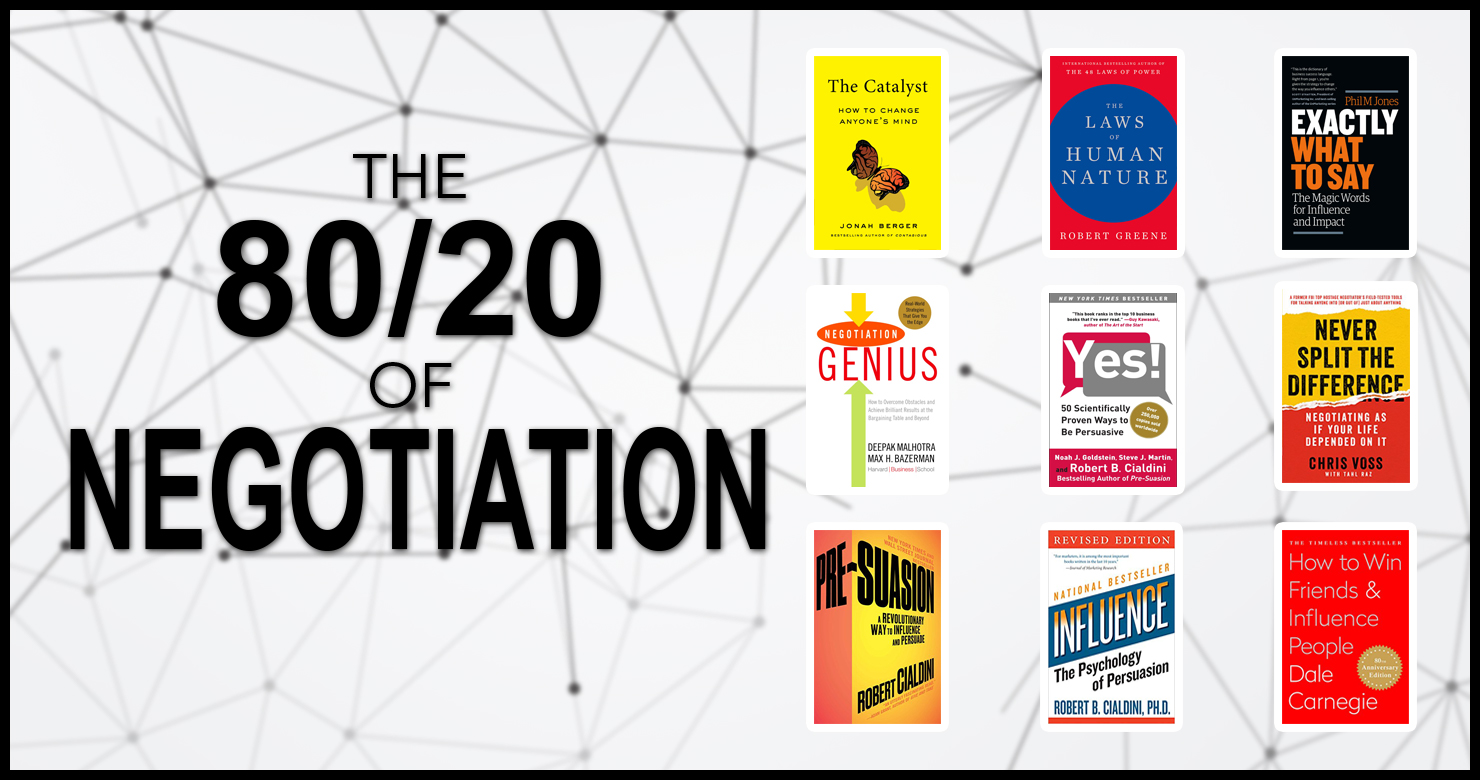
Learning a small number of big ideas from the field of negotiation will help you on a daily basis however there are a few instances where improving your negotiating skills will have a huge impact on your life.
Perhaps the most significant gains that you can achieve from negotiation is with your income. Your ability to negotiate a higher hourly rate coupled with the power of compound interest could be worth hundreds of thousands of dollars over your life. Learning the core principles of negotiation could be the single highest value thing that you do.
I have taken the top 10 books on negotiation and created a latticework of mental models for the topic. This framework allows for better understanding and I have found it makes it easier to remember the ideas.
The Books:
- Never Split the Difference
- 3D Negotiation
- Getting to Yes
- Exactly What to Say
- Negotiation Genius
- How to Speak/How to Listen
- Difficult Conversations
- Non-Violent Communication
- Start with No
- Just Listen
49 Mental models for Negotiation:
- Agenda Setting Theory
- Algorithms
- Anchoring
- Attentional Bias
- Asymmetric Warfare
- Consistency & Commitment Bias
- Cooperation
- Curiosity Instinct
- Denial
- Ego
- Emotions: Anger, Calm, Embarrassment, Empathy, Fear, Guilt, Humility, Neediness, Powerlessness, Shame, Vulnerable, Validated
- Expectations & Predictions
- First Impression Bias
- First Principles Thinking
- First Conclusion Bias
- Friction
- Hanlon's Razor
- Ikea Effect
- Incentives
- Inoculation
- Inertia
- Irrationality
- Language Instinct
- Leverage
- Liking
- Loss Aversion
- Mise-en-place
- Momentum
- Newton's 3rd Law
- Narrative Instinct
- Opportunity Cost
- Pareto Efficiency
- Reciprocity
- Reframing
- Resistance
- Randomness
- Scarcity
- Self-Preservation
- Social Proof
- Stress
- Supply & Demand
- Surface Area
- System 1 vs System 2
- Tendency to Want to Do Something
- The Map is Not the Territory
- Trust
- Utility
- Velocity
- Vividness Bias
1. Agenda Setting Theory
- Our culture has conditioned us to look for the best deals, to not waste money, to avoid penalties/fines and to finish everything on our plate. Sometimes these ideas cause us to lose value, don't be so focused on winning that you forget that your time has value.
- "Alienating communication stems from and supports hierarchical or domination societies, where large populations are controlled by a small number of individuals to those individuals, own benefit. It would be in the interests of kings, czars, nobles... that the masses be educated in a way that renders them slavelike in mentality. The language of 'wrongness', 'should', and 'have to' is perfectly suited for this purpose: the more people who are trained to think in terms of moralistic judgments that imply wrongness and badness, the more they are being trained to look outside themselves, to outside authorities, for the definition of what constitutes right, wrong, good and bad."
2. Algorithms
- As humans, we often run on autopilot and use heuristics to navigate life. The word "because" is often enough to get people to do what you want because what follows the word is less relevant than the word "because" itself. As a negotiator use "because" when making a demand.
- Conditional (if/then) statements are often believed because of the speech patterns and habits that we have grown up with. For example:
- "If you give me a chance in this role, then I am confident you won't be disappointed."
- "If you decide to give this a try, then I'm sure you won't be disappointed" - Another example of a conditional statement is: "If I can....will you?" For Example: "If I match the price for you, then would you be happy to place the order with me today?"
3. Anchoring
- Anchors shape peoples' perceptions. Higher anchors, such as minimum bid prices, will usually increase the final price at an auction. Give a plausible reason why you are using a specific anchor. A "because" plays an important psychological role and having any reason helps (even if it is not logical)
- If you know enough about your counterpart's reservation value, you should make a reasonably aggressive offer. If you do not have enough information about your counterpart's reservation value, then it is best to let your counterpart make the first offer.
- There are many criteria that you can use to anchor negotiations in your favor including:
- Market value
- What a court would decide
- Precedents
- Moral standards
- Scientific judgment
- Equal treatment
- Costs - Anchor with an extreme offer. Use a number that doesn't feel like it has been plucked out of the air. An odd number like $39,543 looks like it is the result of a thoughtful calculation. Then surprise your counterpart with an unrelated gift. - When starting negotiations, begin with a high anchor by alluding to a high price that someone else might charge: "If you go to 'abc' they will charge you $2000 a day". - Provide a range. Columbia Business School found that people who gave a range were offered a much higher salary. Use a "bolstering range" where the low number is the amount that you want. - Use flexible but extreme offers and "non-offer-offers" to anchor, for example: "We'd obviously need to do our due diligence on your company to determine our valuation. Our general sense is that private companies of this size tend to sell at 12 times earnings, which is what we're currently thinking". When you make such a statement, watch for the person's reaction very closely, you have 2 goals: (1) Learn about their 'Zone of Possible Agreement (ZOPA)' and (2) Shaping their perception. - A non-offer that is unrealistic may work well as an anchor because it doesn't undermine credibility or expertise. For example: "Purchasing is undoubtedly going to demand price cuts of 15% or more just to get the conversation started". - If you have been anchored, clearly and politely communicate that you are ruling the offer out of consideration. Deflect their extreme anchor offer by saying "no" in a variety of ways: (1) How am I supposed to do that? (2) What are you trying to accomplish here? - Anchor emotions. If you can anchor a person's emotions so that they expect a loss, they will be motivated to avoid it. For example say: "I have got a lousy proposition for you...you're going to think I'm a lousy businessman. You're going to think I can't budget or plan."
4. Attentional Bias/ Identity
- We see the world differently because:
- We have different information: We notice different things. If you take your nephew to a parade, he might notice the trucks, and you the cheerleaders. We notice what we care about.
- We have different interpretations: We are influenced by past experiences. We often aren't aware of how past experiences affect our view of the world, we just think this is how things are. We apply different rules, for example: "It is unprofessional to be late".
5. Asymmetric Warfare
- If your position is weak, consider relinquishing what little power you do have. Sometimes it is better to give up fighting and to ask the other side for help.
6. Consistency & Commitment Bias
- Everyone thinks they are open-minded because the opposite is being closed-minded. People's perception of their open-mindedness makes them feel obligated to explore possibilities."It seems like you are giving them a choice, when you are really you are heavily weighting the only option you are giving them. Ask: "How open-minded are you about at least trying..?"
- When possible, mention precedents and past practices, as something you have done before is less likely to be contested.
- Research on the non-rational escalation of commitment shows that we have a strong desire to justify our prior decisions and behaviors. If someone isn't doing something, say: "I'm guessing you haven't got around to...." . Either the person responds with pride or they double down on their commitment.
- Use a commitment (and loss aversion) to avoid a bidding war, for example: "We're going to commit to a financial package that will be at the top of the industry, but we're not going to reveal it until we have your commitment to take it or reject it. We don't want this package to be used to start a bidding war with your current company."
7. Cooperation
- Lecturing doesn't work as it makes people become defensive. Instead, try and work on a joint activity to lower their guard and get them to open up. This is what hostage negotiators do, they work with kidnappers on the task of getting food or medical supplies.
- People often think that if we accept another person's story then we must reject our own. Don't think of it as a binary choice, embrace both. Extend an invitation by using phrases such as:
- Can you help me understand....?
- Let's work on how we might....?
- I wonder whether it is possible to....
8. Curiosity Instinct
- Asking a direct question can be rude, adding: "Just out of curiosity..." helps to soften it.
- "I'm not sure if it's for you but...." - This phrase creates curiosity and intrigue. It causes the listener to feel less pressure, putting them at ease.
- Instead of asking: How can they think that? Ask: "I wonder what information they have that I don't?" or: "How might they see the world such that their view makes sense?"
9. Denial
- You can get your counterpart to bid against themselves by saying "no" 4 times without actually saying the word:
- How am I supposed to do that?
- Your offer is very generous, I'm sorry, that just doesn't work for me.
- I'm sorry, I'm afraid I just can't do that (at that price).
- No, said with a downward inflection.
10. Ego
- Don't defend your ideas, invite criticism and ask for advice. Ask: "What concerns would you have with this idea?"
- Use the phrase: "Correct me if I am wrong". It shows you are open. If they don't correct you, it implies that you are correct.
- If someone acts defensive (or different from how they normally are) it could be because something you have said is a threat to their identity.
- People will become defensive if you say something they feel is untrue. Don't say: You are a racist. Say: I feel discriminated against.
11. Emotions
- Great negotiators don't try and ignore or deny emotions, they identify them and influence them. "Emotions aren't the obstacles, they are the means." Emotions are based on our perception, and perceptions are negotiable. You can change your feelings by changing your thinking:
-
Ask yourself: What story am I telling myself that is bringing me this feeling.
-
Explore the other person's intentions.
-
Think about the contribution system.
- Emotions are triggered by 5 core human interests:
- Autonomy - The desire to make independent choices.
- Appreciation - The desire to be appreciated, valued, and recognized.
- Affiliation - The desire to be part of some group.
- Role - The desire to have a meaningful purpose.
-
Status - The desire to be seen and given acknowledgment - When expressing your feelings, try to use a specific emotion. When you have a decent vocabulary of feelings that allow you to express your emotions, it allows you to better connect with a person. When you've noticed an emotion in someone else, label it with one of the following:
-
It sounds like
- It seems like
- It looks like
-
Do not say: "I hear...." because hearing "I" can cause people to become defensive. It also indirectly shows that you are focusing on yourself and it causes you to take responsibility for the words that follow. - People make decisions with their emotions but use logic to justify themselves. Help them make their decision feel right (and follow up with logic to help them justify their decision). - Create a future scenario that allows the person to feel their emotions (either loss or gain), for example: "How would you feel if this decision led to your promotion?" - When negotiating take notes, it will help you to control your emotions. You won't show excitement or disappointment as easily. Taking notes also allows the person to feel more at ease, more important and respected, as they feel like they are being listened to. - When you take notes you are listening and not talking. Your notes will also help to provide you with more information and documentation. - Diffuse confrontation and emotions by using these phrases:
-
"Correct me if I am wrong"
- "I appreciate what you've done"
- "Our concern is fairness"
- "Could I ask a few questions to see if my facts are right?"
- "Let me see if I understand what you are saying"
- "Let me get back to you"
- "One fair solution might be...."
- Avoid using "But" as it creates tension by negating what you just said. Start a new sentence instead like this: "This is not a matter of trust. The issue is the principle"
11.1 - Emotions: Anger
- "We are never angry because of what someone else did. We can identify the other person's behavior as the stimulus, but it is important to establish a clear separation between stimulus and cause. If someone arrives late for an appointment, we may need reassurance that they care about us and as a result, we may feel hurt. However, if we want some rest and some time to ourselves, or if we are running late, we may in fact be grateful for their tardiness. Instead of saying: "I am angry because they are late.... instead say: "I am angry because I am needing..."
- 4 Steps in Expressing Anger:
- Breathe. Stay quiet.
- Notice the thoughts that are making you angry.
- Notice what needs are being unmet.
-
Express your feelings and unmet needs. - If someone seems frustrated or angry try the following steps:
-
Step 1: Try not to see it as an attack but as an expression of their needs.
- Step 2: "I'm confused/frustrated/[insert emotion] because I'd like to be clearer about what you are referring to. Would you be willing to tell me what I've done that leads you to see me in this way?"
- Step 3: "Are you feeling (how they appear to be feeling) because (their need which isn't being met)" For example: Are you feeling unhappy because you are needing to be heard?" - Comfort someone angry by asking: "What would you like me to do?". This question can not be answered with a simple yes or no, forcing the person to think and move away from the emotional side of the brain which might be causing them to be angry and triggering their emotions. - People become angry if you don't give them the chance to talk. If someone becomes angry say: "It sounds like you are angry, and I want to understand why that is, please tell me what is on your mind?" - If possible, avoid interrupting someone when they are venting. When they make an exaggerated statement, ask calmly: "Do you really believe that?" - Threats are usually ill-advised as they lead to counter threats. Warnings are better as they are less likely to cause counter-threats.
11.2 - Emotions: Calm
- Listening is the cheapest concession we can give in a negotiation. When people feel like they are being listened to they:
- Listen to themselves more carefully and clarify their own thoughts, allowing you to learn more about what they are thinking and their goals.
- They become less defensive.
- They are more willing to listen to other points of view.
-
They become calmer and more logical. - Softening Words to Calm:
-
Perhaps
- Maybe
- I think
- It seems
-
Start with: How & What... avoid Why - Softening Phrases to Calm:
-
What about this is important to you?
- How can I help make this better for you?
- How would you like us to move forward with this?
- How can we solve this issue?
- What's your objective?
- How am I supposed to do that?
11.3 - Emotions: Embarrassment
- Provide a justification so that the person can save face.
11.4 - Emotions: Empathy
- If someone says that they are feeling ugly, don't tell them they are beautiful, this only reassures them, they are probably looking for empathy. Instead say: "Are you feeling unhappy with your appearance today?"
11.5 - Emotions: Fear
- People fear conflict, and so arguments (that are potentially useful) are avoided for fear they may escalate. If you want to be a great negotiator, manager or spouse you need to get over your fear of conflict.
- When people are shown images of faces with strong emotions, there is a 'fear' reaction in the amygdala. When people are asked to label the emotion, the rational part of the brain is activated, and fear decreases.
- Negotiators often ask threatening questions that cause their counterparts to lie or become defensive. Reduce fear and help to put people at ease by asking less threatening, indirect questions:
- "How much would I need to increase my order to qualify for a discount?"
- "What are the characteristics of your typical buyer?"
- "Do you purchase your materials domestically?"
11.6 - Emotions: Guilt
- Our culture uses guilt as a tool to control people, it is often used to manipulate and coerce. Parents might say: "It hurts Mommy and Daddy when you get poor grades" causing the child to believe that their behavior is the cause of their parent's feeling.
11.7 - Emotions: Humility
- Often when someone is not listening to you, it is not because they are stubborn but because they don't feel heard. Be humble and shift your stance from "I understand" to "help me understand". Use questions such as:
- Can you say a little more about how you see things?
- What information might you have that I don't?
- How do you see it differently?
-
What impact have my actions had on you? - Let people know that what they have said has made an impression on you. Let them know that you are trying to understand them:
-
I never knew you felt that way.
- It sounds like that is really important to you?
11.8 - Emotions: Neediness
- Neediness is your greatest weakness in a negotiation. When you are needy you lose control and make bad decisions. Always have the mindset that you do not need this deal.
11.9 - Emotions: PowerlessNESS
- People behave their worst when they feel powerless. Always provide an option or an out.
11.10 - Emotion: Shame
- The word "should" has the power to create shame and guilt, for example: "I should have known better." We resist learning when we use "should" because it implies that we have no choice.
11.11 - Emotions: Vulnerable
- The biggest factor that contributes to vulnerability is binary thinking: I'm either competent or not, good or bad, loveable or not. Binary thinking causes us to be sensitive to feedback
- Being vulnerable can help to resolve conflicts. For example: "I'm feeling frightened to bring up this issue..."
11.12 - Emotions: Validated
- Often we make the mistake of failing to acknowledge a person's feelings and instead, going direct to solving the problem, causing the person to feel unheard and invalidated. Start by acknowledging their feelings: "It sounds like my making plans is frustrating for you".
12. Expectations & Predictions
- Sometimes there will be differences in belief about how things unfold with permits, price and other things outside of both parties' control. Use beliefs in future events as a contingent agreement.
13. First Impression Bias / Mise-en-place
- The more prepared you look the fewer people will lie to you because it increases the risk that their lie might be discovered.
14. First Principles Thinking
- Take responsibility for your feelings. Other people's actions may be the stimulus for how we feel but they are not the cause. When someone says something negative, we have 4 choices:
- Take it personally by taking blame and criticism. If someone says: "You are the most self-absorbed person I know!" You react: "I should have been less self-absorbed." We accept the person's judgment and blame ourselves. This has an effect on our self-esteem, resulting in guilt and shame.
- Blame the speaker. Someone says: "You are the most self-absorbed person I know!" You react: How dare you say that. I am always putting you first. You are far worse than me."
- Be conscious of needs: You react: "When I hear you say that I am the most self-centered person you've ever met, I feel hurt because I need some recognition of my efforts to be considerate of your preferences. By reacting this way we become aware that our feelings of hurt come from a need to be recognized.
- Be conscious of the other person's needs. You react: "Are you feeling hurt because you need more consideration for your preference?" - Focus on interests, not position. Often negotiators think they should listen to find out what the other person wants. This can be a bad idea because it detracts attention from discovering, why they want what they want. Don't attack their position, look behind it. Don't reject or accept it, Treat it as an option. Look for the principles that reflect their position and look for ways to improve them that might help both you and them. - We often ask: "Does that make sense" or "wouldn't you agree" because it is reassuring but you learn more by asking: "How do you see things differently?" - Agree on principles before agreeing on terms. - If someone gives you a price, ask how they arrived at that figure.
15. First Conclusion Bias
- Being the first person to ask a question after a presentation is an effective way to get through to powerful people. Not only is it a way to make an impression with the audience (who you may meet afterward), as they will appreciate someone having the courage to ask the first question, but the speaker will also appreciate you for getting the ball rolling and it may be an opportunity to connect with them afterward via Email or in person.
16. Friction
- Invite 'no'. For example, use a template such as: "I have a little demonstration of what a xyz can do for you. Maybe it will interest you, maybe it won't. I don't know. If you'd like to look, I'd be happy to show you, and if you're interested, great, and if you're not, that's fine too. I'll be on my way."
17. Hanlon's Razor
- When we think others have bad intentions, it has an effect on how we act, and how we act causes the person to react differently and our initial thought becomes a self-fulfilling prophecy.
18. Ikea Effect
- "How" questions engage with the person because they ask for help/advice. The other person thinks the solution is their idea.
- Open-ended questions allow you to suggest ideas without sounding pushy. Compare: "You can't leave" with "What do you hope to gain by leaving?"
19. Incentives
- Ask yourself: Who might get the most out of this deal, and are they part of the negotiation?
20. Inoculation
- Inoculate against the other's side arguments. Any counterarguments that you can think of can be inoculated against if you highlight them yourself.
21. Inertia/Status Quo Bias
- Often "No" doesn't mean "No", it is often used as a means to protect the person and to maintain the status quo.
22. Irrationality
- Be careful to label someone as irrational, it can have a negative effect on you. If you think someone is irrational, you think that there is nothing you can do or say to make them negotiate effectively and you give up.
- Behavior that appears to be irrational often has a rational (but hidden) cause such as the person:
- Being uninformed.
- Having hidden constraints.
- Having hidden interests. - Be aware that there might be a difference between what people say they want and what they really want. This is why it is useful to probe and understand their position.
23. Language Instinct
- Out of the 4 elements of communicating, listening is learned first and used most (46% of the time) but yet it is never taught in school. The biggest mistake people make when it comes to listening is that it is often seen as a passive activity. Keep questions in mind while listening to stay focused, such as: What is the significance of the conclusion to me?
- The most powerful tool in verbal communication is your voice. There are 3 voice tones that a negotiator has:
- Late-night FM DJ voice: Inflecting your voice in a downward manner. Talk slowly, talk clearly. This style of talking shows that you have things under control.
- The positive playful voice: This is the voice you should be using most of the time. You should have a light and encouraging attitude. Relax and smile while talking in this voice as it can be detected.
-
The direct or assertive voice. - The most critical step in persuasion is known as "Buy-in". This is the point at which the person goes from resisting to listening (and to then consider what is being said). The key to getting buy-in is saying what the other person is thinking (but not saying). - You will be listened to and your interests are taken into account if the other person feels like they have been listened to and they have felt understood. People think that people who understand them are more sympathetic and more intelligent, and their opinions are worth listening to. Show that you are listening by asking: "Did I understand correctly what you are saying....?" - There are 4 areas of nonviolent communication:
-
Observations
- Feelings
- Needs
- Requests - For example, 1-3 would be expressed like this: "Felix, when I see two balls of soiled socks under the coffee table and another three next to the TV, I feel irritated because I am needing more order in the rooms that we share in common." And it would then be followed by a request: "Would you be willing to put your socks in your room or in the washing?" - 3 is a magic number, it has rhythm and is easy to listen to a list of 3. Leave your desired choice until the end.
24. Leverage
- Each principle your counterpart agrees to becomes a lever that you can use to persuade.
- Be careful with using too much leverage as people who feel like their autonomy is being taken away will act illogically.
25. Liking
- Change can only happen when we accept people as they are, this is known as unconditional positive regard.
- When planning a negotiation strategy, people focus their time and effort on what to say. The easiest and most effective thing to focus on is your demeanor.
- Making mistakes can help you to be more liked. Columbo (the TV detective) would get people to open up to him because he would make them feel superior and as a result comfortable. "The next time you find yourself in a situation in which your counterpart is a little standoffish or doubtful, try being a little less okay. Pretend your pen has run out of ink and ask to borrow one for a moment. Or search your pocket for your notepad and come up short and ask to borrow a slip of paper."
- Ask questions that allow people to offer advice. Their answer will make them feel wise and interesting. For example: "That's amazing, you grow all of your own herbs? How do you keep your cilantro from bolting?"
- Use an apology, use the person's name: "I am sorry David, how am I meant to do that?"
26. Loss Aversion
- Would you rather find $20 on the street today or $10 on two separate days? Most people would say the latter. However consider an alternative scenario, would you rather lose $10 on two occasions or $20 once? To maximize happiness, separate total gains into a number of small wins instead of one big win. To minimize pain, combine losses, allowing for only one loss to think about. When making concessions, don't make them all at once. Doing so will make your counterpart see them more favorably compared to one lump sum concession.
- When sharing good news, break it up. For example, if a task was completed earlier than planned and under budget, tell your client these two pieces of information at different times. For losses do the opposite: Make one big demand, instead of many small demands, and if you have bad news, share it all at once.
- Use loss aversion to avoid having your emails ignored. Ask: "Have you given up on this project". This gives the person a feeling of safety and the illusion of control and it encourages an explanation of their position.
27. Mise-en-place (Preparation)
- The biggest mistake in negotiation is a lack of preparation. If your counterpart perceives that you have done your homework, they are less likely to deceive you. Mention that you know people in the industry on a personal level and or that you keep an eye on market rates regularly.
28. Momentum
- Guide a person through the process, tell them what is going to happen and end with a question. For example: "What happens next is that we are going to take a few moments, complete some of your personal details and get things set up for you to receive everything...what is the best address for you?"
29. Newton's 3rd Law: Action & Reaction
- We have a tendency to feel rejected when someone says "no" or "I don't want to". It is useful to notice and empathize when this happens. If we get hurt and take it personally we fail to understand what is happening to the other person. When we become conscious of what the other person needs and the reason behind their "no", we learn what they want that is stopping them from responding how we would like. By empathizing with someone's "no" we protect ourselves from taking their response personally. If someone rejects you, respond by asking: "I sense you are angry....is that so?" Their response may teach you if they are coming from a place of anger or possibly fear.
- Mirroring gives you the ability to disagree without being disagreeable. The FBI uses a simple technique to mirror in negotiations, they repeat the last 3 words of what the person has said. Mirroring should give the impression that you are trying to understand the other person. When you mirror the other person feels understood and is drawn towards what you have to say.
- After someone says "No" pause and ask one of the following questions:
- What about this doesn't work for you?
- What would you need to make it work?
- It seems like there is something here that bothers you?
- The key to getting people to see things your way is not to confront them on their ideas ("You can't leave") but to acknowledge their ideas openly ("I understand why you're pissed off) and then guide them toward solving the problem (What do you hope to accomplish by leaving?) - If you try and reason with someone who is mentally ill they will feel attacked and continue to feel what they have always felt before, that the world is sane and they are crazy, which is a lonely place to be. If you mirror the person, they will feel less alone. When they feel less alone, they will feel relief and be more likely to relax. As a result, they will feel grateful and due to reciprocity, open their mind.
30. Narrative Instinct
- Allow the person's mind to build your case for you, this is more powerful than anything that you can describe yourself: "Just imagine the impact this could have."
31. Opportunity Cost/Emotions
- Make multiple offers: By making two offers that are of equal value to you, you make your counterpart choose, allowing you to see which issues are most important to them. Using this strategy not only allows you to get more information but it shows your flexibility (resulting in reciprocation) and allows you to anchor on two issues.
- To help get a read on their priorities, take note of:
- Which issues do they keep returning to?
- Which issues have an effect on their emotions and make them tense?
- Which issues do they talk more on vs listening?
- Which issues are they least compromising on?
32. Pareto Efficiency /Emotions
- Pareto efficiency is when there is no way to make a person better off, without making another person worse off. Pareto improvements create value. They are changes to a deal that make one person better off without making another person worse off. You can look for Pareto improvements after the deal has been signed using post-settlement settlements. After a deal has been signed people feel calmer and less anxious and as a result more willing to share information.
- If you want to find ways to dovetail your interests, you need to know what your counterpart's preferences are. Look for things that are low cost to you and high benefit to them.
- Logrolling is the give and take, across different issues. Logrolling requires that you not only know what you want but also what the other person wants. If the other person values something more than you do, you should give it to them in exchange for something that you value more.
33. Reciprocity/Trust
- Use reciprocity to build trust and share and get information. Be the first to share some (low cost) information: "I know we have a lot to talk about, if you'd like, I can start by discussing some of the issues that are most important to me. Then you can do the same."
- Highlight your concessions so that it is top of their mind: People often undervalue or ignore concessions to avoid feelings of obligation to reciprocate. Make it clear that your concession is costly to you. Make concessions contingent: For example: "I can pay the higher price if you guarantee an early delivery".
- Be explicit about what reciprocation means: "I'm making a concession with the understanding that you will reciprocate with concessions of similar magnitude. This is the only way we will be able to reach an agreement we both can accept."
- Recipients of gifts do not care so much about the cost of the gift, therefore even a low-cost (and unrelated) item can help make a deal.
- Don't accept an offer that you really like quickly. Your counterpart may feel like they have made a bad offer. Take some time to ponder it or ask for a nominal concession. The outcome is the same, but the other person is happier. Studies have shown that people who get concessions feel better about the bargaining process than those who are given a simple "fair" offer. They feel better even when they pay more! If you are pleasantly surprised by an offer, don't celebrate, think to yourself: why am I getting such a good offer?
34. Reframing
- Reframe demands as opportunities: Often when we are given a demand we get defensive and think "How can I avoid doing this?" Instead try and reframe a demand by asking yourself: "What can I learn from this demand?" What does it tell me about my counterpart's interests? How can I use this information to capture value?
35. Resistance
- When we hear any kind of demand either from ourselves or others, we resist because it threatens our autonomy. Any fun activity performed because of obligation will eventually lose its fun and resistance will soon follow. However, if we are conscious of the purpose behind an action, to make our life and the life of others more wonderful, then the play will always remain. Instead of saying: I have to... say to yourself: "I chose to...."
- Observe without evaluating, judging or criticizing. If we are not careful and mix observing with evaluating, we increase the risk that people think we are criticizing them, they then resist hearing us. For example: "You are too generous" vs "When I see you give all your money to others I think you are being too generous."
- Telling someone to change makes it less likely they will. People need to be understood before change occurs. The more you can relieve a person's need to be defensive, the easier it becomes for them to listen to what you are saying. Request, do not demand: "Would you be willing to set the table?" vs "I would like you to set the table." Use phrases such as: "I was surprised that you made the comment. It seemed uncharacteristic of you..."
- Asking: "Can I have your number?" creates an extra step and causes permission-based resistance. Instead ask: "What is the best number to contact you on?"
36. Randomness
- Use non-round numbers, such as $48,945, so as to give the number credibility and weight. Ask your counterpart for a pen and do some fake calculations to make it look like you are finding every last dollar. On your final offer throw in a nonmonetary item, which will give the impression that you are at your limit.
37. Scarcity
- Deadlines make people do impulsive things that are against their own interests. Good negotiators resist the effect that deadlines have on their psychology and take advantage of it in others.
- When you tell your counterpart about a deadline you will get a better deal. Hiding a deadline is not a good idea as it will:
- Increase the risk of an impasse and
- Cause you to increase your concessions as the deadline approaches.
38. Self-Preservation
- If we tell a CEO that they are killing the planet, we reduce our chances of persuading them to change as it is rare for someone to focus on another person's needs when they are being attacked.
- In order for someone to reveal their pain, they must feel at ease and safe.
39. Social Proof
- People find solace in the fact that others have done something similar and it worked out well for them. Sometimes people need to be told what to do, but it is rude to say: "I think you should do this." The next time you want to say: "I think you should do...." instead say: "Most people would do xyz in this situation".
- Some examples of how social proof can be used in negotiations:
- When selling a property have an open house, so that people come at the same time.
- When a prospective client asks for a list of times for a meeting, only provide a few to make it appear you are busy.
40. Stress
- When negotiating, start by considering your counterpart's most basic human needs of feeling safe and feeling in control. When you ask a direct question, it puts people on edge. They might feel under pressure or put on the spot. The fill-in-the-blank technique helps to avoid this. It disarms people because you combine words with hand gestures that invite the other person to uncross their arms. For example: "You're thinking of buying our software, or a product like it, because (gesture insistingly with your hands)" "And by changing to our software you are hoping to accomplish....?
41. Supply & Demand
- Never do a deal without talking to other parties that might be interested. Having other interested parties will change your own self-perception and conviction. Do not negotiate with your most preferred suitor first as this will have implications if you are rejected. Be careful when bringing in another suitor if the person you are negotiating with values loyalty.
42. Surface Area
- Break down a proposal into pieces so that you can negotiate them separately, allowing for compromise. Ask yourself (and your counterpart): what can we do (including even outside of this deal) that could create the most value together? What can we do to increase the value of the total pie?
43. System 1 vs System 2
- "If you know how to affect your counterpart's system 1 thinking, by how you frame and deliver your questions and statements, then you can guide his system 2 rationality and therefore modify his responses." By asking: "How am supposed to do that?" You influence your counterpart's emotional system 1 mind into thinking that their offer isn't good enough. As a result, his system 2 mind uses logic to rationalize to give a better deal.
44. Tendency to Want to Do Something
- When you go into a shop, instead of telling the salesperson what you need, describe what you are looking for and ask for their help, advice, and suggestions. When you have found an item, instead of offering a price, say: "It is a little more than I have budgeted" and ask for their help (with the price).
45. The Map is Not the Territory
- When things don't add up it is often because our frame of reference is wrong. Your plan will never work unless you break free from your expectations. Allow the known-knowns to guide you but not blind you. Having an enhanced awareness to any unknown unknowns can free your mind to see and hear things that can cause a huge breakthrough. Always ask yourself: "Why are they communicating what they are communicating right now?"
46. Trust
- Not until you are trusted will be persuasive. You can gain trust by:
- Telling stories (that invoke laughter)
- Being modest about your credentials.
- Associating with others who people trust.
47. Utility
- Look for issues that are easy for one party to give and that are valuable for the other party: High benefit, low cost. "The most frequently overlooked sources of value in an agreement arise from difference/complementarities of interest among the parties." Ask yourself: What is something they need that I don't value nearly as much?
48. Velocity
- One of the biggest mistakes is going too fast in negotiations. Research shows that time is one of the best tools for a negotiator.
49. Vividness Bias
- We pay too much attention to vivid features of a deal and overlook less vivid ones that could have a larger impact on our satisfaction. For example, we might focus on the fact that a property has a swimming pool, hot tub, or terrace, even though we may not use them much. We tend to focus on items that are easy to communicate such as wages, not only are these easy for us to understand but they are also easy for us to communicate to others, to show off and to gain status. To avoid the vividness bias: be aware of it and also create a scoring system so that you keep yourself focused on the things that truly matter to you.
- The more abstract you are the more difficult it becomes for your audience to relate to you and the more academic you seem.
- Make your interests vivid, specific, and concrete. "The one who fares better is the one who makes the other side's weakness more salient throughout the negotiation."
- To overcome your lack of vividness, you should be more physical in the way you present:
- Increase the energy and modulation in your voice
- Over-emphasize body movement.
- Increase the use of gestures.
- Use your fingers to draw attention to a number of points.
- Sketch a diagram in the air if you don't have a whiteboard.