56 Mental Models for Persuasion
Follow me on X: @DaviddeSouza
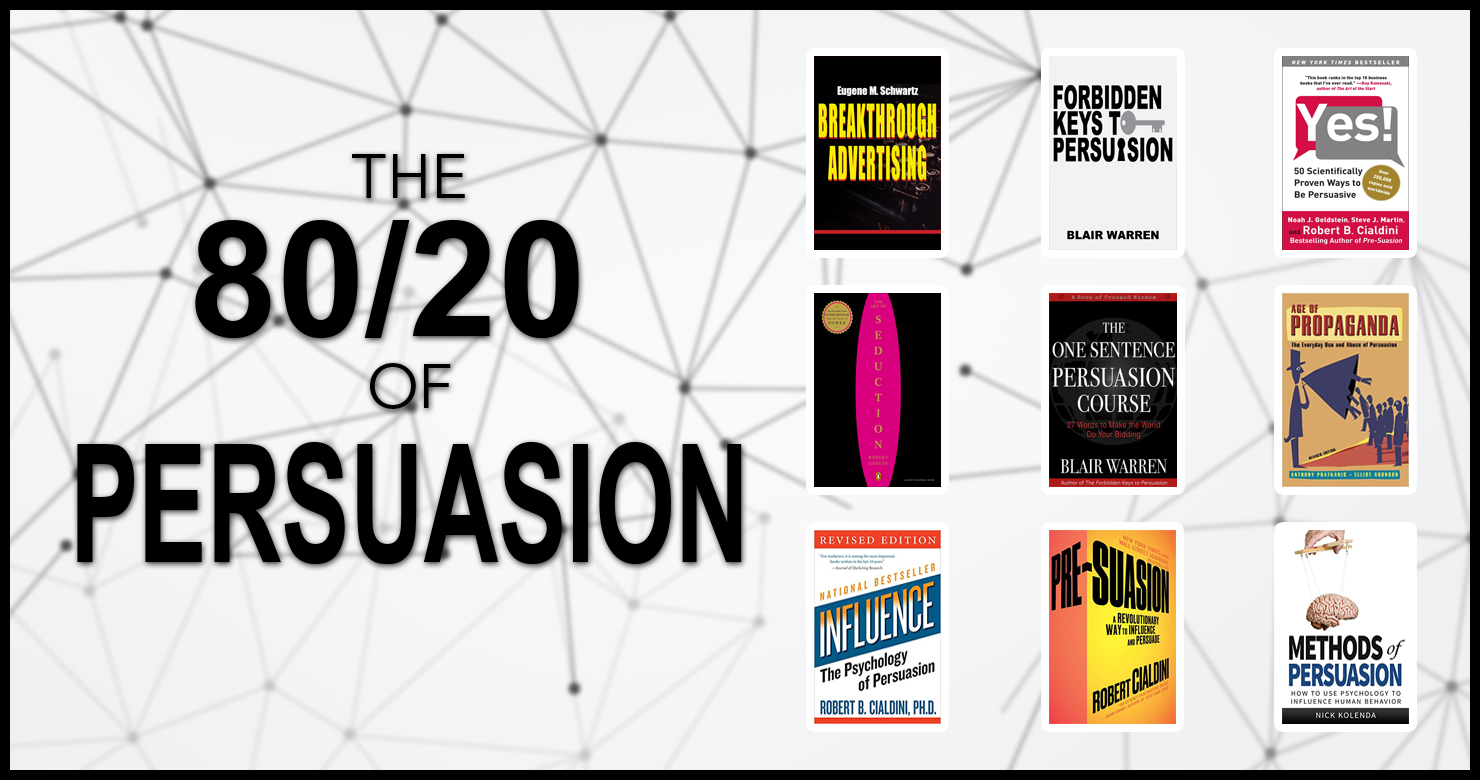
Persuasion was a skill taught by ancient Greeks. They believed it to be critical to human happiness due to its power to filter the best ideas and avoid coercion and civil unrest.
If you want your ideas to be taken seriously you need to learn how to persuade. Persuasion is no longer taught in schools, but I’ve distilled the core principles from the best books on the subject.
I've scoured second-hand book shops and spent hours looking for expert sources of persuasion. If you think I've missed a book please do let me know in the comments as I am always looking to refine my thinking and this list.
The Books
- Pre-suasion
- Influence
- Age of Propaganda
- The Process of Persuasion
- The Hidden Persuaders
- The Art of Manipulation
- Thank You for Arguing
- The Catalyst
- Breakthrough Advertising
- The Forbidden Keys to Persuasion
- The One Sentence Persuasion Course
- Persuasive Copywriting
- Win Bigly: Persuasion in a World Where Facts Don't Matter
- Made to Stick: Why Some Ideas Survive and Others Die
- Contagious: Why Things Catch On
- Yes!: 50 Scientifically Proven Ways to Be Persuasive
I've studied these books and distilled the core principles from each. I've deleted any overlapping principles to produce this ultimate guide on the 80/20 of persuasion:
56 Mental Models for Persuasion
- Action & Reaction: Newton's Third Law
- Activation Energy
- Agenda Setting Theory
- Algorithms
- Alloying
- Anchoring
- Association
- Attentional Bias
- Authority
- Availability Heuristic
- Choice Architecture
- Commitment & Consistency Bias
- Confirmation Bias
- Critical Mass
- Curiosity Instinct
- Denial
- Desire
- Ecosystems
- Ego
- Emotions: Anger, Calm, Fear, Guilt, Hope, Mystery, Resentment, Revenge, Sadness, Shame, Smugness, Uncertainty
- Evolution: Adaptation
- Evolution: Sexual Selection
- Feedback-Loops
- First Conclusion Bias
- Flywheel Effect
- Incentives
- Inversion
- Language Instinct
- Liking/Disliking
- Loss Aversion
- Mise-en-Place
- Momentum
- Narrative Instinct
- Niches
- Opportunity Cost
- Optionality
- Pareto Principle
- Randomness
- Reciprocity
- Resistance
- Sampling
- Scarcity
- Second-Order Thinking
- Seeing the Front
- Self-Preservation
- Sensitivity to Fairness
- Social Proof
- Status
- Supply & Demand
- System 1 vs System 2 Thinking
- Tendency to Minimize Energy Output
- The Ikea Effect
- The Map is Not the Territory
- Trust
- Velocity
- Vividness Bias
1. Action & Reaction: Newton's Third Law
- For every action, there is an equal and opposite reaction. People will often respond by fighting back to a direct message. Stories are an indirect form of messaging that works under the radar of persuasion.
- We often watch the mass media in a mindless state and are therefore more susceptible to persuasion because we do not make an attempt to refute the messages.
- When you confront a person about their beliefs, they will harden their belief even if your argument is perfect.
- Mirror verbalization: Repeating back what a customer ordered increased tips by 70%.
- People are often drawn to people who treat them badly because they subconsciously feel unworthy, they are drawn to people who confirm this.
- If someone makes a claim, for example, We spend too much money. Don't say they are wrong and provide counterexamples. Instead say: Because you deserve to be treated well and I want what's best for you.
2. Activation Energy
- When making an argument start from the audience's commonplace (a view that your audience, as a group hold), not yours.
- People are more likely to be persuaded if they have taken a small step in the right direction as long as the first step was made voluntarily and without coercion. The momentum will propel them to carry on.
-
To get people to act, use the emotions of:
- Desire
- Lust
- Joy
- Love
- Esteem
- Compassion
3. Agenda Setting Theory
- The media does not change opinion by providing compelling evidence that changes peoples' minds. They persuade by giving selected issues more coverage than others. The audience believes (due to the greater attention being paid) that the selected issues are the most important.
- "The mass media may not be successful much of the time in telling people what to think but it is stunningly successful in telling its readers what to think about..."
- Studies have shown that people watch the news primarily to be entertained and being informed is only of secondary importance.
- 'Master persuaders move your energy to the topics that help them, independent of facts and reason'.
- We see what we've been conditioned to see. We accept the ideas that we've been trained to accept. Pressure to make us see differently will just make us frustrated and annoyed.
- The US employs 8,000 people and spends more than $400 million on propaganda per year.
4. Algorithms
- Fixed action patterns are blindly mechanical behaviors in animals. For example: A robin will attack a clump of red feathers but leave a stuffed replica without the red feathers. Humans also have these triggers.
- We have created a world so complex and with so much information that we must deal with it by using shortcuts like animals that we once transcended.
- Even though we consider ourselves rational animals we are rationalizing animals. Experts say that over 99% of our behavior is simply the result of conditioned responses.
- When we have false maps in our brain, persuasion can negatively affect us. It is the result of living in a black + white world and allowing ourselves to respond automatically to words and symbols that we associate as either being good or bad. Just as someone with hay fever can have physical symptoms triggered by paper flowers, our mind can also play tricks on us so that we are triggered when we hear words such as communist, democrat, republican or capitalist.
- The word "because" acts like an automatic reflex to get someone to do something.
- Using the word "and+most important" as a joining phrase which implies the sentence after is similar to the one before.
-
After centuries of use and conditioning, these words, regardless of their truth carry weight and should be woven into your writing:
- It's as simple as
- Here's why...
- And, most important of all is the fact that
- Therefore...
- There is a basic underlying reason for this...
- They discovered in case after case that....
- This has been proven in thousands of studies
5. Alloying
- Use layering: "Not only do you get this but you also get...."
6. Anchoring
- The door-in-the-face technique: You begin by asking for a large favor and then follow up with a smaller ask.
- We are more likely to become influenced when we are asked for a big request, which is followed up with a smaller request, even if we are interested in neither. For example Boy Scouts selling circus tickets and countering with a chocolate bar.
- Rejection then Retreat Technique: Make a large ask, something you know you'll be rejected for, and then ask for the item that you wanted initially. The optimal strategy is: exaggerate the initial position enough but not too much.
- When given a bonus gift for purchasing a product, the value of the bonus gift will decline. To overcome this instead of writing: "Receive a free Ecourse" change it to: "Receive a $500 Ecourse at no cost to you."
7. Association
- The most important factor of persuasion: The thoughts going through the person's head when the communication is being heard.
- Virtue Device: Virtue words bring to mind pleasant images. For example democracy and freedom.
- Poison Device: Use "bad" words/symbols to persuade us to reject by association, avoiding the need to present facts and arguments.
- Together Device: Use poison words, virtue words and testimonials to organize the group as one mind.
- Voting location has a big impact on how people vote. More than 10,000 people voted for school funding when the voting location was at a school.
- Weight is linked metaphorically to seriousness, importance, and effect. People rated a candidate higher when their rating was read from a heavy clipboard.
- Warmth is linked with being friendly. When a warm cup was given to a person, they rated the person more warmly.
- The Catholic church tried to use force to convert people but they realized that this wasn't effective. Propaganda was used to convert people voluntarily. As a result propaganda has negative connotations in Protestant countries and positive connotations in Catholic countries.
8. Attentional Bias
- Your message must get the person's attention. A message that is ignored can not be persuasive.
- A communicator who is able to focus a person's attention on a key element pre-loads it with importance.
- Persuaders often draw our attention to the most favorable feature before they talk about the product. For example: A furniture website that features fluffy clouds as the background causes visitors to place more importance on comfort.
- The only job of your headline is to stop your customer and to compel her to read the second line.
- Personal information about ourselves is a strong magnet of attention. Use the word 'you' liberally before you make a pitch to predispose your audience for a full consideration.
- Use incongruity theory to gain people's attention.
- Create surprise by breaking a pattern that people have come to expect.
- Physical needs are the foundation of Maslow's pyramid and can take priority over our safety. Mental engagement can override them. For Example, We can be starving hungry and then something distracts us and we don't notice the hunger.
9. Authority
- A society built on authority provides many advantages, including the development of resource production, trade, defense, expansion and social control. Guidance from a recognized authority provides a useful shortcut, helping us to decide how to act.
- People defer to experts. When you show your credentials it will allow you to influence them. Don't brag - ask someone to highlight them for you.
- Use "experts have discovered" which continues the acceptance momentum.
- Lawyers use jargon that we don't understand. If we do not understand the problem we are at their mercy.
-
A confident person is more persuasive. Show confidence with:
- A low number of speech errors (pauses help with this).
- Authoritative tone.
- Steady body posture.
10. Availability Heuristic
- You don't need to change anything except what the person is thinking about at the moment they make the decision. For example: Asking them if they are an adventurous person? or Playing French music (to buy French wine).
- Pre-suasion is guiding attention before a person receives a message to move the listener into agreement. The key is to focus the person on concepts that are aligned and associated with the information they are about to receive.
11. Choice Architecture
- We prefer choice even if it makes us worse off. For example: People preferred to make the choice when to turn off life support even though they felt worse compared to a doctor making the decision.
- When our choices are taken away or threatened, we react against this loss of control. To gain back control and to feel autonomous, we often engage in the forbidden behavior.
- When given just one option people will find holes in it. By giving multiple options you divert their brain to thinking about which option is best.
- Increased choice can result in increased frustration.
- When making a choice, we are more likely to make the selection that will make others envious.
- An indecisive person will naturally follow someone who confidently leads them.
- When someone is indecisive using a 'fake because' will give them self-justification to go ahead.
- Act as if the choice hurts you personally.
- Give the impression you are conceding a plan and not making a choice: "OK, so let's tweak/improve it".
- When everyone has finished making their point and they are petering out and time is short: summarise the best 5 opinions in a way that favors you.
- Powerless people will lash out. Make them feel powerful. Give them the feeling of control.
- Give the audience a choice of an action that defines them as a group.
- Frame your choice to your audience as: 2 ways to win and no way to lose. This is a natural high-ground maneuver.
- A logic Sandwich: "Since [commonplace], then we should [your desired choice]."
-
Questions are a powerful tool for persuasion because they structure a person's decision-making process by:
- Directing our thoughts to the relevant issues.
- Specifying the range of options.
12. Commitment & Consistency Bias
- Consistency is powerful in influencing human behavior because of 'commitment'. Researchers asked people to predict if they would vote on election day. As most people want to seem virtuous they said 'yes' and this acted as a commitment device and more people went to vote.
- Charities use consistency when calling and asking "How are you?" Our natural reaction is to say "Fine/Good" and they then reply with "I'm glad to hear that because I am calling to see if you can help the unfortunate victims of...."
- Give a person the label of a certain trait and then make a request consistent to that trait (and provide examples of when they have done something similar).
- Highlight a discrepancy between what a person might recommend others to do and what they are doing. This technique works because we strive for consistency. We want our beliefs and behaviors to align.
- Use ideas & concepts that people already understand. Schemas increase memory and comprehension.
- After a person has answered a question favorably, say "I'll let the others know" to increase commitment as their decision has now been publicly declared.
- The Rule of Belief: "If you violate your prospect's established beliefs in the slightest degree nothing you promise him, no matter how appealing, can save your ad."
- People who write down a statement are more committed to it even after new evidence is provided, especially those who do so publicly. People who do not write down a statement are more willing to change their minds.
- You can increase the likelihood that someone will come to an event by saying: "We'll mark you down as coming then, Okay?" [Pause]
- Foot-in-the-Door Technique: Start by asking for a small request in order to gain compliance for a larger request.
- Throwing a Low-Ball Technique: The seller does not intend to sell at the low price, their only goal is to get the buyer to decide to buy. Once this is done a number of steps cement the commitment: Paperwork, financing, etc.
- It relieves discomfort when you can show people there is a pattern.
- To overcome the effects of peoples' consistency bias, avoid framing their commitment as a mistake. Tell them: "Their decision was correct at the time they made it".
13. Confirmation Bias
- Confirm peoples' suspicions. Help them throw rocks at their enemies.
- Cults often confirm what prospective members thought about their families: They are out to sabotage them.
- If you don't want to confirm someone's suspicion, we can agree that there is a possibility their suspicion is true and ask how they had come to that conclusion.
- The self-fulfilling prophecy - the tendency for the definition (or label) of something to become true. For example: People who are labeled smart, act smarter.
- The Positive Test Strategy: When deciding if a possibility is correct, people tend to look for confirmation instead of instances that it's not correct.
14. Critical Mass
- If information is within peoples' 'zone of acceptance', then that information will work to change peoples' minds. If information is outside the person's 'zone of acceptance' then the information will not persuade and it will often have a backfire effect and people become even more certain their initial thinking is correct. The solution is a more moderate appeal.
15. Curiosity Instinct
- Gaps cause pain that we try and fix/close. Create a mental gap in your story to create curiosity.
- Reveal a secret (or a lie) in headlines.
- "By now you are wondering...." is a hypnosis technique that implies that you know what your audience is thinking. This creates a connection between you, and everything else that you say will be more interesting.
- When you encounter a verbally aggressive bully, feign a sympathetic curiosity: asking for definitions, more details and suggested sources.
- Urban legends don't have to be repeated. If you have to repeat something maybe it wasn't interesting or sticky.
16. Denial
- We dismiss people who say we are wrong.
- Viewpoints that are too extreme fall into peoples' 'region of rejection' and get discounted.
- Justify peoples' failures, give them a scapegoat.
-
Cicero said:
- The 1st line of defense is the denial of facts.
- The 2nd is to challenge the definition of the action.
- The 3rd is to question the quality of the action.
- The final defense is to question the right of the tribunal.
17. Desire
- Logic alone will not get people to act, they need desire and emotion.
- Their beliefs may be shallow or profound, valid or false, logical or wishful thinking. It is not your job to argue with them.
- Make a promise that is: (1) Commanding (2) Specific (3) Desirable. For example: Earn your annual salary by working 4 hours a week.
- Desires can be: Physical (strong), Material (car), Sensual (thirst for a cold beer).
-
People all have similar psychological needs:
- They need to feel needed.
- They need a sense of hope when dealing with a difficult situation.
- They need a scapegoat.
- They need to be noticed and understood.
- They need to know things others (and they) aren't supposed to know. Ask a favor, make people feel important. Share a secret. Make a confession
- They need to be right. The instant someone feels like they are trying to be changed they feel they are "wrong" and resist.
- They need a sense of power. Give people a limited set of options that you decide
-
Hidden motivations are:
- Emotional Security
- Reassurance of Worth
- Ego Gratification
- Creative Outlets
- Sense of Power
- Roots
- Immortality
-
Often there is a conflict between our desires and persuasions. This conflict is the basis of all drama and human character.
- "People don't change: only the direction of their desires do."
- People pay less for soap compared to a cream. Soap only makes you clean while the cream sells the hope of beauty. You are buying the promise. We do not buy vegetables, we buy the hope of health. We do not buy a car, we buy the promise of prestige.
- If we can control our desires we can safeguard from the tendencies that can hijack our health and relationships.
- "When irrational acts are committed knowingly they become a delicious luxury."
18. Ecosystems
- We often have the belief that from an evolutionary perspective humans need to be part of a group. It depends: If the person is scared or in a wary state of mind the "Don't be left out" message is more effective. If the person is feeling romantic the "Be one of a few" is more effective and the popularity-based appeal will fail.
- Groups are maintained and strengthened by focusing their members' attention on another rival group.
- "You can persuade a man only insofar as you can talk his language by speech, gesture, tonality, order, image, attitude, idea, identifying your ways with his'.
19. Ego
- Appeals to self-image are effective.
- Create the image that people want to see of themselves and sell that.
- Ask people to describe themselves. The first thing they mention will be their identity and who they consider themselves to be.
- When we forgo judgment and instead entertain the idea that people’s actions make sense given their own sense of mortality and their own interpretation of reality, we are well on the way to understanding them.
- Both flattery (and greed) are one of the most powerful motivators.
- Ask for advice on books, videos and work habits. Let them know their recommendation was good (if you liked it) and the result of the advice.
- Tell a person how their advice has helped you. This is indirectly saying: "You are smarter than me".
20. Emotions
- When we become emotional our sense of reason shuts down. We don't realize when this is happening.
- The more you understand words and the emotions they carry for people, the more effective you'll be at persuading.
- Most people think they use logic but in reality, their decisions are emotional and based on character.
- Facts and reason only influence our decisions on trivial things. With important decisions, emotion is attached, and we make decisions first and then rationalize after.
- We make a snap emotional decision to buy a product. We then look for information to rationalize our decisions.
- Focus on feelings instead of functions (of the product).
- Emotions cause buying vs information (that causes analysis). You want your reader to act.
- Statistics don't produce emotion. Bring them to life by making them more relatable or human.
-
High arousal emotions make people share more because they motivate them to action.
- High Arousal/Positive Emotions: Awe. Excitement. Amusement (humor)
- High Arousal/Negative Emotions: Anger. Anxiety. Disgust.
- Low Arousal/Positive Emotions: Contentment
- Low Arousal/Negative Emotions: Sadness
-
Find your reader's pain point and you've found your way into their emotions.
- The job of the copywriter is not to create desire but to channel and direct it by taking hopes, dreams, fears and desires.
-
Don't tell the person how to feel, or not be afraid. Instead:
- Show evidence
- Offer support
- Tell stories
-
Those who give us the greatest sense of power gain more loyalty than those who demand it.
- Emotional Refusal: Don't show the emotion the bully wants you to show. Look calm and you'll gain the audience's sympathy.
- Don't pre-warn of the emotion you'll invoke, it will inoculate the listener. For example: This will make you laugh.
20.1 Emotions: Anger
- Anger is the most effective emotion to get people to act.
- Belittlement Charge: Highlight the opposition belittling your group's values or desires. This will make your group angry.
- Keep things simple: The more confusing something is, the more annoyed people will become.
- Overcoming someone's anger: "Nothing makes me feel worse than failing to live up to my standards. So I'm going to do everything possible....
- When someone is aggressive, massage their ego by agreeing with their feelings (not their point of view): "I don't blame you for feeling that way. I've felt that way myself". Empathize with their feelings. Follow up with sharing an experience that caused you to feel something similar.
-
When someone is harsh be humble:
- It calms the person, taking the wind out of their sails.
- It embarrasses them.
- The best response: "You are probably right" or "I guess you are right"
20.2 Emotions: Calm
- You can calm someone's emotions by overemphasizing yours. This works well if you make a mistake and you overplay how stupid you have been.
- Use the passive voice to calm emotions. For example: Active: The dog bit the girl. Passive: The girl was bitten by the dog.
- People who set our minds at ease because we think the world can be understood are label makers. Example: The doctor who is able to describe what is going on in your body.
20.3 Emotions: Fear
- Don't build better mousetraps. Build larger mice (or the perception that they are big). Build a fear of mice in your customers.
- Fear works when there are clear steps to help the person change, otherwise, the person will be indecisive.
-
The Hierarchy of Persuasion:
- Big Fear
- Identity
- Small Fear
- Aspirations
- Analogies
- Reason
- Hypocrisy
- Word Think
-
If we can't allay fears, tell the person that it is OK to be afraid. Don't tell someone not to be afraid.
20.4 Emotions: Guilt
- People who are made to feel guilty were 3 times more likely to comply with a request. When we feel guilt we are less likely to pay attention to the logic of an argument.
- When buying, there is often conflict between pleasure and guilt. When selling, provide moral permission for the person to have fun without guilt. Offer absolution: "You deserve it" or "It's the right thing to do."
-
The propagandist arouses feelings of dissonance by threatening self-esteem, by making the person feel guilty by:
- Making them seem like a hypocrite.
- Making them seem like someone who does not honor their word.
-
The propagandist offers a solution, a way of reducing dissonance, guilt or shame by:
- Giving to charity.
- Buying a car.
- Voting for a politician.
20.5 Emotions: Hope/Fear
- The 2 great combos of persuasion are (security + hope) and (insecurity + fear).
20.6 Emotions: Mystery
- 'Mystery is created not from an unexpected moment but from an unexpected journey. We know where we're headed - we want to solve the mystery- but we're not sure how we'll get there. Mysteries are powerful because they create a desire for closure.
20.7 Emotions: Resentment
- Saying: "Yes, but...." causes resentment.
20.8 Emotions: Revenge
- If we don't want to help someone get revenge we can acknowledge the desire to seek revenge.
20.9 Emotions: Sadness
- Sad buyers are willing to pay 30% more on average compared to neutral buyers. Sad sellers are willing to sell an item for 33% less than a neutral buyer.
20.10 Emotions: Shame
- Over sympathizing: If you exaggerate sympathy you can make a person feel ashamed of their behavior.
20.11 Emotions: Smugness
- When someone is condescending, smug or not listening to you. Ask a question and then remain silent until they respond.
20.12 Emotions: Uncertainty
- When there is confusion people are attracted to the most confident person.
- The more ambiguity there is around an idea/event/product, the less valuable that thing becomes. This is the uncertainty tax.
- Overcome uncertainty by using trials of products or services.
21. Evolution: Adaptation
- Build a bridge between what your reader currently believes and what you want them to believe. Build up using their kind of logic, not your own.
22. Evolution: Sexual Selection
- Sex only sells for items people buy for sexually related purposes: (lipstick, cologne, form-fitting clothes).
- A study showed that an attractive woman can have a large impact on the opinions of an audience on a topic that had nothing to do with beauty. Her impact was greatest when she admitted expressing a desire to influence the people as if we are trying to please someone who is attractive.
23. Feedback-Loops
- The inoculation effect: If we are given brief exposure to a message that we can refute we become immune to any further full-scale presentation of the same message.
- Switch the tense to the future to avoid an argument going around in circles: "How is blaming me going to help with (.....). Let's decide on a plan and figure out how we can get along".
- "You have heard my opponent brag about his past, but I want to talk about the future."
24. First Conclusion Bias
- A well-tailored suit can result in deference from strangers: 3.5 x more people followed a person wearing a suit who walked into traffic at a crossing.
25. Flywheel Effect
- By thinking someone is more beautiful, wiser or able, you bring out their best side which makes them blossom.
26. Incentives
- Due to loss aversion, it is usually more persuasive to mention what you would lose instead of what you'll save.
- New ideas (and inventions) are accepted quickly when it affects people's self (or group) interest/preservation.
-
We can make people care about our ideas by:
- Appeal to self-interest.
- Appeal to their identities.
- Appeal to the person they want to be.
- Not being analytical.
- Creating empathy for 1 specific person (not a group).
- Highlight that the idea is associated with something they already feel strongly about.
27. Inversion
- Reluctant Conclusion: Be reluctant in something you are keen to prove.
- Recovery is often faster from severe injuries compared to minor ones because with a severe injury we get it treated straight away. With minor injuries, we put it off and the problem isn't fixed.
- Counterarguments are more effective than arguments, especially when the original argument is shown to be mistaken or misdirected.
28. Language Instinct
- The words used to describe an object or situation direct our thoughts and responses, they define and create our social world. For example: "Fresh frozen" was preferred to "frozen fish".
-
The do/don't of adjectives and adverbs:
- Don't tell how great something is, let the reader decide.
- Information, not emphasis.
- Evoke the emotional response you are looking for. Do not describe your emotions. Readers do not care how the writer is feeling.
- Don't say it was night: show the reader it was night by saying "the moon reflected in the lake".
-
Cognitive poetics have found rhyming leads to increased persuasion.
- Instead of using "um" get in the habit of starting a sentence with "and" when being questioned.
-
Ads that contain the following words sell more products:
- New
- Quick
- Easy
- Improved
- Now
- Suddenly
- Amazing
- Introducing
29. Liking/Disliking
- "If you could master one element of personal communication that is more powerful than anything we've discovered it is the quality of being likable.... if your audience likes you, they'll forgive just about everything else you do wrong. If they don't like you, you can hit every rule right on target and it doesn't matter".
- To persuade and move people from their current view, you need to make them feel at ease and comfortable.
- Any attempt to sell to someone who doesn't know or like you will fail 95% of the time.
- Humans are susceptible and open to people who think like them. When you think like someone, they will see you as a friend. It's easier to change a mind on 1 issue, after being seen as a friend, than on every issue as an enemy.
- The more familiar something is the more it will be liked: "What the masses term truth is the information which is most familiar."
-
You can be likable by:
- Say what the audience already thinks.
- Making people feel comfortable.
- Controlling the atmosphere/situation to your best advantage.
-
You can enhance your likability with:
- Attractiveness - Grooming well.
- Similarities - Age, religion, politics, interests,
- Compliment - Tell people you like them
- Contact - Familiarity usually results in greater liking
- Working together - Use 'we'
30. Loss Aversion
- People are more motivated by loss than by a proportional gain.
31. Mise-en-Place
-
The best order of a speech is: ethos, logos, pathos.
- Ethos: Get the audience to like you through: shared values & identity + concern for their interest.
- Logos: Use logic and facts to make your case. We should do.... because of...
- Pathos: Use patriotism, anger and other emotions that result in action.
32. Momentum
- Anadiplosis: Build a thought/sentence, on top of another by using the last word/phrase in the sentence to start the next sentence. The momentum builds up to make your delivery unstoppable.
- Use common symptoms that allow for a stream of "yes" answers.
33. Narrative Instinct
- 'You aren't selling the product you are selling the experience of ownership'.
- Folk legends are credible because local details are added.
-
Stories are more persuasive than facts for 2 reasons:
- It's difficult to argue against something that happened to a specific person unless we were there.
- We become distracted in the drama of the story and don't have the cognitive resources to reason or question, and we are therefore more likely to be persuaded.
34. Niches
- If you try and argue 10 different points, none will be remembered. Find the single most important point.
- You want the customer to be loyal and loving towards your brand even when there is little difference between your products and your competition. To create this 'illogical loyalty' create differentiation in the mind of the buyer.
35. Opportunity Cost
- Every decision is a comparison of alternatives. If you can influence how people see the alternatives you can sell any decision.
36. Optionality
- Play games you can't lose by having multiple ways you can win. An ad that has the opportunity to include partners' products which will improve the relationship, even if the ad does not work.
37. Pareto Principle
- 90% of award-winning ads use the same 6 templates. A group of novices were trained for 2 hours on how to use a template. Their ads were 50% more creative compared to the professionals.
-
The 3 basic templates that account for 60-80% of all stories.
- The Challenge Plot: Contains obstacles that are daunting. This story inspires using courage and perseverance to overcome obstacles.
- The Connection Plot: A story about people that connects different demographics. This plot makes us want to help and be tolerant of others. This plot is about relationships with people.
- The Creativity Plot: This story's plot involves solving a problem that has been around for a long time.
38. Randomness
- When someone treats us continually well, we receive a consistent reward. The result is that we take them for granted. Give people sporadic reinforcement to keep them wanting you.
39. Reciprocity
- Reciprocity is so strong that even if the person is disliked it will still work.
- Gifts provide a good opportunity to bring ethos and solidify relationships.
-
There are 3 major factors that influence reciprocity:
- Significance: When a waiter gave two candies with the bill it increased tips by 3.3% (compared to no candy) to 14% with 2 candies.
- Unexpected: One candy was expected and so when a second was given it inflated the tip.
- Personalized: The more personalized the request, the more likely the person will agree.
-
A recipient places more value on a favor compared to the person who gave the favor initially. However, as time goes on the value decreases in the receiver's mind but increases in the giver's.
- Before you get to the toughest request (on a call to a customer service agent) tell the person how happy you are with their service and that you are going to write a letter of appreciation. After you have their manager's details, ask for one final request.
- Start a chain of concessions. Offer a compromise on an issue (or an unrelated one) or admit you were wrong on a minor point or statistic. This will make people feel like they have beaten you and allow them to concede on something else without looking bad.
- The foot in the door technique: Using small favors to encourage people to do larger ones.
40. Resistance
- There are two opposing forces 'desire' and 'resistance' when one is greater than the other, the purchasing decision is made. The longer the decision is being considered, the higher the tension becomes, and eventually, the purchase will be made.
- 'In response to a major objection say: "9 out 10 times you would be right....and I believe you would in this case too, but it has unusual circumstances that make it a little different. Explain the circumstances and tell him why it is in his best interest to do it your way.'
- People resist unwelcome attempts to persuade them. People can't resist what they do not notice.
- A great marketer has the ability to express powerful, hidden reasonings indirectly because some reasoning is socially unacceptable. They can not be expressed openly. The buyer would reject them.
- When it comes to change, people usually add heat and pressure but rarely think about removing barriers.
41. Sampling
- If you know or can predict how someone feels towards a person, group, product or idea, you have an advantage when trying to secure their support, vote or business.
- Even when people know their likes and dislikes you cannot trust them to be accurate. The answers they will tell you are those they think sound sensible, intelligent, and rational. For example, most people would say they want more positive news on TV. Men say that they want an intelligent woman but would rather have an attractive one.
42. Scarcity
- The lower your expenses in business and in life the more freedom you have to walk away and the more opportunities you'll attract.
- Remove details that give your audience the opportunity to think "That's not me". Have enough blank space so they can incorporate their own narrative.
- The attractiveness of an object (or person) can be increased by making it appear scarce and unavailable.
- We want an item when it is scarce and we want it, even more, when we are in competition for it.
- When customers were told of forthcoming scarcity due to exclusive information (vs non-exclusive) they purchased 6 times more.
- Jurors who are told to disregard evidence weigh it more heavily.
-
To persuade a group:
- Say very little, just a question to guide discussion when needed.
- Wait until everything has been said and people are tired and ready to go home.
- At the right moment: Give back the best of what you've been given.
- Raise your hand and extend your fingers and say:
- 'It seems to be me that the matter under discussion involves 5 points...'
- The group will like your suggestions as it is mainly their own.
- A person can save face if at least one of the points can be used (even if partially) and credited to them.
43. Second-Order Thinking
- Do not trust people to act in a rational manner. Their behavior makes sense when you consider their deeper needs, goals, and motives.
- Choose your argument wisely. Let sleeping dogs lie when they don't affect your primary concerns.
- Achieve a larger goal by admitting you are wrong on a smaller point: "You win. Now, how about we....."
- Ask a friend to ask a question that would put you in a favorable position.
44. Seeing the Front
- The High Ground Manoeuvre: Moving an argument from the details on which there is disagreement to higher ground where everyone agrees.
45. Self-Preservation
-
Self-preservation is the first law of persuasion. Self-preservation can take many forms:
- Satisfying Hunger
- Preserving youth and beauty
- Success
- Pride/vanity
- Kindness and Generosity
- Commanding
-
"We are most likely to find revolutions where a period of improving economic and social conditions is followed by a short sharp reversal in those conditions. It is not traditionally the most downtrodden people - who have come to see their deprivation as part of the natural order of things- who are especially liable to revolt. Instead, revolutionaries are more likely to be those who have been given at least some taste of a better life. When the economic and social improvements they have experienced and come to expect suddenly become less available, they desire them more than ever and often rise up violently to secure them.
46. Sensitivity to Fairness
- Antithesis: Make it sound like you are carefully weighing up both sides, evaluate the results and come to a conclusion.
47. Social Proof
- People make decisions based on their identity, norms, and principles. They ask themselves: What do people like me (environmentalist/mothers/Firemen) do in situations like this?
- In the same way that a recorded "cheep-cheep" sound can cause a bird to be mothering, even when there is no chick present. Television executives exploit the same shortcut by using canned laughter to stimulate us to laugh.
- Pluralistic ignorance is the tendency to look to see what everyone else is doing and to use that inaction as a cue. In a staged experiment, 85% of people helped an epileptic having a seizure when they were the only person present but this decreased to 31% with 5 bystanders present.
- "Since 95% of people are imitators and 5% initiators, people are persuaded more by the actions of others than by any proof that we can offer".
- Use: "Many people are saying...." to invoke social proof.
- Multiple sources of recommendation do not have much of a difference if they are similar (for example an extra family member or coworker) because it is not about how many others, it's about additional information.
- When you need emergency help, do not allow bystanders to come to their own conclusions. Isolate one person, stare, shout and point at them and no one else: "You sir, in the black jacket, I need help I am having a seizure, call an ambulance".
48. Status
- Status symbols are important to people caught in a stratified company (or life).
- People share things that make them look good. We don't share things that make us or others look bad.
- Remarkable things make people who talk about them remarkable and give them social currency.
- Make people feel like the prestigious group that owns the product.
- Products that are too good or too high status may cause people to ask: "Am I good enough for this product?"
- Conspicuous Reserve - A common technique of people in a secure, high social position. The desire to show their status but to do so in a modest way. They show their superiority by highlighting their indifference to status. They buy old station wagons and deliberately downgrade.
- Most lawsuits (and bad reviews) come from a sense of belittlement. People lash out when they are belittled to increase their status/ego or to shrink yours.
49. Supply & Demand
- The most important tactic in manipulation is: 'I don't need you, you need me.'
- The person who can afford to walk away (or make his opponent think he can) has the upper hand. Humans are stubborn when we think someone needs something from us: we often react by not wanting to do it.
- Never be desperate. Radiate confidence and independence.
50. System 1 vs System 2 Thinking
- System 1 is when the brain is making emotional and intuitive decisions. System 2 is when the brain makes logical, analytical and rational decisions. Match the system with the decision being made. For example System 1: I feel this is for you. System 2: I think this is for you.
-
The 2 routes to persuasion:
- Peripheral: Little attention needed. persuasion is determined by simple cues. For example: watching TV while doing another task
- Central: The listener is careful and thoughtful in their consideration. In this situation, persuasion is determined by how well the message can stand up to scrutiny.
-
To help find a person's real motive, ask: 'Is there any other reason apart from [their initial one]'
51. Tendency to Minimize Energy Output
- "Civilization advances by extending the number of operations we can perform without thinking about them" - Alfred North Whitehead
- Peoples' decision-making goal is usually to make their decision good enough and gone, as a result, we use 'satisficing': we select the first practical option that presents itself.
- The media is persuasive because we don't question it and take it for granted that it represents reality.
-
Propaganda takes advantage of two human tendencies:
- Mental shortcuts - Our desire to conserve mental energy.
- Rationalizing of thoughts and behavior - So they appear reasonable to ourselves and others.
-
We are cognitively lazy we accept a conclusion without any good reason. for example: "May I use the photocopier because I have copies to make".
- Stereotypes are necessary. We can not analyze all information. We do not have the energy, time or capacity.
-
When making decisions we often rely on shortcuts when we are:
- Indifferent
- Tired
- Uncertain
- Rushed
- Distracted
- Stressed
52. The Ikea Effect
- People sometimes doubt what they are told but they never doubt what they conclude.
- Ask someone why they support an initiative. This will reinforce to themselves the reasoning.
- Strategic ambiguity is where you intentionally leave out words from your message. People use their imagination to fill in the gaps which is more persuasive than you can be yourself.
- The greater the effort and pain involved in a commitment, the greater the influence on the person. For example, initiation ceremonies.
-
One of the most effective persuasion tactics is self-generated persuasion via:
- Group discussion
- Role Play
- Asking the person to imagine.
- Questionnaires asking for your opinion.
- Contests that ask: Tell us why you like our company in 50 words.
53. The Map is Not the Territory
- We often try and increase accuracy to the point of uselessness. We should provide enough information to be useful and then a little more as needed.
- If you can't validate a person's dream, you can still acknowledge how important having a dream is and then move in a more positive direction.
54. Trust
- Mentioning a drawback (or something against your self-interest) makes you more trustworthy which puts you in a better position to promote your strengths.
- Instead of mentioning only positive characteristics and leaving negative features until the end (or never), mention them early on. Use 'however', 'but', or 'yet' to divert the listeners' attention away from the weakness and on to strength.
- If you have an area in which your leverage is weak, mention it during negotiations, to make you seem more trustworthy.
-
Aristotle said: when persuading use:
- Ethos: Present yourself as a good and trustworthy person
- Logos: Use logic and vivid historical imagery to illustrate points.
- Pathos - The message should take into account audiences' preexisting beliefs and emotions.
-
People have a 'latitude of acceptance' however this can be broken if the source is highly credible.
- You can attack someone's reputation without appearing to: "I'm not interested in making personal attacks, but I just want to....(the opposite of their bad character).
- Mirroring increases trust. In negotiations mirroring resulted in deals 67% of the time compared to 13% (without mirroring).
- When information is banned we have a greater need for that information and our perception towards that information is more favorable and believable.
55. Velocity
- Multiple Yoking: Speak fast. Speak logically. With a succession of verbal punches. This will overwhelm your opponent and wow your audience.
- Speak faster when you have a weak argument, speak slower when you have a strong argument.
56. Vividness Bias
- Sharpen desire by allowing the reader to see it, feel it, touch it, sit in it, imagine their friends talking about it.
- If your product stimulates the senses, then describe how.
- People are more likely to be influenced by one clear, vivid personal example (such as a story) compared to a trove of statistical data.
- Abstract nouns are not as easy to remember as concrete ones, for example: car vs empathy.
- Asking someone to test a claim is vivid and a powerful form of persuasion.
Enjoyed this? Follow me on X: @DaviddeSouza