The Storytelling Book: 80/20 Summary
Follow me on X: @DaviddeSouza
- Amazon: Link
- Score: 10/10
- Skill Category: StoryTelling
- Mental Models: Attentional Bias, Choice Architecture, Commitment & Consistency Bias, Ego, Emergence, Emotions: Surprise, Equilibrium Evolution: Natural Selection, Feedback Loops, First Conclusion Bias, Incentives, Randomness, Sampling, Scarcity, Status, System 1 vs System 2 Thinking, Trust
Mental Models from the book
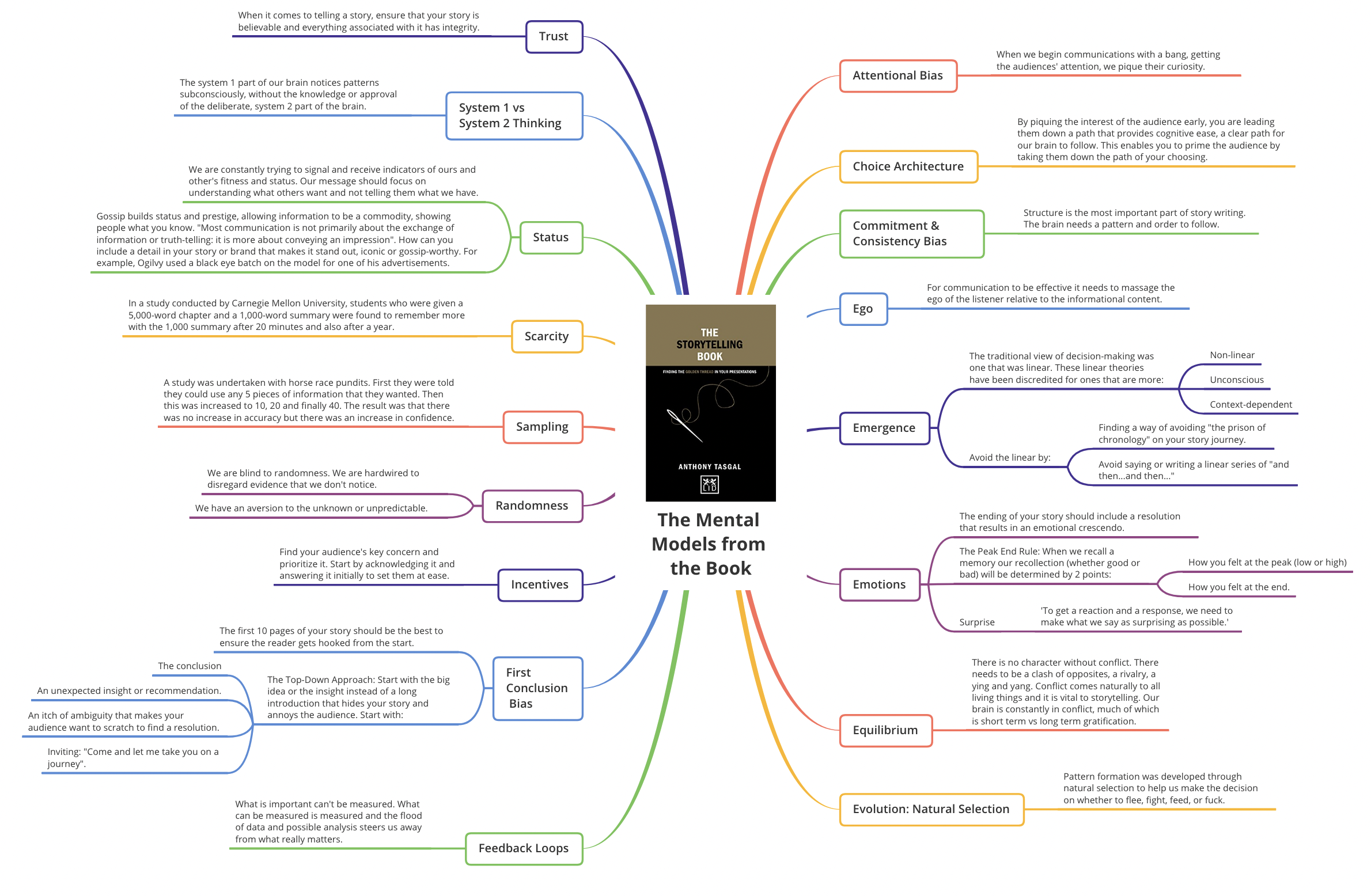
'The Storytelling Book' can be summarised into 17 mental models:
1. Attentional Bias
- When we begin communications with a bang, getting the audiences' attention, we pique their curiosity.
2. Choice Architecture
- By piquing the interest of the audience early, you are leading them down a path that provides cognitive ease, a clear path for our brain to follow. This enables you to prime the audience by taking them down the path of your choosing.
3. Commitment & Consistency Bias
- Structure is the most important part of story writing. The brain needs a pattern and order to follow.
4. Ego
- For communication to be effective it needs to massage the ego of the listener relative to the informational content.
5. Emergence
-
The traditional view of decision-making was one that was linear. These linear theories have been discredited for ones that are more:
- Non-linear
- Unconscious
- Context-dependent
-
Avoid the linear by:
- Finding a way of avoiding "the prison of chronology" on your story journey.
- Avoid saying or writing a linear series of "and then...and then..."
6. Emotions
- The ending of your story should include a resolution that results in an emotional crescendo.
-
The Peak End Rule: When we recall a memory our recollection (whether good or bad) will be determined by 2 points:
- How you felt at the peak (low or high)
- How you felt at the end.
6.1 Emotions: Surprise
- 'To get a reaction and a response, we need to make what we say as surprising as possible.'
7. Equilibrium
- There is no character without conflict. There needs to be a clash of opposites, a rivalry, a ying and yang. Conflict comes naturally to all living things and it is vital to storytelling. Our brain is constantly in conflict, much of which is short term vs long term gratification.
8. Evolution: Natural Selection
- Pattern formation was developed through natural selection to help us make the decision on whether to flee, fight, feed, or fuck.
9. Feedback Loops
- What is important can't be measured. What can be measured is measured and the flood of data and possible analysis steers us away from what really matters.
10. First Conclusion Bias
- The first 10 pages of your story should be the best to ensure the reader gets hooked from the start.
-
The Top-Down Approach: Start with the big idea or the insight instead of a long introduction that hides your story and annoys the audience. Start with:
- The conclusion
- An unexpected insight or recommendation.
- An itch of ambiguity that makes your audience want to scratch to find a resolution.
- Inviting: "Come and let me take you on a journey".
11. Incentives
- Find your audience's key concern and prioritize it. Start by acknowledging it and answering it initially to set them at ease.
12. Randomness
- We are blind to randomness. We are hardwired to disregard evidence that we don't notice.
- We have an aversion to the unknown or unpredictable.
13. Sampling
- A study was undertaken with horse race pundits. First they were told they could use any 5 pieces of information that they wanted. Then this was increased to 10, 20 and finally 40. The result was that there was no increase in accuracy but there was an increase in confidence.
14. Scarcity
- In a study conducted by Carnegie Mellon University, students who were given a 5,000-word chapter and a 1,000-word summary were found to remember more with the 1,000 summary after 20 minutes and also after a year.
15. Status
- We are constantly trying to signal and receive indicators of ours and other's fitness and status. Our message should focus on understanding what others want and not telling them what we have.
- Gossip builds status and prestige, allowing information to be a commodity, showing people what you know. "Most communication is not primarily about the exchange of information or truth-telling: it is more about conveying an impression". How can you include a detail in your story or brand that makes it stand out, iconic or gossip-worthy. For example, Ogilvy used a black eye batch on the model for one of his advertisements.
16. System 1 vs System 2 Thinking
- The system 1 part of our brain notices patterns subconsciously, without the knowledge or approval of the deliberate, system 2 part of the brain.
17. Trust
- When it comes to telling a story, ensure that your story is believable and everything associated with it has integrity.
Mental Model Mind Maps
Mind maps can help you to remember the most important parts of a book. Signup to my newsletter below to get a free mindmap of this book:
Enjoyed this? Follow me on X: @DaviddeSouza