Yes! - 80/20 Summary
- Amazon: Link
- Score: 8/10
- Skill Category: Persuasion
- Mental Models: Action & Reaction: Newton's 3rd LawActivation Energy, Algorithms, Anchoring, Choice Architecture, Consistency & Commitment Bias, Incentives, Emotions: Sadness, Reciprocity, Trust, The Ikea Effect
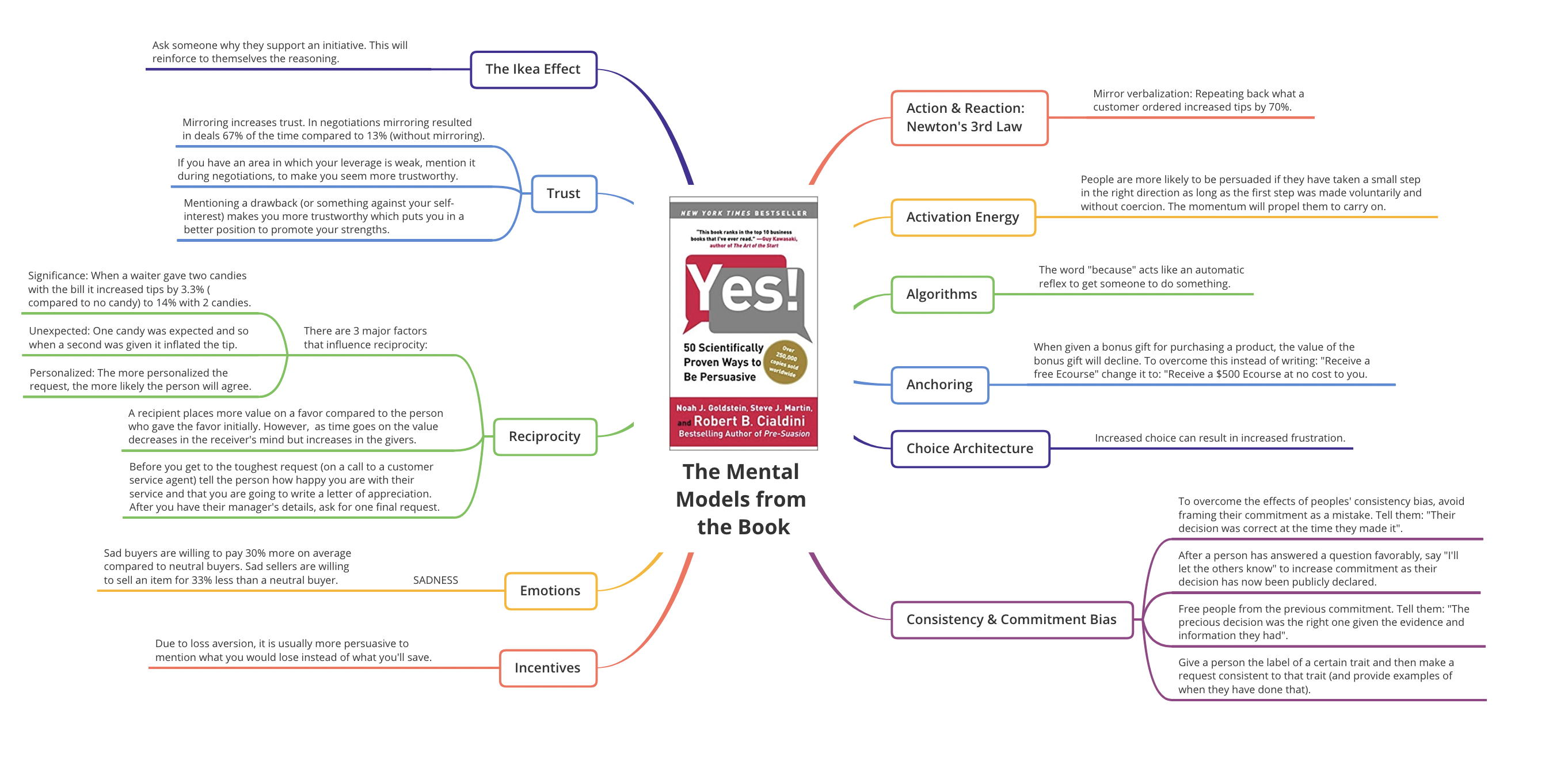
Mental Models from the book:
'Yes!' can be summarised into 10 mental models:
1. Action & Reaction: Newton's 3rd Law
- Mirror verbalization: Repeating back what a customer ordered increased tips by 70%.
2. Activation Energy
- People are more likely to be persuaded if they have taken a small step in the right direction as long as the first step was made voluntarily and without coercion. The momentum will propel them to carry on.
3. Algorithms
- The word "because" acts like an automatic reflex to get someone to do something.
3. Anchoring
- When given a bonus gift for purchasing a product, the value of the bonus gift will decline. To overcome this instead of writing: "Receive a free Ecourse" change it to: "Receive a $500 Ecourse at no cost to you.
4. Choice Architecture
- Increased choice can result in increased frustration.
5. Consistency & Commitment Bias
- To overcome the effects of peoples' consistency bias, avoid framing their commitment as a mistake. Tell them: "Their decision was correct at the time they made it".
- After a person has answered a question favorably, say "I'll let the others know" to increase commitment as their decision has now been publicly declared.
- Free people from the previous commitment. Tell them: "The precious decision was the right one given the evidence and information they had".
- Give a person the label of a certain trait and then make a request consistent to that trait (and provide examples of when they have done that).
6. Emotions: Sadness
- Sad buyers are willing to pay 30% more on average compared to neutral buyers. Sad sellers are willing to sell an item for 33% less than a neutral buyer.
7. Incentives
- Due to loss aversion, it is usually more persuasive to mention what you would lose instead of what you'll save.
8. Reciprocity
- There are 3 major factors that influence reciprocity:
- Significance: When a waiter gave two candies with the bill it increased tips by 3.3% (compared to no candy) to 14% with 2 candies.
- Unexpected: One candy was expected and so when a second was given it inflated the tip.
- Personalized: The more personalized the request, the more likely the person will agree. - A recipient places more value on a favor compared to the person who gave the favor initially. However, as time goes on the value decreases in the receiver's mind but increases in the givers. - Before you get to the toughest request (on a call to a customer service agent) tell the person how happy you are with their service and that you are going to write a letter of appreciation. After you have their manager's details, ask for one final request.
9. Trust
- Mirroring increases trust. In negotiations mirroring resulted in deals 67% of the time compared to 13% (without mirroring).
- If you have an area in which your leverage is weak, mention it during negotiations, to make you seem more trustworthy.
- Mentioning a drawback (or something against your self-interest) makes you more trustworthy which puts you in a better position to promote your strengths.
10. The Ikea Effect
- Ask someone why they support an initiative. This will reinforce to themselves the reasoning.
Mental Model Mind Maps:
Mind maps can help you to remember the most important parts of a book. Signup to my newsletter below to get a free mindmap of this book: